
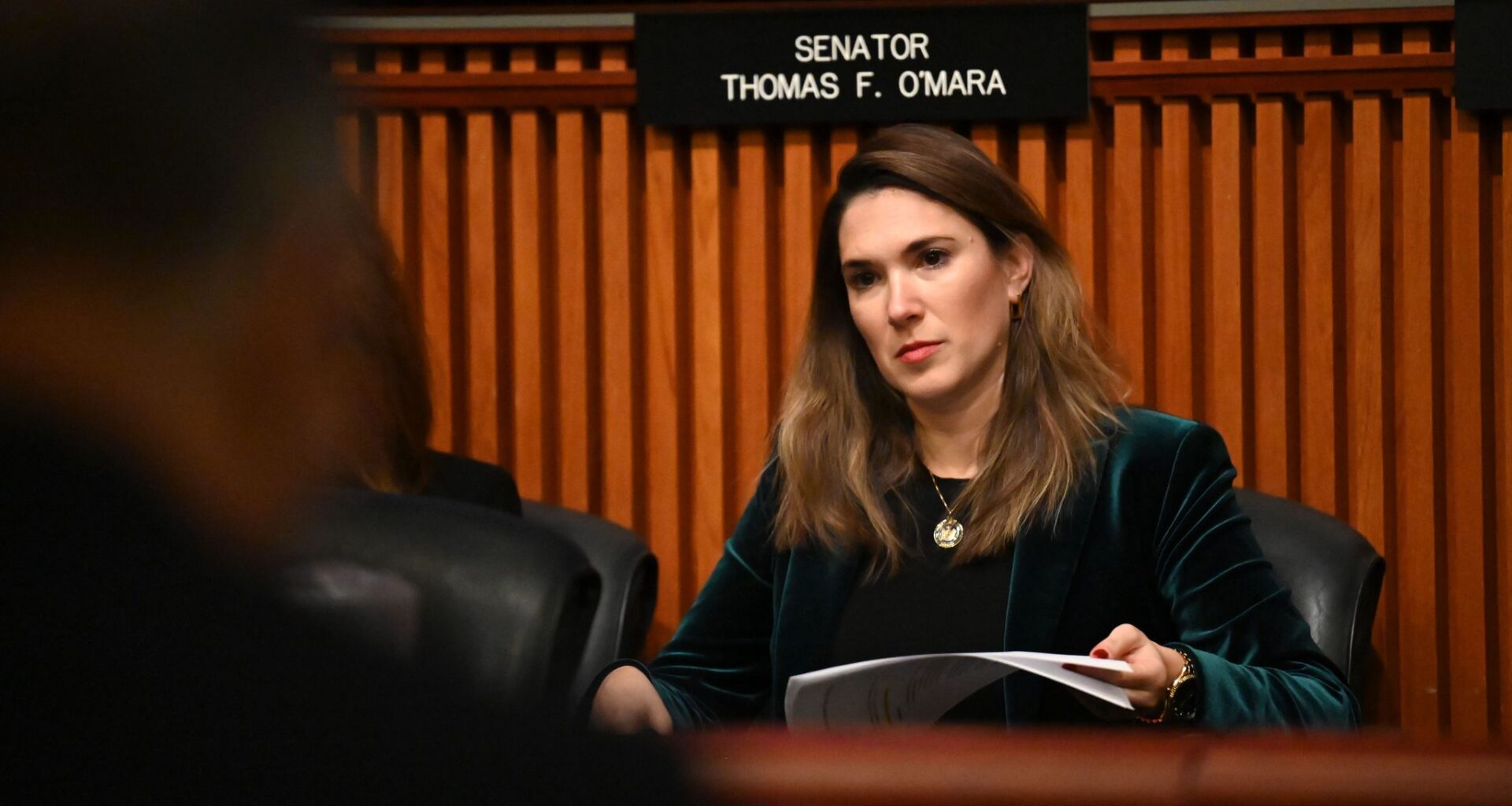
State Sen. Michelle Hinchey’s proposal, the AI Labor Information Act, would require annual reporting from businesses with 50 or more employees on job losses to artificial intelligence.
Will Waldron/Times Union
ALBANY — The idea that tens of thousands of office workers in New York could be replaced over the next five years by computer programs reads like the plot of a dystopian science fiction novel. But the trend is already underway: approximately 54,000 workers nationwide lost their jobs last year because of artificial intelligence, according to a Congressional report released in December.

For many, AI first appeared through generative text-prompt applications like ChatGPT. But the technology has continued to evolve rapidly. Generative AI now powers sophisticated “agentic systems” capable of performing tasks without human prompting, which many experts predict are the next wave of job-replacement technology.
Article continues below this ad
For state Sen. Michelle Hinchey, who grew up in Saugerties and remembers the economic pessimism that followed the closure of IBM’s Kingston plant 30 years ago, the implications for upstate New York are profound. She worries not only about mass layoffs, but also about whether unemployment insurance systems are prepared.
“We are watching the fast march towards a kind of full elimination of entry-level jobs, mid-management jobs, even mid-to-senior management jobs, across many, many sectors,” Hinchey told the Times Union.
Anthropic — the company behind Claude, one of the most advanced and widely used large language models — released a labor market impact report on March 20 that predicted jobs in the computer and math, business and finance, and life and social sciences are most vulnerable to AI replacement.
Make the Times Union a Preferred Source on Google to see more of our journalism when you search.
Add Preferred Source
In the Hudson Valley, which Hinchey represents in the Senate, approximately 40,004 residents work in computer and math-related fields, with job titles including programmer, software developer, database architect and information systems manager, according to data compiled by Lightcast, a labor market analytics firm. These workers account for roughly 2% of the regional workforce. Their salaries place them solidly in the middle class, earning more than $100,000 annually in every county except Ulster and Columbia.
Article continues below this ad
Dutchess County has nearly twice the average share of computer science workers compared to neighboring counties, with 3.9% of its workforce employed in tech-related jobs.
In the Capital Region, Albany County has the region’s highest concentration at 5.5%, while Rensselaer County reports 3.4%.
Beyond computer science, other white-collar occupations facing high exposure to AI replacement include office administration, professional business services, finance, information services, private education and healthcare. Altogether, more than half a million New Yorkers work in fields considered especially vulnerable to market consolidation and contraction driven by AI.
With New York’s occupational exposure among the highest in the nation, according to some studies, lawmakers say the need for legislative action has taken on new urgency. Hinchey’s proposal, the AI Labor Information Act, would require annual reporting from businesses with 50 or more employees on how many workers were fired, which positions were replaced in whole or in part by AI, and how many work hours remain assigned to humans.
Article continues below this ad
“To be able to move forward in a responsible way, we have to start understanding what the scope and scale are for us,” Hinchey said. “Every year we don’t becomes another year of signaling to the tech industry that we’re not paying attention.”
Though her bill has not yet made it to the floor for deliberation, much less the governor’s desk, Hinchey said she felt positive about it passing this session. After moving through respective introductory Labor Committees in both houses, the Senate version is now in the Finance Committee. The Assembly version, carried by Rochester Assemblymember Harry Bronson, has additionally passed through the Codes Committee to arrive at the Ways and Means Committee.
“In a year like this, when there are so many bills that have been delayed because of the budget process, that it’s moved through the relevant committees at all is a really good sign,” Hinchey said, noting that labor unions like the AFL-CIO are lobbying for the bill.
As a member of the Senate’s Internet and Technology Committee, Hinchey questioned tech industry representatives during a January public hearing examining how artificial intelligence should be regulated.
Article continues below this ad
Among those testifying was Alex Spyropoulos, director of government relations for Tech:NYC, an industry trade association. He emphasized upskilling and AI literacy as part of the solution.
“We work with a lot of organizations in New York City through our foundation work (and) our ‘decoded futures’ programming, where we’re upskilling a lot of these AI nonprofits to help them to understand the tools that AI can provide for them and how they can integrate them into their workflows because they are under-resourced,” Spyropoulos said, adding, “We all know the local nonprofit that wishes it had more time to spend serving the community but instead spends time doing data processing.”
The increasingly popular buzzword “upskilling” echoes the language of “retraining” that dominated economic debates three decades ago, when New York grappled with the loss of manufacturing jobs. In the first seven years after the North American Free Trade Agreement took effect, 46,210 New Yorkers lost factory jobs, according to a report from the nonprofit think tank Economic Policy Institute.
Those layoffs followed the elimination of tariffs on many products shipped north from factories in Mexico, where factory bosses paid their employees 85% less than their U.S. counterparts, according to a 2020 study in the academic journal Norteamerica. To many observers, the uneven distribution of AI-related job losses in the Hudson Valley presents a modern parallel.
Article continues below this ad
Among the local facilities that moved production to Mexico after NAFTA are a home environment and healthcare products plant in Columbia County; a battery manufacturer for industrial lift trucks in Orange County; a devices, connectors and splicers plant in Poughkeepsie; and an electronic transformers plant in Saugerties. Those moves collectively eliminated more than 3,800 jobs.
But for many Hudson Valley residents, no closure remains more infamous than IBM’s 2.5 million-square-foot air defense computer systems manufacturing plant.
IMB, then Kingston’s largest employer, laid off 2,800 workers during the first six months of 1994 before shutting the plant entirely later that year. Although the closure coincided with NAFTA’s implementation, IBM described the cuts as part of a broader worldwide reorganization unrelated to the trade agreement.
For now, most blue-collar workers remain relatively insulated from the coming wave of AI disruption. Except in areas where AI automates customer-service functions — such as self-checkout kiosks in grocery stores — customer service representatives, call center employees and data-entry workers currently face some of the highest levels of job insecurity. Nearly all are traditionally white-collar positions.
Article continues below this ad
But Hinchey is also deeply concerned about people who have not yet entered the workforce.
Nearly a year ago, Anthropic CEO Dario Amodei sounded alarms during an interview with Axios when he predicted artificial intelligence could “wipe out half of all entry-level white-collar jobs … in the next one to five years.”
“Historically, the way people get into the job market and make a career is to take an entry-level job in an industry they’re interested in. You learn the skills and work your way up and that’s how you build a sustainable life,” Hinchey said, adding, “If we are broad-strokes eliminating the entry-level jobs and the pathways into these careers, that is a fast march towards a true oligarchical society.”
Ben Winters, director of AI and privacy for the Consumer Federation of America and another speaker at the Senate hearing in January, urged lawmakers not to attribute every layoff directly to AI adoption itself.
Article continues below this ad
“I think the way AI development and deployment are happening right now creates the conditions for false claims of innovation and the need for automation, which leads to firings and playing around with people’s jobs and lives,” he said. “Sometimes they rehire, sometimes they don’t. What we’ve seen again and again is that the unregulated tech industry extracts as much as possible from people.”
Tech:NYC did not respond to a request for comment.
Mass layoffs, unemployment lines, foreclosed homes and white-collar workers on picket lines: Hinchey warns that without safeguards, those science-fiction nightmares could become reality.
Article continues below this ad
“It would be irresponsible and unrealistic to put our heads in the sand and say, ‘Well, ban all AI,’” she said. “It’s not going to happen. This is a global economy and we’re in an international fight for AI dominance. We can’t say we can’t use it. But we also need to protect our people.”