
A new site-specific exhibition at the Brooklyn Botanic Garden explores cultural beliefs and traditions in conversation with contemporary environmental stewardship.
“Ancestral Ecologies,” by artist Olalekan Jeyifous and architect AD-WO, uses animism — the belief that all animals, plants, rocks, rivers and objects are spiritual beings — as a way to examine modern human relationships with the natural world.
“We’re really interested in this notion of nonhuman aliveness,” Jeyifous said in a statement. “So, this is a collaboration not just with each other but also with the plants, soil, and environment.”
 The exhibit takes inspiration from cultural beliefs and traditions and from BBG’s habitats. Photo courtesy of Jeremy Weine/BBG
Inspired by beliefs long held by Indigenous communities and the African and Latinx diasporas, the exhibit also takes cues from BBG’s “micro-ecosystems” especially its native plantings.
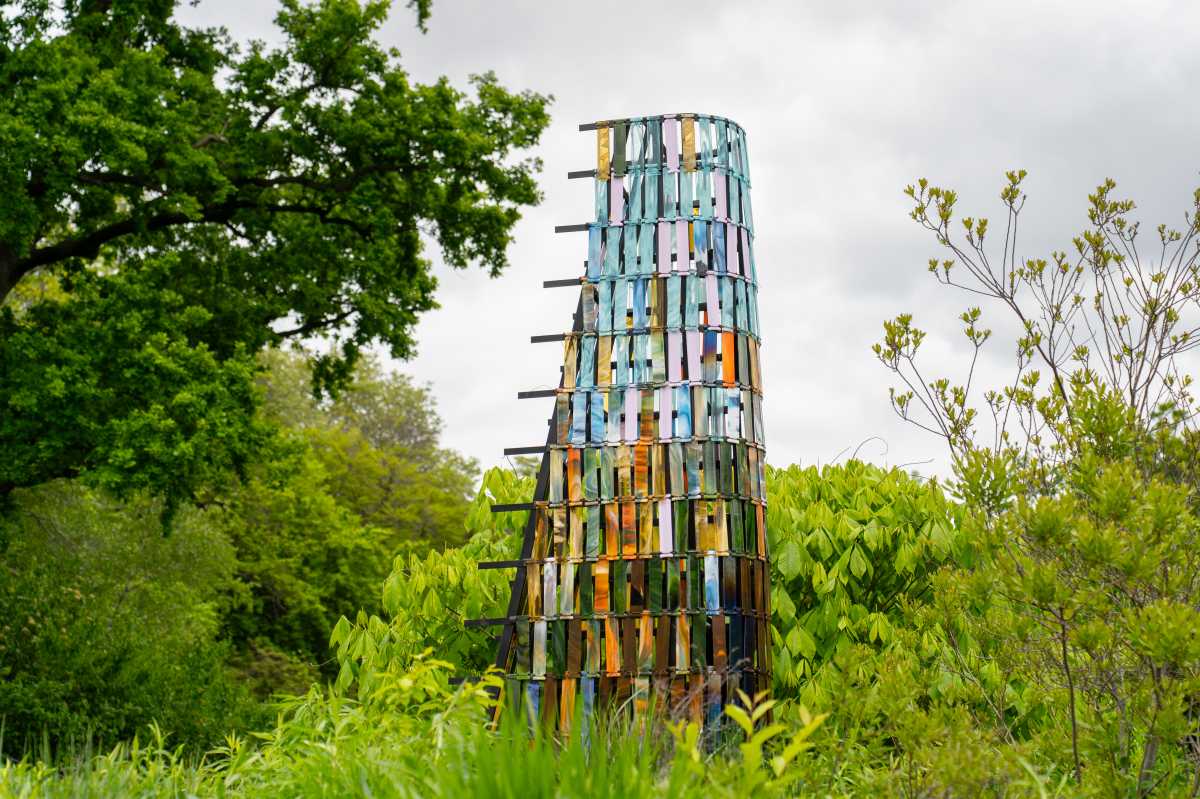
“Serpentine Specter,” a tall, colorful piece made of bioderived fibers and colored glass, sits in the Native Flora Garden. That garden, filled with native plants and designed to mimic the natural habitats that once covered the city, including a bog, a meadow and pine barrens. “Serpentine Specter” references those habitats, their inherent adaptability and sustainability, and the specialized life forms who call them home.
In the Elizabeth Scholtz Woodland Garden, “Sonic Strands” comprises hanging curtains strung with sea beans, cowrie shells, recycled glass, and other “historically potent objects” from the African and Latinx diasporas and the Indigenous people of Brooklyn.
 ‘Sonic Strands’ comprises hanging “curtains” strung with beads, shells and other objects. Photo courtesy of Jeremy Weine/BBG
The strands were created in part by BBG visitors during a special event, and make noise when they flutter in the wind or vibrate, reflecting “the histories of movement and cultural continuity in Brooklyn as a collective of artistic voices.”
Nearby, “Animist Capsules,” a series of earthen sculptures studded with colorful tile and other cultural objects, are covered with moss and fungi. The sculptures are meant to invite and extend the ecological process of decomposition, according to the artist, and frame it as a source of continual renewal, rather than an end.
The final piece, “Earthen Tiles,” the subsoil usually buried deep up to the surface in the form of handmade tiles, revaluing soil-based construction common in some parts of the world but uncommon in the West.
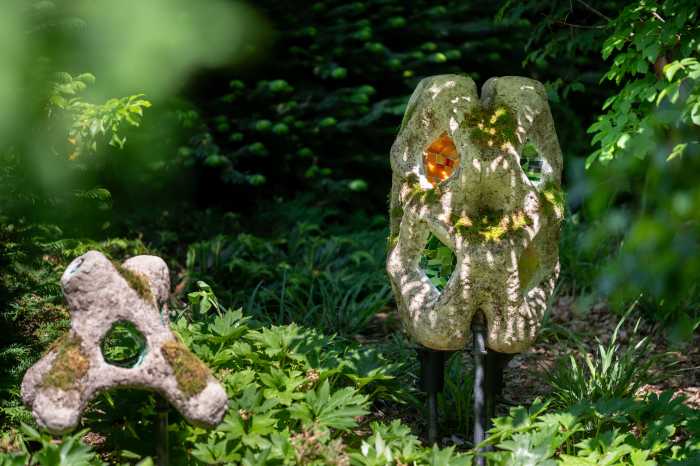 “Animist Capsules” explore decomposition as a source of renewal. Photo courtesy of Jeremy Weine/BBG
 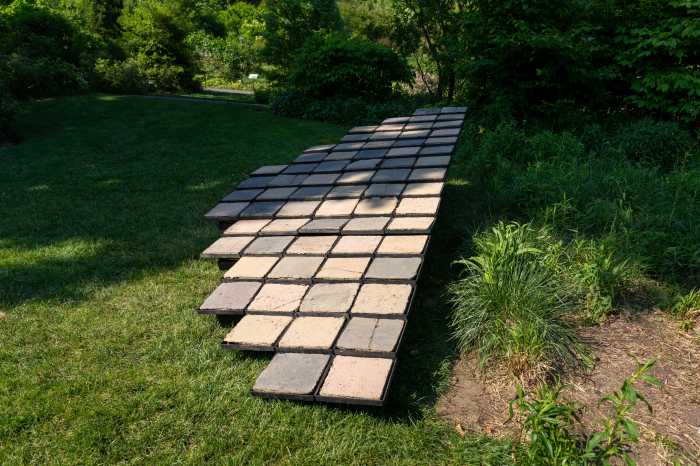 “Earthen Tiles,” the fourth installation in “Ancestral Ecologies.” Photo courtesy of Jeremy Weine/BBG
“Ancestral Ecologies” is the first exhibition from BBG’s new Heidi Nitze Art x Environmental Fellowship, and Jeyifous and AD-WO are the inaugural fellows. The team worked closely with BBG staff and outside experts to design and create the exhibit, even working alongside participants of the Garden’s annual Greenest Block contest to incorporate the garden practices of diaspora communities in Brooklyn.
“Brooklyn Botanic Garden is proud to serve as a dynamic incubator for innovative work that blends artistic practice, scientific discovery, and pressing environmental issues,” said Sonal Bhatt, VP of education and interpretation at BBG. “This fellowship supports thought-provoking collaborations that will spark meaningful connections for visitors about the wonder and power of plants and the natural world. We are profoundly grateful to the Heidi Nitze Foundation for their visionary partnership in realizing this transformative program at Brooklyn Botanic Garden.”
“Ancestral Ecologies” and an accompanying gallery exhibit are on view at the Brooklyn Botanic Garden now through Oct. 25, 2026.