
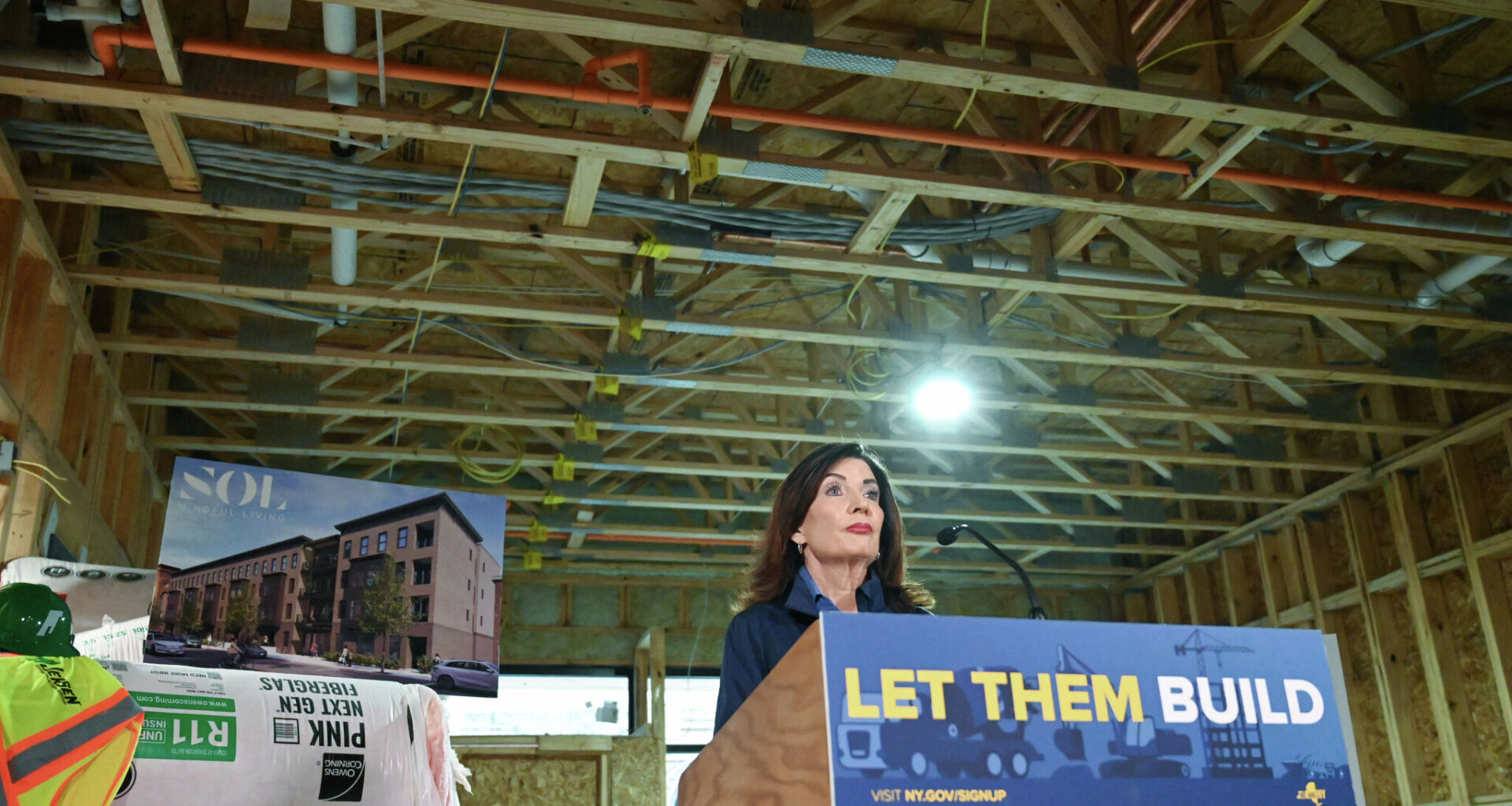
Gov. Kathy Hochul signed into law a sweeping measure meant to streamline the environmental review process. The goal is meant to speed up new housing and certain infrastructure projects.
Will Waldron/Times Union
ALBANY — In 1975, then-Gov. Hugh Carey signed landmark legislation into that required municipal agencies to consider the potential environmental and ecological consequences of development projects.

More than a half century later, that law, the State Environmental Quality Review Act, has faced increasing scrutiny from lawmakers and economic interests who contend it has been slowing or stopping construction in a state facing one of the nation’s most severe housing shortages due to inventory gaps and high costs.
Article continues below this ad
Opponents of certain construction projects — especially at the local level — can often lean on the strict requirements of the environmental review law to bring litigation challenging those developments or to force deeper reviews that can drive up costs or kill the plans. That occurs even though plaintiffs rarely prevail in these cases, according to a New York Journal analysis.
On Wednesday, Gov. Kathy Hochul signed into law a sweeping measure designed to streamline the environmental review process. The goal is to speed up new housing development and spur much-needed infrastructure projects.
It’s a major policy win for Hochul, who has made increasing New York’s housing stock a priority for her administration.
Make the Times Union a Preferred Source on Google to see more of our journalism when you search.
Add Preferred Source
“Red tape and duplicative reviews have stopped New York from doing the very building that made us the envy of the world, making our housing more expensive and our infrastructure outdated,” Hochul said. “That ends today.”
Article continues below this ad
Hochul’s administration has said that it can take as much as 56% longer to build in New York than states with similar populations, economies and demographics.
In the village of Fredonia, a project to upgrade an aging water treatment plant and pull water from nearby Lake Erie was challenged and delayed by opponents who alleged the city didn’t comply with the state environmental review process and other regulations. A judge dismissed the lawsuit but the project was considerably delayed, prompting Fredonia Mayor Michael Ferguson to be among the public officials in favor of overhauling the review process.
A ‘tremendous win’
The measure was based on a bill introduced and passed in the Senate last year by state Sen. Rachel May. The legislation aimed to facilitate more construction on already developed land and discourage suburban sprawl.
Article continues below this ad
On Tuesday, May praised the changes to the environmental review law as a “tremendous win for New York state.”
“With this policy, we continue to protect the environment from harm while also stopping environmental law from being weaponized by wealthy litigants who just don’t want new housing built in their communities,” May said.
Still, New York needs hundreds of thousands of new homes to make up for decades of underproduction and to meet growing demand.
Hochul has said the changes will exempt certain types of housing “that have no significant impacts on the environment” from undergoing the environmental review process. But she said those projects must still comply with regulatory and permit requirements governing water use, air quality, environmental justice, and protection of natural resources. Local zoning and other permitting requirements remain in place.
Article continues below this ad
Hochul proposed the overhaul in January as part of her executive budget, arguing that New York’s approval processes had become a major obstacle to housing and infrastructure construction. Her plan would have created broad new exceptions from environmental review for projects including large housing developments, childcare centers, water infrastructure and green energy projects.
The changes drew strong support from local governments, including Albany Mayor Dorcey Applyrs and local leaders in Cohoes, Rensselaer, Watervliet and Hudson. Developers and advocates said the changes could improve housing stock.
Gov. Kathy Hochul takes questions during a news conference in Menands earlier this month. Hochul has said that New York’s environmental review process had become a major obstacle to housing and infrastructure construction.
Will Waldron/Times Union
The Citizens Budget Commission, a nonprofit and nonpartisan think tank, supported Hochul’s proposal and said the changes would generate substantial benefits for housing in the state.
Article continues below this ad
The nonprofit’s research found that environmental reviews can increase costs by 10% for similar projects Hochul is proposing to exempt.
That is potentially enough to make projects infeasible in markets with lower rents than New York City, the nonprofit said. The group also said shorter deadlines for completing reviews could reduce uncertainty and cost overruns.
However, environmental organizations and some Democratic lawmakers warned the original proposal went too far, arguing it weakened longstanding protections and created overly broad exemptions, particularly through its expansive definition of “previously disturbed” land.
On Tuesday, Roger Downs, the conservation director for the Sierra Club Atlantic Chapter, criticized the Legislature’s actions.
Article continues below this ad
“The governor’s proposal to exempt new housing projects from environmental review will create a new set of problems and costs that could undermine any ‘affordability’ the reforms seek to achieve,” Downs said. “Without environmental review, new housing could be mired in wetlands, built on toxic contamination sites or decimate irreplaceable habitat, with little recourse for an impacted community to challenge.”
He contends that an environmental review “is not the primary reason for housing delays, and negating the benefits of SEQRA will not bring us more affordable homes — only more hardship to our communities and the natural world.”
What is being changed
Some state Republicans voiced concerns about the changes this week.
Article continues below this ad
“I have concerns about the SEQRA reforms, but I count on our local governments to look out for the welfare of their local communities, even though I know this is undermining their ability to take a hard look at the environmental impacts for projects in their communities,” said Jack Martins, a Republican state senator representing parts of Nassau County and ranking member of the Housing, Construction and Community Development Committee.
The law does not supersede environmental requirements, permitting or local zoning.
The final version approved by lawmakers and signed Wednesday was significantly narrower than Hochul’s original proposal.
It allows certain projects to build or improve housing, parks, trails, or schools to undergo streamlined review if they are built on “previously disturbed” land. That means sites already altered by development. Any prior improvements to the land must have occurred at least two years before the permit application.
Article continues below this ad
Development on forested land would continue to undergo environmental review, as would projects involving land never previously developed and agricultural land that hasn’t been farmed in at least two years.
The state environmental review process would still apply to developments near wetlands or that lack sewer connections. The exemption doesn’t apply to historic sites or disadvantaged communities.
The final deal also retained some of Hochul’s procedural reforms, including that an agency has to complete the environmental review process within two years. Extensions are allowed for limited reasons, such as project redesigns or newly discovered impacts.
Larger buildings would still fall under the law, though the size threshold differs between New York City and other parts of the state.
Article continues below this ad
Outside of New York City, the exemptions would apply to housing of up to 300 units in urban areas and up to 100 units in non-urban areas. The exemptions also apply to mixed-use developments with less than 20% earmarked for commercial ventures.
Areas that do not have zoning would be capped at 20 units.
Certain major infrastructure projects are exempted, such as lead pipe removal or sewer initiatives impacting disadvantaged communities. Projects that improve a building’s energy efficiency and indoor environmental quality, or reduce its carbon emissions, would also be exempted.
Article continues below this ad
In passing the law, New York joins other Democratic-led states in revising its environmental review process. California, which is also facing similar cost of living pressures, adjusted its framework last year. Massachusetts Gov. Maura Healey has proposed cutting regulations to fast-track housing construction.