
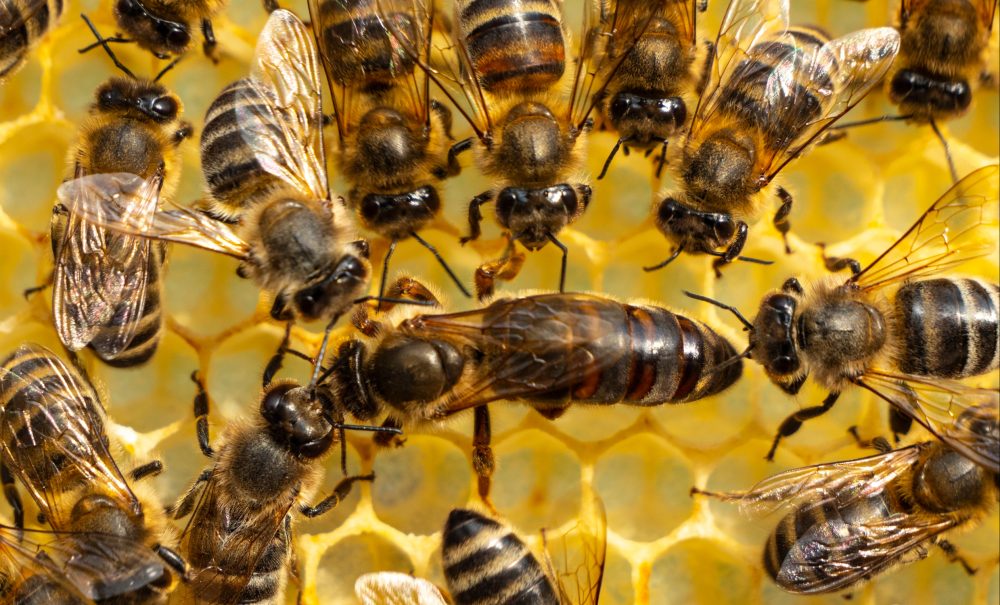
In late summer, queen bumblebees stand out easily. They are much larger than the worker bees around them and move more slowly between flowers.
But queens and workers actually begin life the same way – from identical eggs with the same DNA.

For years, scientists have wondered how one larva becomes a queen while another becomes a worker that cannot reproduce and lives a shorter life.
A new study published by Penn State researchers has uncovered part of the answer in the common eastern bumblebee, Bombus impatiens.
The study found that worker bees play a much bigger role in creating queens than scientists once thought.
Same DNA creates queen bees
Bumblebee colonies run on a strict social system. Queens reproduce and establish colonies. Workers gather food, care for larvae, and defend the nest.
Despite these dramatic differences, female queens and workers share the exact same genetic blueprint.
“Since all these females share the same DNA, it’s a striking example of how the same genotype can produce very different forms,” said Etya Amsalem, the corresponding author of the study.
“It’s also a practical question since bumblebees are important for pollination, so knowing how to produce queens could improve commercial breeding and management.”
Scientists have long suspected that hormones help determine which developmental path a larva follows. The Penn State team focused on a hormone called juvenile hormone, often shortened to JH.
Hormone shapes bee roles
Juvenile hormone has many jobs in insects. It controls growth, affects molting, and helps shape body size. In several social insects, including ants and honeybees, high levels of JH have been linked to queen development.
But bumblebees remained something of a mystery.
“A single female egg in bumblebees holds the blueprint for two completely different life paths: the giant, reproductive queen or the small, sterile worker,” said Seyed Ali Modarres Hasani, lead author of the study.
“We wanted to understand what triggers the change in the female life trajectory, when it happens, and who controls the process.”
The answer turned out to involve not only the larvae themselves but also the workers caring for them.
Worker bees decide future queens
To test the hormone’s role, researchers created small experimental colonies with worker bees and female larvae. They applied juvenile hormone in several ways.
Some larvae received the hormone directly. In other cases, the workers tending the larvae received the treatment instead. The difference was dramatic.
Larvae treated directly with juvenile hormone did not become queens. However, larvae raised by workers exposed to the hormone often developed queen-like traits.
This showed that workers act as gatekeepers during caste development. Rather than larvae deciding their own fate internally, caregiving workers appear to control who receives the signals needed to become a queen.
That discovery changes the traditional picture of royal development inside a bee colony.
Development depends on timing
The study also found that timing matters enormously. Larvae only responded to juvenile hormone during a narrow developmental window about seven to eight days after hatching.
Before this period, the hormone had little effect. Afterward, the opportunity disappeared.
“We also determined that larvae are only sensitive to this hormone on days seven and eight of their development,” Hasani said. “By tracing the juvenile hormone, we saw that workers pass the hormone into the food they make from nectar and pollen.”
This critical period differs from what scientists see in Bombus terrestris, a closely related European bumblebee species. In that species, caste determination occurs much earlier.
The findings suggest that even closely related bees may use different developmental schedules to produce queens.
Queen-making through feeding
The research team then tracked exactly how juvenile hormone moved through the colony. They used a labeled version of the hormone that allowed them to follow its path through bee tissues.
The hormone appeared in worker bee blood-like fluid, known as hemolymph. Researchers also detected it in regurgitated food produced by workers for the larvae. Finally, they found the hormone inside the larvae themselves.
The workers were literally feeding the hormone to developing bees.
This process resembles the way honeybee larvae receive royal jelly, though the mechanism differs. In Bombus impatiens, the transfer involves a direct hormonal delivery through food shared by worker caregivers.
Larvae respond to hormone signals
The story became even more interesting when scientists examined the larvae’s own hormone production.
Larvae exposed to outside juvenile hormone reduced their own internal hormone synthesis. Their bodies appeared to sense the incoming supply and respond by lowering production.
This points to a feedback system linking hormone levels to the gland responsible for producing juvenile hormone in the first place.
Instead of a simple switch that turns queen development on or off, the process appears highly regulated and dynamic.
Workers control queen production
The study also raises questions about who truly controls a bumblebee colony.
In some species, queens exert strong influence over caste development. Removing the queen can cause many larvae to develop into future queens. But Bombus impatiens behaves differently.
Previous studies cited by the researchers showed that removing the queen from a colony does not automatically trigger queen production. The new findings support the idea that workers themselves control much of the process.
Rather than a centralized monarchy, this species may operate through collective worker decisions.
Colonies prepare for next season
Queen production also follows the colony’s seasonal cycle. Near the end of the season, colonies begin producing new queens and males before winter arrives.
“Every colony will produce many new queens at the end of the season,” Amsalem said.
“These queens will leave the colony, mate and go into winter diapause, and then each queen will start a new colony in the next spring.”
“In that sense, producing as many queens, and males, at the end of the season is the ultimate purpose of the colony.”
Older workers increase hormone feeding
Worker bees themselves change as colonies age. Older workers can activate their ovaries and begin producing males, a shift linked to rising juvenile hormone levels.
“Bumblebee workers do not reproduce when the colony is young, but they can activate their ovaries and produce males as the colony ages, which causes an increase in juvenile hormone levels,” Amsalem said.
“As a result, over time, they feed larvae more of the hormone. When enough workers do this simultaneously, usually towards the end of the season, larvae receive doses that are high enough during the critical window to develop into queens.”
Helping protect bumblebees
Bumblebees are important pollinators for wild plants and crops, but many populations are declining.
Learning how colonies produce queens could help scientists improve breeding programs and support bee conservation.
The study also shows how evolution reused an old insect hormone for new social roles.
In Bombus impatiens, worker bees decide which larvae become queens by feeding them hormonal signals at the right time.
The study is published in the journal Insect Biochemistry and Molecular Biology.
—–
Like what you read? Subscribe to our newsletter for engaging articles, exclusive content, and the latest updates.
Check us out on EarthSnap, a free app brought to you by Eric Ralls and Earth.com.
—–