
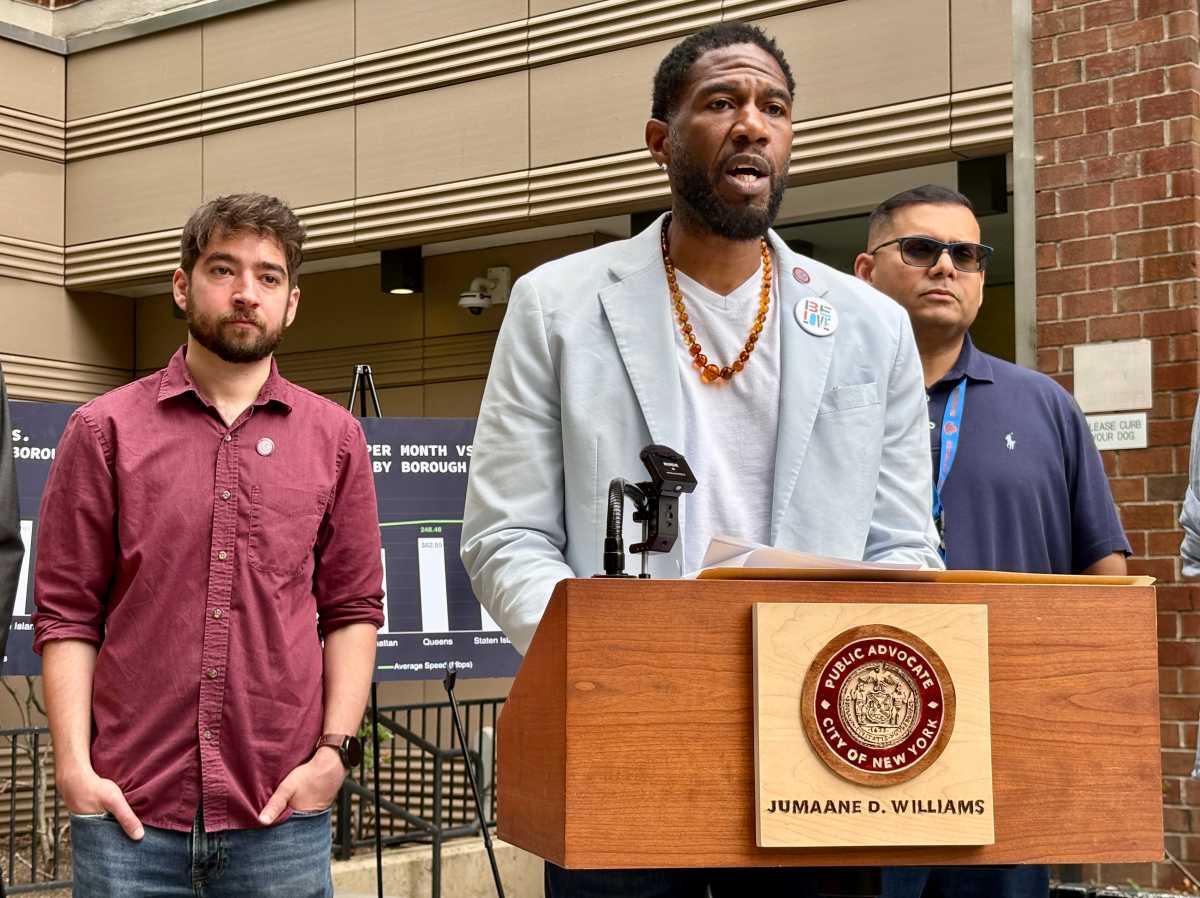
Multiple efforts by the city and private telecom corporations to get New Yorkers connected to the internet continually failed to meet expectations, marked by ineffective public oversight, broken promises and inefficient use of funding and infrastructure, according to a new report that Public Advocate Jumaane Williams’ office released on Wednesday.
But the city’s past failures don’t need to dictate its future success, Williams said at a May 27 press conference at the Grand Street Guild residences in the Lower East Side, where he introduced his proposal to build a city-owned fiber-optic network that can deliver affordable high-speed internet to every household in NYC.
The plan, which could take more than a decade to complete, aims to improve affordability and economic benefits for the lowest-income neighborhoods, some of which see as many as one-third of households forgo internet service or rely on mobile-only access.
“The digital divide is more than generational – it’s geographic, and it’s economic,” Williams said. “Some neighborhoods – primarily Black and Brown, lower-income areas – are paying the highest rates for the slowest speeds. Many more are relying solely on their cell phones for access, and that disparity has real-world consequences.”
Williams called on the city to treat internet connections like a municipal utility, similar to water, gas, or electricity, rather than a private luxury.
“You literally can’t access society in 2026 without access to reliable internet service,” Williams said.
As it stands, private corporations are responsible for building and maintaining the city’s vast underground network of cables and fiber optics, responsible for delivering internet to residences and businesses. This, Williams argued, created a lack of competition among Internet Service Providers (ISPs), resulting in higher prices that effectively cut off access for low-income New Yorkers.
“The same communities that have long been cut off and discounted from services through both physical infrastructure and systemic injustice risk being left behind online as well,” Williams said.
If the city built out its own infrastructure, it could open the market to both large and small ISPs, nonprofits, and community-owned broadband organizations. Williams said this would increase competition and lower the cost of connectivity for an essential service.
Mesh NYC is one community-owned network expanding affordable internet access in underserved neighborhoods through rooftop routers that connect to nearby buildings and use its network. It brought the Grand Street Guild residences internet access at $10 a month.
Warren, a combat veteran in his 70s living in the Grand Street Guild residences, told amNewYork that before the building was connected to the MeshNYC network, he couldn’t afford to purchase internet service.
“ I used the Wi-Fi from my next-door neighbor,” Warren said. “He would, on occasion, just let me use the password.”
He said the affordable network was a game-changer for someone on a fixed income like him.
“ I live off Purple Heart money and Social Security,” Warren said. “That’s all the income I have. NYC Mesh has been great.”
Rob Johnson, a board member and community leader with NYC Mesh, said that adding city-owned fiber infrastructure would improve low-cost options’ ability to expand internet connectivity across the city to people of all incomes.
“ We serve hundreds of people in these buildings,” Johnson said. “We serve thousands of people across New York City. But to really get to everyone, it’s gonna take a village, and we’re proud to be part of that village.”
The plan proposed a staged approach to building out the city’s broadband infrastructure, beginning in the immediate and near future, with increasing oversight and enforcement of existing ISPs. Wednesday’s report cited multiple instances in which major internet providers failed to meet their contractual obligations to the city or engaged in deceptive practices.
Williams’ report did not provide an exact estimate as to how much it would cost to build its own high-speed internet network, but it noted that a similar report published during the de Blasio Administration in 2020 gave it a $2.1 billion price tag. That estimate would almost certainly be higher today due to inflation, the new report indicated.
A 2015 Department of Information Technology & Telecommunications (now the Office of Technology & Innovation) audit found that Verizon shirked its contractual commitment to provide internet access to all NYC residents who requested it. The audit found tens of thousands of requests sat pending for more than a year. The dispute continued until the city filed a lawsuit in 2017, which was eventually settled in 2020 with Verizon agreeing to make its fiber optics available to an additional half a million households, including all NYCHA residents.
When major ISP Charter Communications, owner of Spectrum, merged with Time Warner Cable in 2016 it was required to meet certain standards of speed and network accessibility as a condition of the merger. But the New York State Public Service Commission found that two years after the merger, Charter Communications had intentionally misrepresented its network’s accessibility by counting already existing infrastructure as part of a mandatory expansion required under the merger.
Williams said that bringing affordable broadband to all New Yorkers should begin with accountability, but that the city needed to follow that up with reform, suggesting investigations and audits into the current practices for providing internet service in NYC and making changes to allow more ISPs and nonprofits access to the market. Finally the report suggests that the city build out its own infrastructure, using abandoned and unused underground fibers to reactivate long-dark connections.
He said that New Yorkers deserve more.
“You shouldn’t have to make a plan to get on the internet to get the services that you need.,” Williams said. “I want folks to imagine that you are trying to get some services that you deserve and that you are supposed to get, and the thing that’s stopping you is that you can’t afford to pay for the broadband and the fast services. That’s unfair.”