
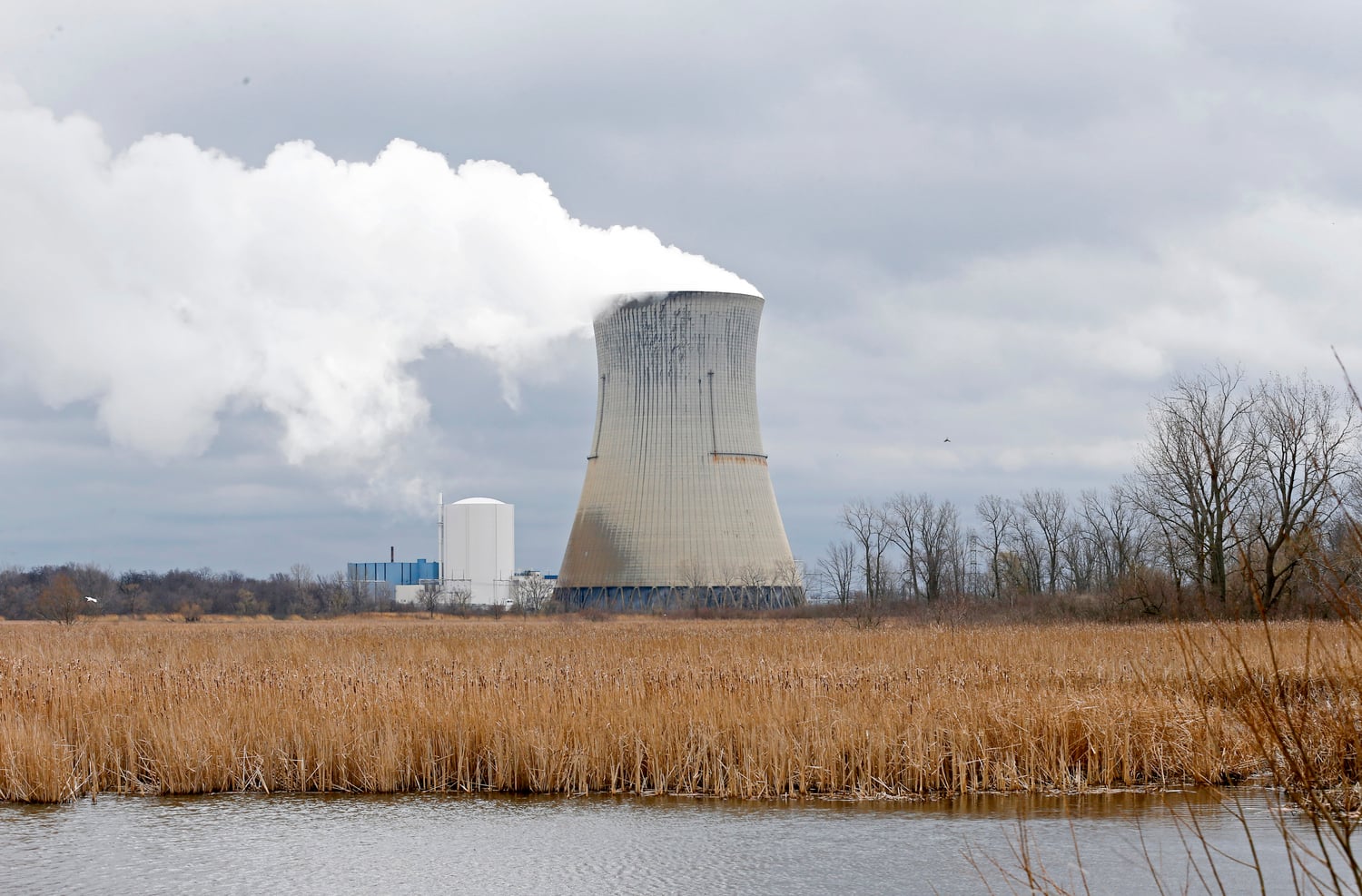
New York State is moving forward with a plan to build a new nuclear power plant somewhere in Upstate New York. Gov. Kathy Hochul said it will help the state transition from fossil fuels to clean energy.
Massena in St. Lawrence County is being considered as a location, but right next door is the Akwesasne Mohawk Reservation. People there have a long, troubled history with industry polluting the environment, and they’re skeptical of the state’s plan.
Richard HallerNY’s plan for nuclear power Upstate stirs painful history of pollution in Akwesasne

The entrance to FirstEnergy Corp.’s Davis-Besse Nuclear Power Station in Oak Harbor, Ohio. Photo: Ron Schwane/AP Photo
Earlier this spring, at the Akwesasne Cultural Center on the Mohawk reservation, people gathered to pound black ash logs. Tyler Currlyhead used the back end of his ax, making the fibers peel right up, in long, thin strips. These strips, also called splints, are used to weave traditional Mohawk baskets.
“So we go into the woods in the winter and cut some down, the black ash, store them, and then every Thursday in May, we’ll be here pounding,” said Currlyhead.

Black ash log pounding at the Akwesasne Cultural Center. Photo: Richard Haller
Mohawks started doing this to save the trees from the emerald ash borer, an invasive insect from Asia. But it’s also about preserving Mohawk culture in Akwesasne.
Riccardo Najar is bundling up the black ash splints for baskets. He says he’s concerned with New York State’s potential plan to install a nuclear power plant near Akwesasne.
“The nuclear plants. It’s going to have an effect on the health of the land and the people, the air we breathe, the food we consume. Out of all places in the world, they want to put it close to the community here.”

Riccardo Najar bundling black ash strips for baskets. Photo: Richard Haller
Last year, Gov. Kathy Hochul announced that she’s directing the New York Power Authority, or NYPA, to build a nuclear plant somewhere in Upstate New York. It’s part of the state’s ambitious carbon reduction goal to combat climate change.
Assemblyman Scott Gray is pushing to build a nuclear plant in the North Country. Gray says Massena is a top contender because NYPA already has the infrastructure there.
“So they already have a facility in Massena, and so it’d be an incremental expansion of that facility,” said Gray. “And there’s a lot of jobs that are associated with being an energy sector or an energy hub.”
Last November, Gray held community information sessions in Potsdam and Watertown to discuss Nuclear energy. But he didn’t hold one in Akwesasne Mohawk territory, which is right next to Massena.

Attendees asked questions about local impacts, like electricity costs, potential jobs and safety. But many said they left with more questions. Photo: Catherine Wheeler
Angelo Johnson, the Akwesasne Land Resource Manager, said a lot of his community members are worried.
“It’s pretty scary to think that something like that could be just upstream of us,” said Johnson. “People are just really weary of big players coming in like that, and you know, contaminating our land, our air, and water. It’s very concerning because there hasn’t been much consultation with the people of Akwesasne and the Tribe.”
St. Regis Mohawk Tribe Environmental Director Tony David said nuclear energy should be a concern for all tribal nations.
“The primary concerns for nuclear energy development involve the release of radioactive energy, resulting in impacts to human health and the environment,” said David. “The Mohawk territory of Akwesasne, this is our homeland. It is irreplaceable, and we cannot just pack up and relocate Indian land. So, protection of that land is of the utmost importance.”
In January, the two governments representing the US and Canadian sides of the reservation issued a joint a statement saying they won’t support a nuclear power plant at any location near Akwesasne, and requested direct consultation with NYPA.
Akwesasne Mohawks have good reason to be concerned. For decades, industrial giants Alcoa, Reynolds, and General Motors dumped toxic chemicals into the St. Lawrence River – just upriver from Akwesasne. They’re federal Superfund sites today.
The damage was devastating to plants, animals, and people’s health. Angelo Johnson says the contamination is still there, and the cancer rates in Akwesasne are some of the highest in the country.
“It’s slowly eroding away the basis for us to go out and practice our fishing, our trapping, our hunting,” said Johnson. “Just in fear of coming in contact with these pollutants that have just been plaguing our community for decades.”

Photo: Akwesasne Housing Authority
In March, Assemblyman Scott Gray and Community Liaison Brian Murray met with Tribal Governments to hear their concerns.
“It is important that I came so that I can understand and address your concerns, so that I may represent your views in Albany. Through our open dialog, I will ensure that Akwesasne has a voice at the table,” remarked Gray at the meeting.
Depending on the final location, the St. Regis Mohawk Tribal Council may hold an educational session on nuclear energy in Akwesasne.
“We understand the demand for power and the need for improved infrastructure; we just don’t agree that these developments happening in our backyard. There has been so much pollution introduced to our community that we are still dealing with today,” said Tribal Chief Connars.
Gray says he wants to provide more community information sessions and education to get people on board.
“Obviously, they’re sensitive to the natural resources; we understand that we will explain all that to them,” said Gray. “And then they’re also sensitive to what their needs are. Nuclear generation is one of the safest forms of power generation that exists.”
There are 94 nuclear reactors in the U.S, with 4 in New York State. According to the Department of Energy, advanced nuclear reactors are safer than conventional nuclear power plants because they are designed to be fail-safe with passive safety systems that prevent overheating.
But there are concerns beyond radioactive waste, including energy costs and the construction of a facility.

The FitzPatrick nuclear plant sits right next to the cooling tower of Nine Mile nuclear plant on the shore of Lake Ontario. Photo: David Sommerstein.
St. Regis Mohawk Tribe Environment Director Tony David says he understands the need for carbon-free, clean energy to fight climate change.
“We all have something at stake here. We need continuous, consistent production of energy,” said David. “And I think we at the tribe want to be a part of that process, we want to contribute to that process.
But he also says the public needs to be educated about the benefits and risks of nuclear energy.
“There is a lack of information, understanding about nuclear energy, and that’s really the lens through which people are forming these opinions. So I’m hoping for a better dialogue and sharing of information and so that we can just make more informed decisions,” said David.
An environmental task force with members from all six Haudenosaunee nations across Upstate New York is meeting with the DEC and the USEPA to discuss nuclear energy. Back in March, Haudenosaunee delegates wrote a letter to Gov. Hochul against nuclear energy. The letter notes that all operating nuclear reactors in New York State are located on Haudenosaunee homelands, without their people’s consent.
“Nuclear power is not clean, green, or sustainable. When its full life cycle is honestly examined, from uranium mining and milling to reactor operation and radioactive waste, it becomes clear that nuclear energy fails to address climate change while creating dangers that will persist for tens of thousands of years.”