
The cloistered nuns moved out of the Carmelite monastery on the edge of Highland Park in Cypress Hills just over three years ago. Now a developer with plans of rezoning the site to build a nine-story, 345-unit apartment complex on the church-owned site appears to be moving in, and some locals are already organizing against their new neighbor.
A consultant for Watermark Capital Group presented plans for a new 95-foot-tall, 279,208-square-foot building on the grounds of the Monastery of Our Lady of Mount Carmel and St. Joseph at 341 Highland Boulevard to Community Board 5’s Land Use Committee last week.
With City of Yes zoning changes, developers can now, in many cases, build multi-family buildings on areas that previously allowed only single-, two-family, and semi-detached homes, as was the case for much of Highland Boulevard. The revision could mean streetscapes with historic standalone houses, such as Highland Boulevard, could see big changes in coming years. However, Watermark Capital wants to build even larger than what is allowed with City of Yes changes, and is planning to apply for a spot rezoning to accommodate that.
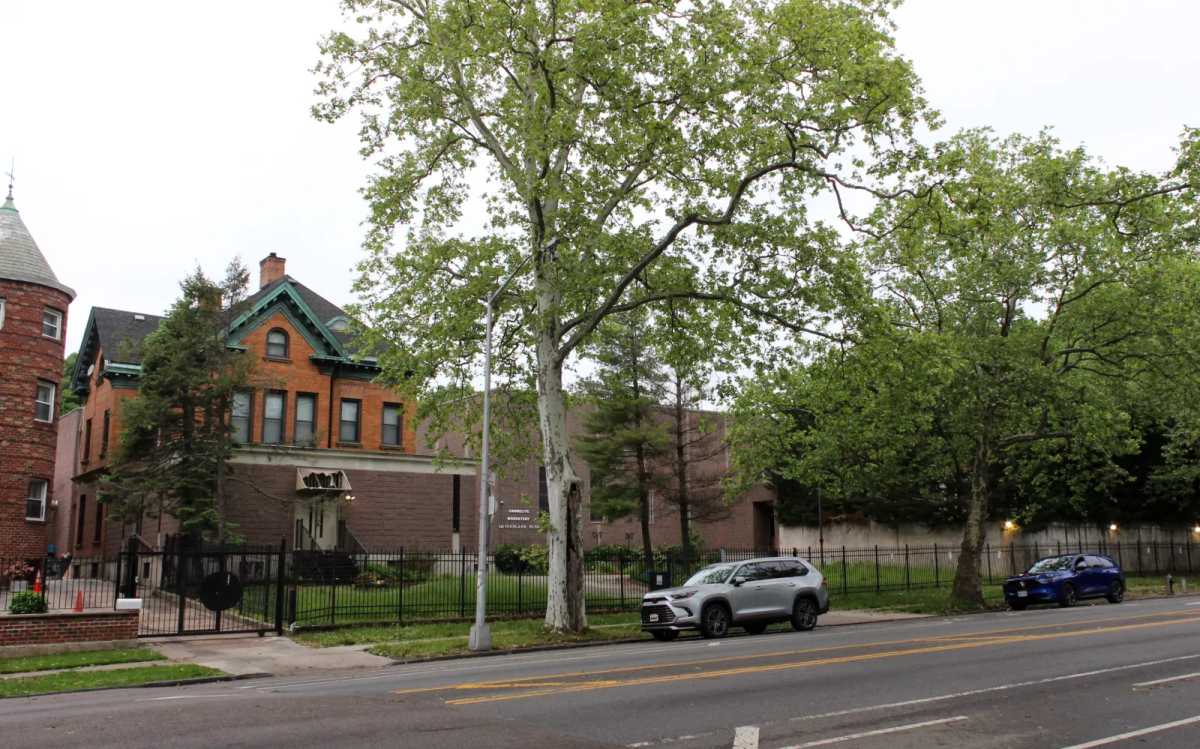
 Developers are proposing a 95-foot tall, 345-unit project at the site. Photos by Anna Bradley-Smith
The presentation shows the development would replace four of the five buildings that make up the monastery, owned by the Catholic Diocese, which backs onto upper Highland Park’s grassy hills. The three-story red brick Edwardian house near the street on the western side of the site, previously home to individuals contemplating religious life, will be preserved in the plans. The dwelling dates back to the early 20th century, with alterations made in the 1970s, records show.
A rep for Community Board 5 said the item was added to the board’s agenda at the last minute after board members got wind of the plans through the community and asked the developer to share the plans with the land use committee. Already the proposal has generated a lot of feedback from locals, the rep said, and the meeting was moved to a bigger venue to accommodate a large audience.
The presentation to the community board on Tuesday, May 19 was just that, with no board vote taking place. Watermark Capital’s rezoning application is not yet publicly visible on the City Planning website, and the developer will be required to hold a number of public hearings, including at the community board level, as part of the land use review process.
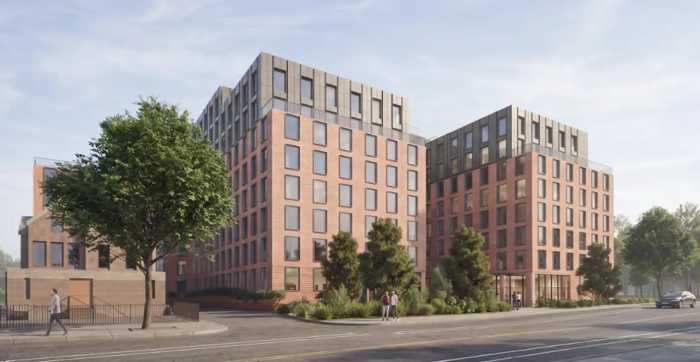 A rendering of the buildings proposed for the site. Image by J Frankl Architects via Community Board 5 Land Use Committee
The Carmelite monastery has been vacant for the past three years since the 10 cloistered nuns moved in 2023, after more than 20 years in the building. The verdant area of Highland Park that had long been an urban sanctuary for the nuns had over time turned into a party hot spot, especially in the early days of the pandemic, and the noise emanating from the park next door eventually led them to pack up, according to the New York Times. The group is now fundraising to build a new monastery outside of Scranton in Pennsylvania.
So far, public records and court documents do not show any sale or ground lease from the Catholic Diocese, nor any applications for permits for demolition or construction. The church has been selling off properties across New York in recent years as attendance numbers decline and aging properties become more expensive to maintain. City records show the Roman Catholic Diocese of Brooklyn purchased the property from the Society of Franciscan Fathers of Greene, Maine, Inc. in 2003 for $2.6 million.
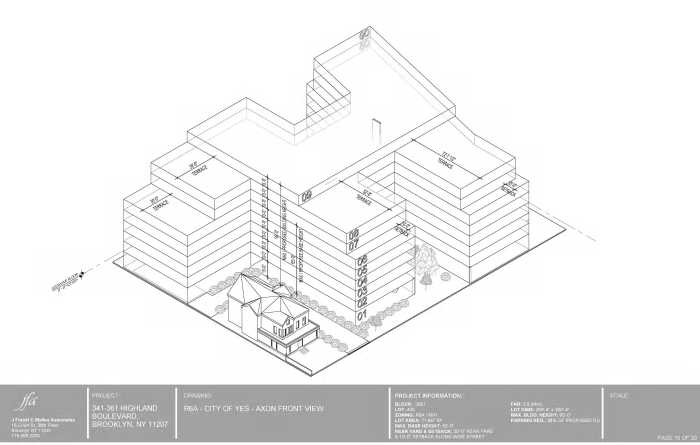
The team behind the proposed development wants to rezone the land from R3-1 to R6A, the presentation shows, allowing them to build a nine-story, 345-unit building rather than the three-story, 105-unit development they could build as of right.
With City of Yes zoning changes, the site can now be developed as of right with a multi-family building, where, in the past, Highland Boulevard’s R3-1 zoning allowed single-, two-family, or semi-detached houses or a community facility. However, Watermark Capital wants to build larger than what is permitted with R3-1 and will try to get an upzoning to R6A, which, with City of Yes changes, would allow the nine stories. The City of Yes changes for R3-1 are a big deal for areas like Highland Boulevard, where standalone houses have dominated the block and could now be razed for multi-family buildings.
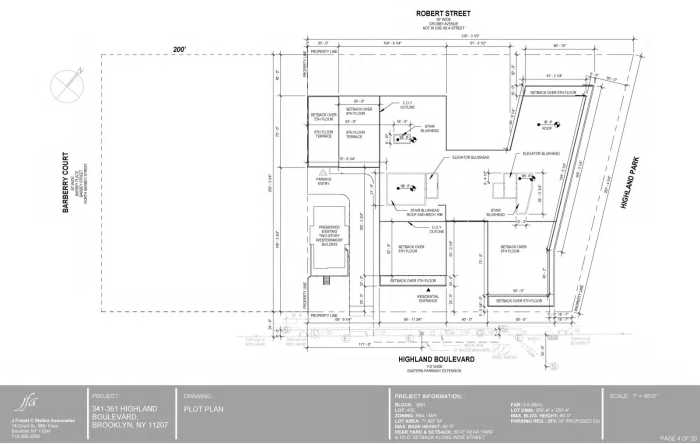 The developer is seeking a spot rezoning, and wants to demap oart of Robert Place. Image by J Frankl Architects via Community Board 5 Land Use Committee
The developer will also ask to demap Robert Place, a small dead-end street that runs along the east side of the section, the presentation says. As well, any development that takes advantage of a rezoning would be required to include affordable housing under the city’s Mandatory Inclusionary Housing program.
Of the 345 apartments planned, 123 would be affordable to families earning an average of 80% of Area Median Income, which is currently $116,640 for a family of three. The presentation says of the 345 units, 62 will be studios, 191 one-bedrooms, 85 two-bedrooms, and seven will be three-bedrooms.
The development would also include 58 underground parking spaces, three indoor recreation areas, outdoor recreation areas “intended to harmonize site with adjacent Highland Park,” and a 40-foot-deep rear yard abutting the park. The presentation shows the building, designed by J Frankl Architects, will be mostly red brick with gray upper stories and big rectangular windows. The H-shaped structure will be set back 70 feet from the western property line and wrap around the three-story Edwardian house, which will become a community facility.
The same day the developer rep presented the plans to the community, a local resident started a petition against the project online, which has so far gathered 115 signatures. The person behind the petition, who isn’t named, said he or she has lived on Highland Boulevard for years and called the area “a charming community characterized by its unique historical architecture and tight-knit residential feel. This is not just about property; it’s about our home, heritage, and community identity.”
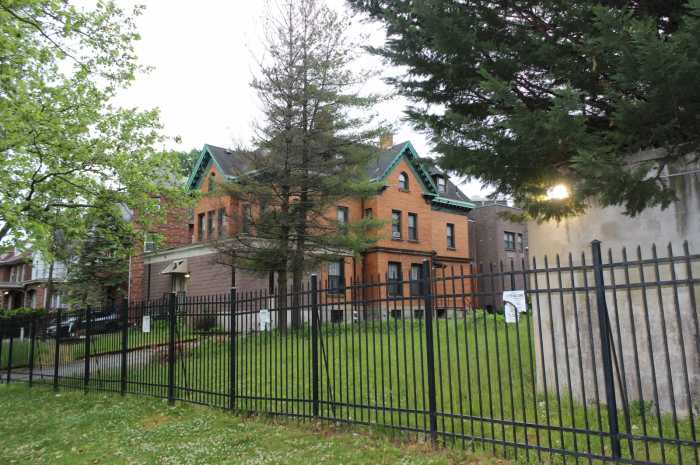 The three-story home on the site will be preserved as part of the project. Photo by Anna Bradley-Smith
The rezoning and new development will have an adverse impact on residents’ way of life by adding a large building to an area of largely single- and two-family homes, the petitioner continued, adding “this kind of abrupt and intense urban development will inevitably alter the neighborhood’s make-up, creating a dense urban environment ill-fitted to our current suburban structure.”
Concerns over traffic, noise, and construction increasing pollution in the area, and the financial burden for homeowners of possibly increased property taxes, are cited in the petition.
“In a time where community preservation should be pivotal, this proposed rezoning only threatens to demolish our history and identity. We urge city planners and officials to halt this rezoning initiative. Instead, we advocate for development plans that respect our heritage while considering sustainable and community-friendly growth,” the petition reads.
Locals have also been handing out fliers at the park that oppose the development, which say “do you love upper Highland Park? Let’s stand against gentrification and greedy developers.”
Brooklyn-based Watermark Capital has developed a number of religious sites as residential in recent years, and is currently behind several ambitious Brooklyn developments, including Duffield Street Houses and one in Borough Park over a rail line.
The rezoning application is currently in the pre-certification stage, and the developer expects it will be certified in the fall of this year “at the earliest,” the firm said in an emailed statement. In the meantime, Watermark has been “actively meeting with the community including the immediate neighbors and Brooklyn Community Board 5 to hear their concerns about the project and to work with them to achieve a result that could satisfy the development’s objectives as well respecting the context in which the property is located. The applicant team looks forward to continuing to engage with the local community board in the coming months.”
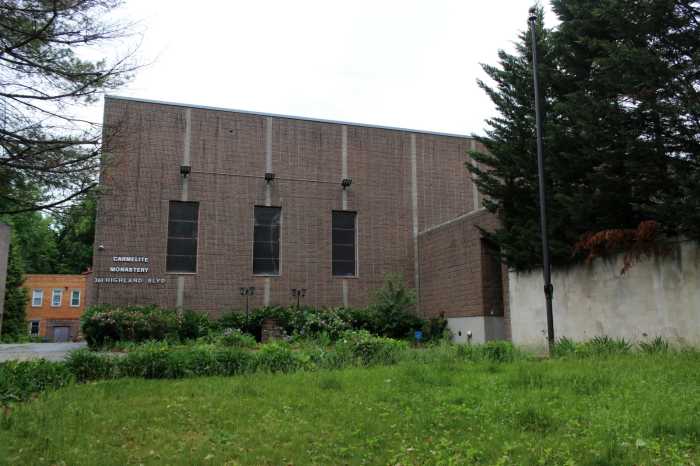 The monastery site in May 2026. Photo by Anna Bradley-Smith
 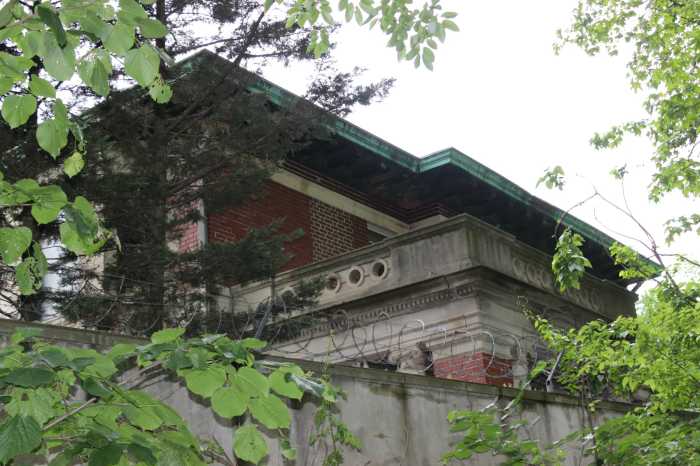 Some locals said the project would negatively impact their way of life. Photo by Anna Bradley-Smith
Once the public review starts, the rezoning process could take approximately seven months to complete. As well, a court must review any sale by the Catholic Diocese, the Attorney General’s office confirmed.
The Catholic Diocese did not immediately return request for comment.
In the earlier half of the century, records show 341, 349, 355, 357 and 361 Highland Boulevard all had brick or wood frame structures, some indicated as stables, at the rear of their lots, facing what is now the park.
In 1968, the Society of Franciscan Fathers of Greene, Maine, Inc. purchased 361 Highland Boulevard. According to the New York Times, the Franciscans made an agreement with the Lithuanian community to build a Lithuanian Cultural Center on the site, and the Lithuanians raised almost $1 million for it. Records show the new building opened around 1974. Around the same time, alteration work was done at 341 Highland Boulevard.
In the late 1990s, the Franciscans did not renew the lease for the Lithuanian Center, leading to a bitter legal fight, as the Times detailed. The property was listed for sale around 2001 and it was eventually purchased by the Catholic Diocese.
This story first appeared on Brooklyn Paper’s sister site Brownstoner.