
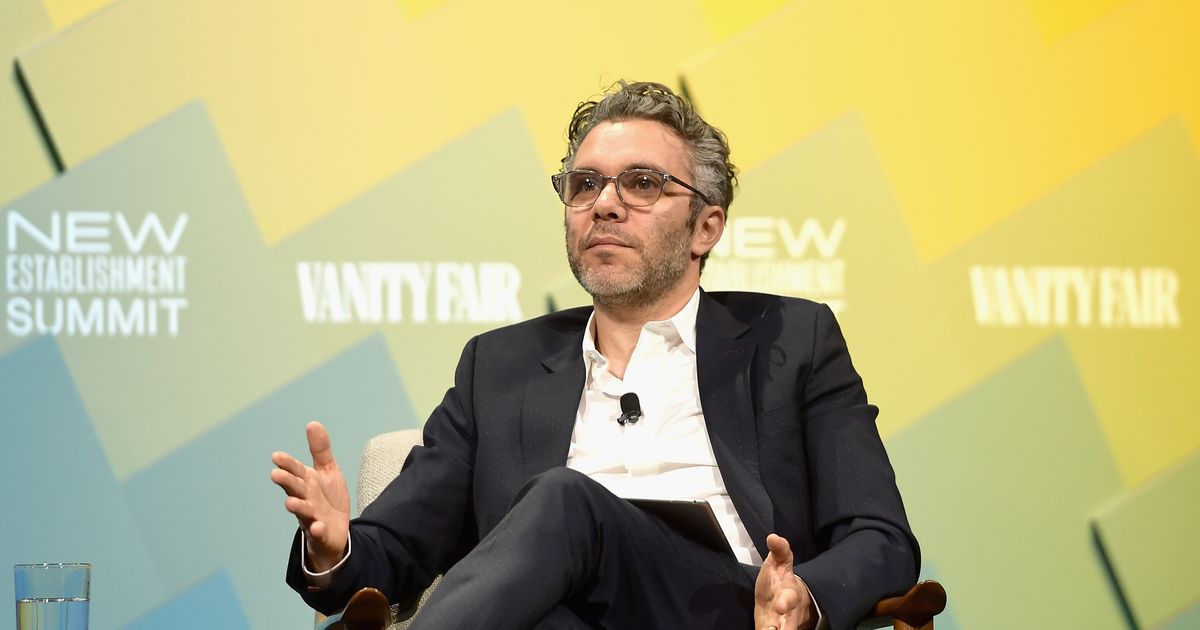
Photo: Matt Winkelmeyer/Getty Images
Nick Bilton recently flew to New York to meet with director Martin Scorsese to discuss the screenplay he adapted from his forthcoming book with Dwayne “The Rock” Johnson, about a Hawaiian crime syndicate, when a very different career opportunity presented itself. During the trip, Bilton also met up with CBS News editor-in-chief Bari Weiss, whom he got to know professionally in Los Angeles, and she gauged his interest in taking over 60 Minutes. “It was an unbelievable opportunity and I couldn’t get it out of my head,” Bilton recalled Thursday, just hours after being named the newsmagazine’s new executive producer.
“I said, look, I want to present my ideas to you and the way I would want to do it, and if you are interested in them, then we can move the conversation forward,” Bilton said in an interview. “And so I did, and she loved them, and I have so many ideas and innovative ideas that I just cannot wait to bring to 60.”
Weiss’s selection of Bilton sent shock waves through the network and coincided with a broader shake-up as CBS News cut ties with 60 Minutes executive producer Tanya Simon, daughter of late 60 Minutes correspondent Bob Simon; veteran executive editor Draggan Mihailovich; and correspondents Cecilia Vega and Sharon Alfonsi, the latter who accused Weiss in December of making a “political” decision in abruptly pulling her report on a notorious El Salvadoran prison, one of several missteps throughout Weiss’s seven-month tenure.
Weiss has already made significant changes, like installing Tony Dokoupil as anchor of the CBS Evening News, but upending 60 Minutes is a far bigger risk. The evening newscast has been perennially in third place, whereas 60 Minutes is not only the network’s most prestigious news show, it remains widely popular, averaging 9.1 million viewers this season. With Thursday’s moves, Weiss is fully putting her stamp on the program, or as one CBS News staffer put it, “It’s a full hostile takeover.”
In a memo introducing himself to the staff, Bilton said he looked forward to speaking with them about what’s working and what’s not, and expected that “in about 30 days I’ll come back to all of you with where we go from here.” There’s, understandably, trepidation inside 60 Minutes and uncertainty among staff about precisely how to proceed before Bilton gives a sense of the future direction. While 60 Minutes just finished the 2025-2026 season, staffers are already preparing pieces for the fall — the fate of which could change depending on Bilton’s interest. The other concern is that Bilton, like Weiss before him, is assuming a powerful perch at CBS News without any network-news experience.
Bilton is an accomplished journalist, having covered technology, politics, and culture for the New York Times and Vanity Fair, where I edited him for several years. I found him to be a prescient columnist — check out what he was writing on AI back in 2022 — and a thoughtful and generous colleague. He’s got a wide-ranging résumé, having written books on the early days of Twitter, dark-web marketplace Silk Road, and the aforementioned one about the Hawaiian mob, along with producing documentaries for Netflix and HBO and writing the screenplay for a Scorsese film.
When I asked about his lack of TV experience, Bilton mentioned how he came to Vanity Fair as a reporter but also started hosting a podcast: “I’d never done that before,” he said. “I went off to Hollywood; I did documentaries. I’d never done that before. I went off to write screenplays and did them for Scorsese with the Rock and so on, and had never done that before. And I think it’s all storytelling at the end of the day.” He’s got a decade of experience in documentaries, he said, and a season of 60 Minutes is essentially a hundred short-form docs.
“Do I need to know which button to press to make sure the show goes on air on a Sunday night? No. If there are questions I don’t have the answers to, there is a building full of people who can answer them,” Bilton said. “But for me, I know how to report, I know how to do investigative journalism. I know how to work with producers, to tell stories in all different formats. And I also bring this understanding of media and technology that spans pretty much every form of storytelling there is, with the exception of comic books, I guess. And so it feels to me like the absolute perfect job and honestly the honor of my career to do it.”
Bilton also told staff in the memo that the job was the “honor of my career” and described 60 Minutes as “the most important television journalism brand this country has ever produced.” And yet, he said, “the audience that watched that first episode is not the same,” as they “have unlimited channels to choose from, not three.” Weiss had struck a similar tone months earlier when she laid out her “21st-century vision” to staff, speaking admirably of the news division’s legacy — and bluntly about the need for change. “We have to start by looking honestly at ourselves,” she said. “We are not producing a product that enough people want.” While CBS legend Walter Cronkite “had two competitors,” she said, the network now fights for attention with a “vast universe of podcasts and YouTube and Twitch and newsletters.”
Though 60 Minutes exists within CBS News, the program has traditionally enjoyed a good measure of autonomy. It had long operated separately on West 57th Street, rather than the CBS Broadcast Center. Bilton acknowledged the longtime separation, but said he thinks “there are opportunities to utilize some of the incredible reporters in CBS News to help with some of the stories that we want to tell on 60.”
“Do you think that someone like me is going to take this job so that I can be told what I’m going to do and the kinds of stories. No, I’m taking this job because I see what we can do with 60 Minutes,” he said. “And I think that there are so many missed opportunities in terms of going beyond the broadcast on Sunday night, which is only one hour long, of doing all different kinds of storytelling. And to me, that’s the most exciting part of this job, that I get to work with this incredible team of producers and correspondents. I get to think of new ideas and new ways to tell stories to reach bigger audiences across all different platforms.”
CBS News under David Ellison’s ownership, and Weiss’s stewardship, has been seen by critics as going soft on the current administration; Paramount’s private party last month “honoring the Trump White House” only fed such perceptions. “There’s a feeling that the wall has come down between editorial independence and corporate interests,” Alfonsi told the Times on Wednesday. “The concern is we’re going to end up with a broadcast that looks like 60 Minutes but doesn’t have the courage or the character to produce 60 Minutes journalism that actually matters.”
When I asked Bilton about such perceptions, he maintained that his job has always been to “hold power to account,” adding, “It’s why I’ve written all the stories I’ve written for 20 years about the tech companies and the CEOs. It’s why I covered the elections the way I did, both Hillary and Trump and Biden and Trump and so on. And that’s what I want to continue doing.”
This post has been updated to reflect that 60 Minutes is still operating out of its West 57th St. offices despite reports of relocating.
Sign Up for the Intelligencer Newsletter
Daily news about the politics, business, and technology shaping our world.
Vox Media, LLC Terms and Privacy Notice