
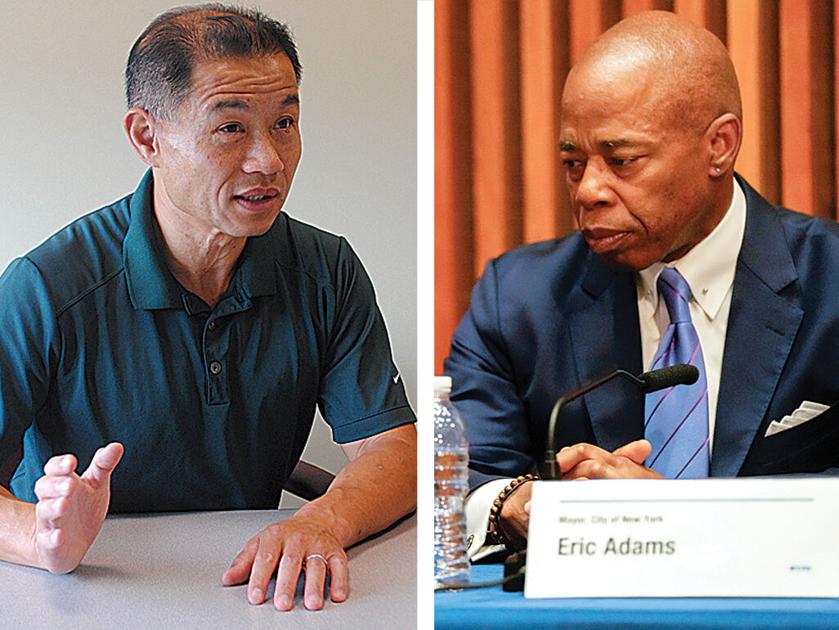
Former Mayor Eric Adams broke new ground last year when he convened a Charter Revision Commission on his last day in office, one that his successor could not dissolve. But legislation to change that was included in one of the budget bills approved by state lawmakers last week that Gov. Hochul is poised to sign today, May 28.
The Election-Related Requirements for Initiating Charter Commissions — ERIC — Act, introduced by state Sen. John Liu (D-Bayside), would let the mayor choose to confirm or annul a panel created by his or her predecessor between 60 days before a municipal general election and Jan. 1 of the following year. It was incorporated into the Public Protection and General Governance fiscal measure.
Per a press release from his office, Liu drafted the measure in response to Adams’ midnight commission. The legislation applies retroactively — once signed, it will have been effective as of Nov. 4, 2025.
“It was a loophole to allow outgoing mayors to convene a commission that would do its work within a new administration,” Liu told the Chronicle Tuesday. “It’s a loophole that I closed with this legislation.
“To the average person in the community, it would seem unseemly for an outgoing mayor to convene such a commission on the last day of office, which is unfortunately what happened.”
Liu said the panels have “never been without controversy,” and while they are set up to make charter changes less political, they inject other politics into the process.
Charter revision commissions are tasked with recommending changes to the city’s founding document that are then subject to voters’ scrutiny on the ballot. The panels can be created in a number of ways, but under state law, mayoral ones take precedence — referenda set forth by other commissions are knocked off the ballot if a mayor’s panel proposes its own.
Hochul last year vetoed a bill that would have prevented those ballot bumps, which have occurred in recent years.
Questions arose after Adams created his commission at the end of last year, including whether Mayor Mamdani could dissolve it or form his own. State law has not previously allowed standing commissions to be disbanded, and, per an explainer from Citizens Union, it is “reasonable to assume” that the sitting mayor could create a parallel panel.
To political analyst Brian Browne, the ERIC Act is “defensible but situationally opportunistic.” It closes the loophole that lets outgoing mayors project power into the future without voters’ approval, Browne said, but its enactment comes “in medias res” and “in a way clearly designed to resolve one specific political standoff.”
Earlier this year, shortly after Adams created his 2026 panel, Browne called the former mayor’s move a “blatant abuse of power.”
“This episode demonstrates a deeper tension in NYC governance: by design, Charter Revision Commissions are supposed to be independent, democratic tools, but the way they are often strategically created by mayors makes them inherently political instruments,” he said in an email. Browne added that it raises questions about “the stability of quasi-independent bodies” and the rise in controversial local actions getting undone by “must-pass budget riders,” if the state can change the rules to let an existing panel be disbanded.
Liu said the situation at the end of last year was a catalyst for closing “a loophole that needed to be closed.” His bill will apply for all future administrations and is not about the former or current mayor in particular, he said.
Adams’ 2026 commission is holding public hearings — the first one was scheduled for yesterday, May 27, in the Bronx.
When it was formed, the panel was set to examine whether to bring open primaries to local elections, which would let voters not affiliated with a given political party cast ballots for that party’s candidates.
Also being considered are moves to build more affordable housing, stop elected officials from increasing their own salaries and address antisemitism, hate crimes and protests near houses of worship, City & State reported last week.
Adams’ previous commission set forth several questions last year looking to speed affordable housing production, and lawmakers challenged them in court. All the panel’s ballot proposals were approved, except for one that would have aligned local and presidential election years.
City Hall did not respond to inquiries by press time about what action Mamdani might take, upon the bill’s enactment.