
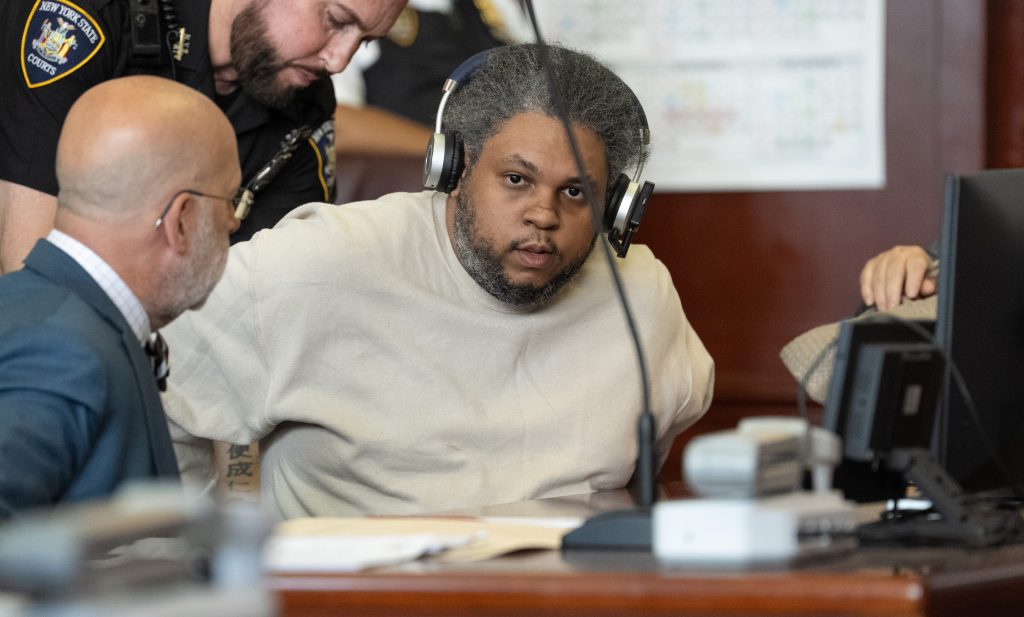
A man who viciously claimed the lives of four of New York City’s most vulnerable residents while in the throes of a psychotic episode as they sought a few hours’ sleep on quiet Chinatown street corners received a 40-year prison term Thursday.
Before sentencing 31-year-old Randy Santos, Manhattan Supreme Court Justice Laura Ward said his crimes and the unimaginably horrific final moments of Chuen Kok, Nazario Vásquez Villegas, Anthony Manson and Florencio Moran Camano resulted from a confluence of societal ills that have defined cases before her for decades.
“It was the coming together of three horrible symptoms of the city: homelessness, mental illness, and narcotics abuse, and hopefully something will eventually be done,” the judge said. “I’ve been on the bench for almost 30 years, and those are the three things that seem to be the constant in almost all of our violent crime cases.”
Ward said she was conflicted by the need to balance rehabilitation with retribution, deterrence, and prevention when faced with the untold nature of the killings.
“I have a difficult time getting past the fact that Mr. Santos targeted the most vulnerable people in our society — people who were doing nothing but sleeping on the street,” she said.
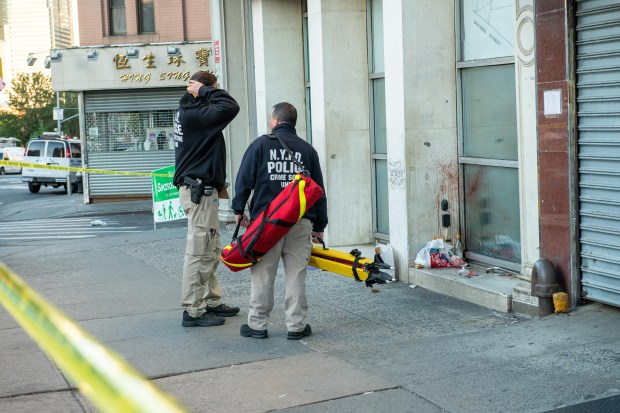 Randy Santos was taken into custody after he allegedly bludgeoned four homeless men to death as they slept in Lower Manhattan on Saturday, Oct. 5, 2019, including at this location outside 2 Bowery St.. A fifth victim was taken to New York Downtown Hospital in critical condition. (Theodore Parisienne for New York Daily News)
A jury in February found Santos guilty of four counts of second-degree murder for taking a 15-pound metal bar and using it to pummel the four homeless men to death violently over the course of a half hour in the early morning hours of Oct. 5, 2019. He was also convicted of attempted murder for an attack the same night on a fifth victim and of brutally attacking a separate man a week beforehand who had been sleeping near the river by Chelsea Piers.
“None of these men knew Randy Santos, Judge,” Assistant District Attorney Alfred Peterson said in court Thursday. “None of them ever spoke with him. They were killed in their own sleep on the streets of our city. There are no victim impact statements here today. There’s nobody here to tell this court about their lives and how their absence is a loss.”
Santos, wearing a beige crewneck sweatshirt, tan pants, and headphones to listen to a Spanish interpreter, did not visibly react when his sentence was imposed. His attorney, Arnold Levine, told Ward that he was a different person from the unbalanced young man he first met in a holding cell in 2019 when his schizophrenia was untreated. He urged the judge to reject the request by DA Alvin Bragg’s office to sentence Santos to 50 years.
“We’d ask that Mr. Santos not be sentenced to die in prison. He is not incorrigible, he’s not beyond redemption or hope,” the attorney said.
“I was his lawyer since day one — in the pens the day he was arrested. He’s almost unrecognizable physically, but he’s also unrecognizable mentally, and in terms of his personality since that day,” Levine said, telling the judge Santos hadn’t been written up for a single infraction on Rikers Island in the four years he’d been consistently taking his meds. “He understands. He has insight into his illness. He understands that he has to take that medication and take it every day, and he can’t live without it.”
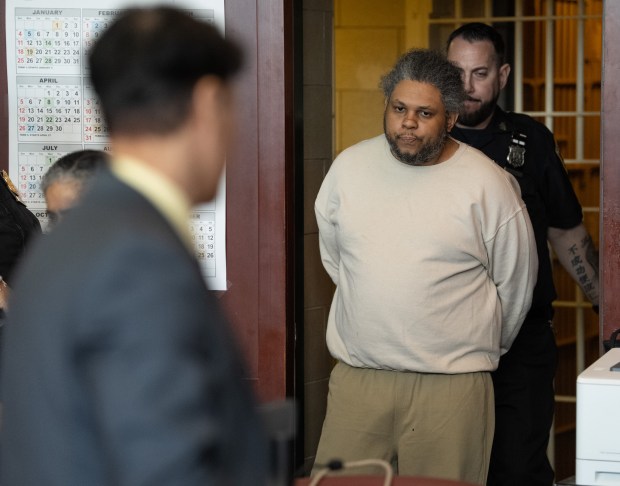 Randy Santos is pictured during his sentencing at Manhattan Supreme Court on Thursday, May 28, 2026, in Manhattan, New York. (Barry Williams/ New York Daily News)
DA Alvin Bragg’s office did not dispute that Santos was severely mentally ill at trial. Rather, the prosecution argued that the legal standard to hold him criminally liable was met — that he was aware his actions were illegal or violated commonly held moral principles.
Trial evidence showed Santos first targeted Manson, fatally striking him in the head seven times as he slept on East Broadway near Catherine St. The 42-year-old Manson was a writer and a familiar face to Chinatown locals who would see him around the neighborhood blogging on his laptop.
Santos then headed over to Chatham Square, descending on Villegas, Moran and David Hernandez. Killed were Villegas, 54, a native of Mexico City and a loving father and grandfather, and Moran, 39, who hailed from the Pacific Coast state of Guerrero in Mexico and was Santos’s youngest victim. Hernandez, 49, was seriously injured.
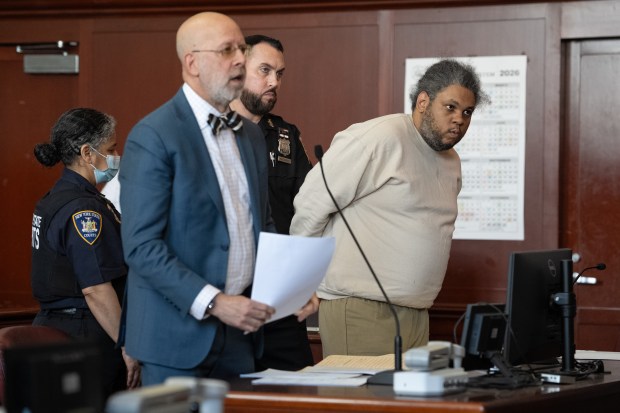 Randy Santos is pictured during his sentencing at Manhattan Supreme Court on Thursday, May 28, 2026, in Manhattan, New York. (Barry Williams/ New York Daily News)
The young man last targeted the 83-year-old Kok, another regular in the community and a service industry worker who had fallen on hard times a decade prior following his wife’s passing. The Chinatown elder was tucked away, sleeping against a building at the end of Doyers St., when Santos fatally beat him to death.
“I saw him on the streets. I knew the corner where he was killed. He was there on a daily basis,” Karlin Chan, 69, a longtime Chinatown community advocate, said Thursday.
Chan told the Daily News that he helped to arrange Kok’s funeral after tracking down his pastor and speaking with congregants at Kok’s now-closed old church.
“They told me that his wife had passed away some 10 years ago. He got depressed or something and he lost his job. It was at a local restaurant, he lost his job and, you know, he wound up on the street,” Chan said.
“I got involved because like I said, nobody cares about the homeless guy. I said I should do the right thing and just arrange for this funeral quietly. A burial, a proper funeral. He’s buried in Princeton Memorial Park, in New Jersey.”
Santos, in brief comments to the court, apologized to his victims and said that he would dedicate himself to education in his incarceration.
“I’m just trying to say I’m very sorry for what I did. I apologize to the people for what I did; I feel bad about what I did,” he said.
“I feel like a different person now. I can’t live without medication. I know I’m going to prison for a long time. I’m now going to use my time to learn English, finish the school and do some programs and learn a trade. I want to be somebody when I get out of the jail.”