
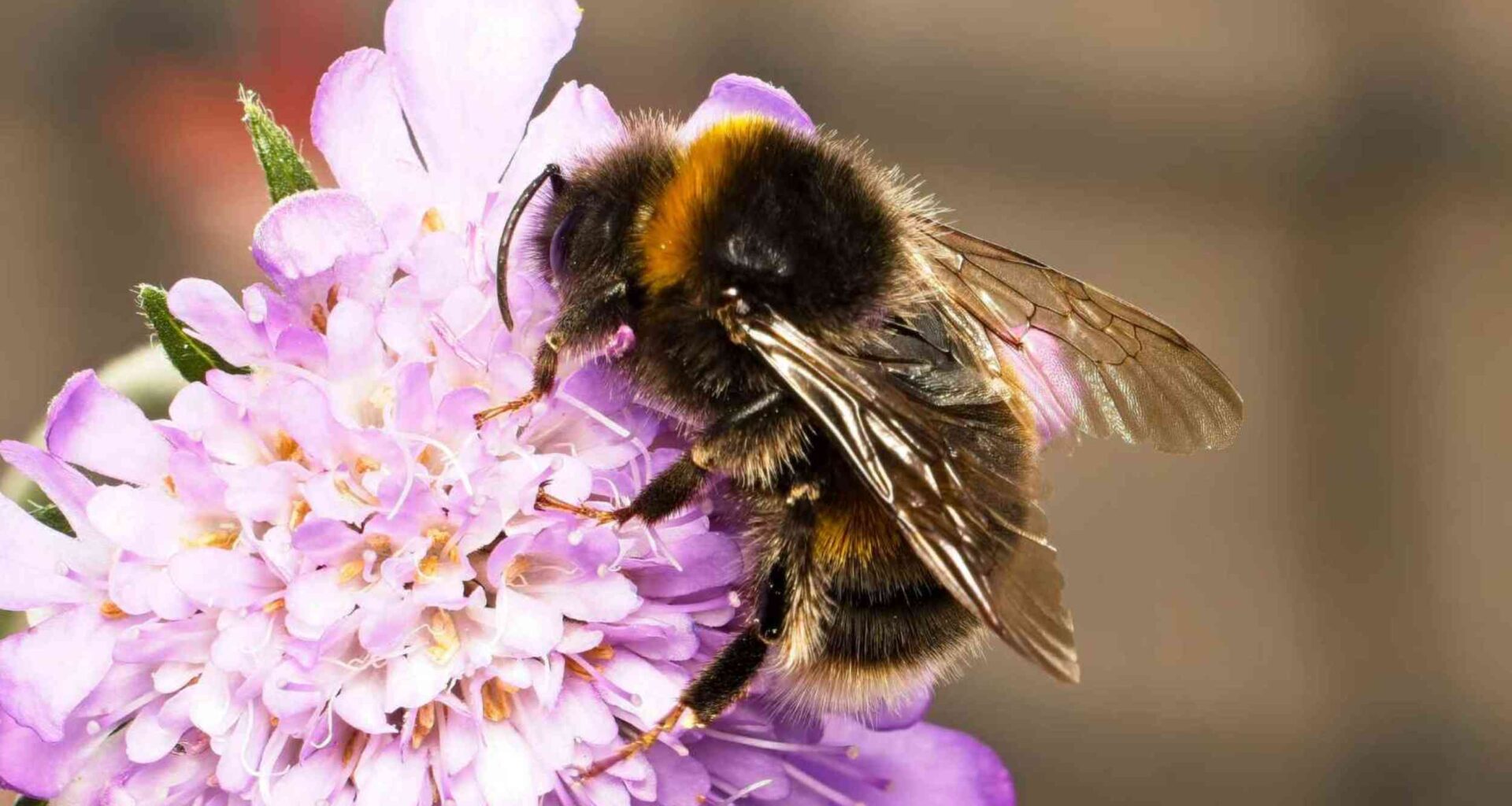
In the network of a bumblebee colony, the worker bees usually get the majority of the attention.
They spend their days visiting hundreds of flowers, gathering nectar and pollen to keep the colony fed while the queen remains in the nest laying eggs.

That picture is not exactly wrong. But it leaves out the weeks before any workers exist, when the queen must forage alone.
A new study suggests she manages it with a sharper sense of smell than any of her daughters will ever possess.
A solitary spring start
A bumblebee colony does not last like a honeybee hive does. Each runs for a single season, and only the year’s new queens survive the winter, sleeping it out in burrows under the snow.
When a queen wakes in spring, the colony she came from has already collapsed. She has to start a fresh one by herself, foraging for nectar and scraping wax into a nursery.
Back at the nest, she climbs onto her larvae and vibrates her flight muscles to keep them warm. Until her first workers emerge weeks later, she alone is the entire labor force.
“It’s extremely high stakes for the queen,” said Dr. Melanie Kimball at the University of California, Davis (UC Davis). One missed step could mean the loss of the entire colony.
Smarter than offspring
A few years ago, Kimball’s collaborator Professor Felicity Muth wondered whether the demands of being a young queen had produced a sharper brain.
Worker bumblebees had been studied for decades, but their mothers had not. Muth hiked into Sierra Nevada meadows during the brief window when fresh queens were still out foraging.
She caught them one by one and tested how quickly each linked a colored card to a sugar reward.
Queens learned that association much faster than workers did. The earlier paper hinted that queen bumblebees carry a general learning edge.
However, it could not rule out the simpler explanation that queens merely had better eyesight.
Following the scent
To understand what was happening, Kimball ran the same experiment with smells.
Working with captive bumblebees, she paired floral scents with a sugar reward and counted how many trials it took for the bee to pick the right one.
Queens learned the rewarding odor in fewer tries than workers did, mirroring what Muth had seen in the field with colors.
Two sensory systems tested in separate experiments produced the same result. The queens beat workers at both.
That makes a strong case the edge is not just about vision. Learning by scent and by sight confirms the queen’s advantage.
A more skilled nose
Kimball also tested how diluted a scent could become before a bee stopped reacting. Queens picked up odors that were too faint for workers to notice.
That extra sensitivity could help in a meadow crowded with competing scents.
A queen who picks up nectar from farther away, or tells one flower from another by scent, may find food faster.
It also complicates the larger story at hand. Is it dependent on brain difference, sensory difference, or some combination of both? This was the team’s next puzzle.
Wired for the job
The pattern fits bumblebee biology. A queen gets only one chance to start a colony. Workers have sisters to absorb the cost of a bad decision, but a queen does not.
The pressure falls hardest on the queen in exactly the kinds of tasks these experiments measure, such as remembering which flower scents lead to a reward.
If she fails, the cost is the collapse of her entire genetic line. Kimball says the long-term goal is now to look directly at the brain itself.
Comparing queens and workers of one species could pin down what is physically different about a faster-learning insect head.
Pollinators under stress
Bumblebees pollinate native wildflowers across the continent and handle crops that smaller bees struggle to pollinate, like tomatoes and blueberries. That makes them important, and hard to replace.
North American bumblebees have been losing ground for decades to habitat loss, non-native honeybees, and farm chemicals.
A different study from Muth’s group showed that some insecticides blunt a bee’s ability to learn scents.
This creates a problem. The very skill that lets a queen launch a colony is likely the same one those chemicals erode. That could put native pollinators under even greater pressure.
The bigger picture
The bigger curiosity behind the research is far beyond bees. Learning and memory appear across mammals, insects, octopuses, and birds, creatures with almost nothing in common genetically.
Putting queens and workers side by side gives biologists an unusually clean comparison.
The two bees are nearly identical except for the trait being tested, stripping away many of the confounding factors that usually cloud questions about how cognition evolves.
What is new is the queen’s edge extending beyond color into scent. It’s a different sense, with the same result.
Researchers can stop asking whether the first finding was a fluke and start asking what brain change makes a queen learn faster.
The study is published in Proceedings of the Royal Society B.
—–
Like what you read? Subscribe to our newsletter for engaging articles, exclusive content, and the latest updates.
Check us out on EarthSnap, a free app brought to you by Eric Ralls and Earth.com.
—–