
In the spring of 1978, I found myself in the middle of a newsroom occupation.
I was a reporter at the Massachusetts Daily Collegian at UMass Amherst, covering student government and local politics. A sit-in led by the paper’s women’s editor evolved into a full occupation of the newsroom. The doors were eventually chained shut. The dispute drew national attention, attracting support from prominent feminist figures including Gloria Steinem, Andrea Dworkin, Robin Morgan, and Simone de Beauvoir.
Many years later, what I remember most is not the protest itself. The women involved were raising serious concerns that would eventually find their way into the mainstream of American journalism and public life. Nor do I remember the event primarily as a conflict between activists and journalists.
What stayed with me was something else: despite the emotional intensity of the dispute, the prevailing journalistic instinct was to proceed carefully. We tried to distinguish reporting from advocacy. We understood that the closer we were to a story emotionally, the more discipline we owed our readers.
That experience came flooding back while watching the New York Times respond to the controversy surrounding Nicholas Kristof’s recent opinion essay on allegations of sexual abuse against Palestinians in Israeli detention facilities.
The original controversy was significant enough. Critics questioned sourcing, corroboration, and evidentiary standards surrounding some of the essay’s most serious claims. Jewish organizations, media critics, and even some longtime supporters of the Times raised concerns.
Then came the newspaper’s follow-up defense.
To me, that response became the real story.
Historically, journalism operated on a simple premise: the more serious the allegation, the higher the burden of proof. The greater the moral stakes, the greater the obligation toward skepticism, precision, and verification.
The New York Times’ response felt different.
Rather than publicly grappling with questions of sourcing, corroboration, and editorial judgment, the paper appeared to many readers to be reaffirming a narrative it believed was morally important.
That distinction matters.
Many critics of Kristof’s essay were not arguing that abuse is impossible. Nor were they objecting to reporting on Palestinian suffering. The central question was whether certain allegations had been sufficiently corroborated before being elevated in one of the world’s most influential newspapers.
Yet much of the response seemed to treat skepticism itself as a form of moral deficiency, as though questioning the evidentiary basis of claims reflected insufficient empathy for victims.
That inversion lies at the heart of a larger transformation that has been unfolding within journalism for years.
Sebastian Junger recently wrote that “a genuine journalist is someone who is willing to destroy his own opinion with facts.” That idea once sat near the center of the journalism profession.
Martin Baron, the former executive editor of both The Washington Post and The Boston Globe, has similarly defended traditional journalistic objectivity, warning that beginning with “moral clarity” can easily slide into confirmation bias and ideological crusades.
Even A.G. Sulzberger, publisher of The New York Times, has championed what he calls “independent journalism,” arguing that a reporter’s highest loyalty must remain with the facts, even when those facts challenge personal beliefs or political alliances.
These are not conservative arguments. They are not right-wing arguments. They are arguments about the discipline of journalism itself.
Older journalistic culture generally treated skepticism as a professional obligation rather than a moral failing. Over time, however, many elite institutions subtly began redefining the role of journalists. Skepticism, detachment, and verification increasingly gave way to moral clarity, emotional authenticity, and visible alignment with favored causes.
Those changes did not emerge from nowhere. They were often responses to legitimate failures, blind spots, and exclusions within traditional institutions.
But they also changed professional incentives.
Increasingly, journalists were rewarded not merely for uncovering facts, but for demonstrating moral alignment with the communities and causes they covered. Skepticism, once regarded as an essential professional discipline, sometimes came to be viewed as evidence of insufficient empathy.
As that shift accelerated, the line between reporting and activism became harder to discern.
Some of this evolution long predates the current war. Many observers viewed the removal of opinion editor James Bennet following internal backlash over the publication of Senator Tom Cotton’s controversial op-ed as an important turning point. Similar tensions surfaced again when opinion editor Kathleen Kingsbury declined to publish a Bret Stephens column defending science reporter Donald McNeil Jr. after his resignation from the paper.
Explaining that decision, Kingsbury said there was an “especially high bar for a piece that could reflect badly on our colleagues.”
It was a revealing statement. Journalism traditionally earned credibility not by shielding institutions from scrutiny but by subjecting them to scrutiny, including scrutiny of themselves.
None of this means that journalists should be detached from human suffering. Nor does it mean they should avoid difficult stories or uncomfortable truths.
Quite the opposite.
Journalists should aggressively pursue facts wherever they lead. They should investigate allegations thoroughly. They should challenge powerful institutions. They should expose wrongdoing.
But they should also remain willing to have their own assumptions overturned by evidence.
That is what journalism at its best has always required.
Back in 1978, the protesters occupying our newsroom believed passionately in their cause. So did many people on the newspaper staff.
But even amid all that conflict, we still understood something essential.
Activists and journalists served different roles.
One sought to persuade.
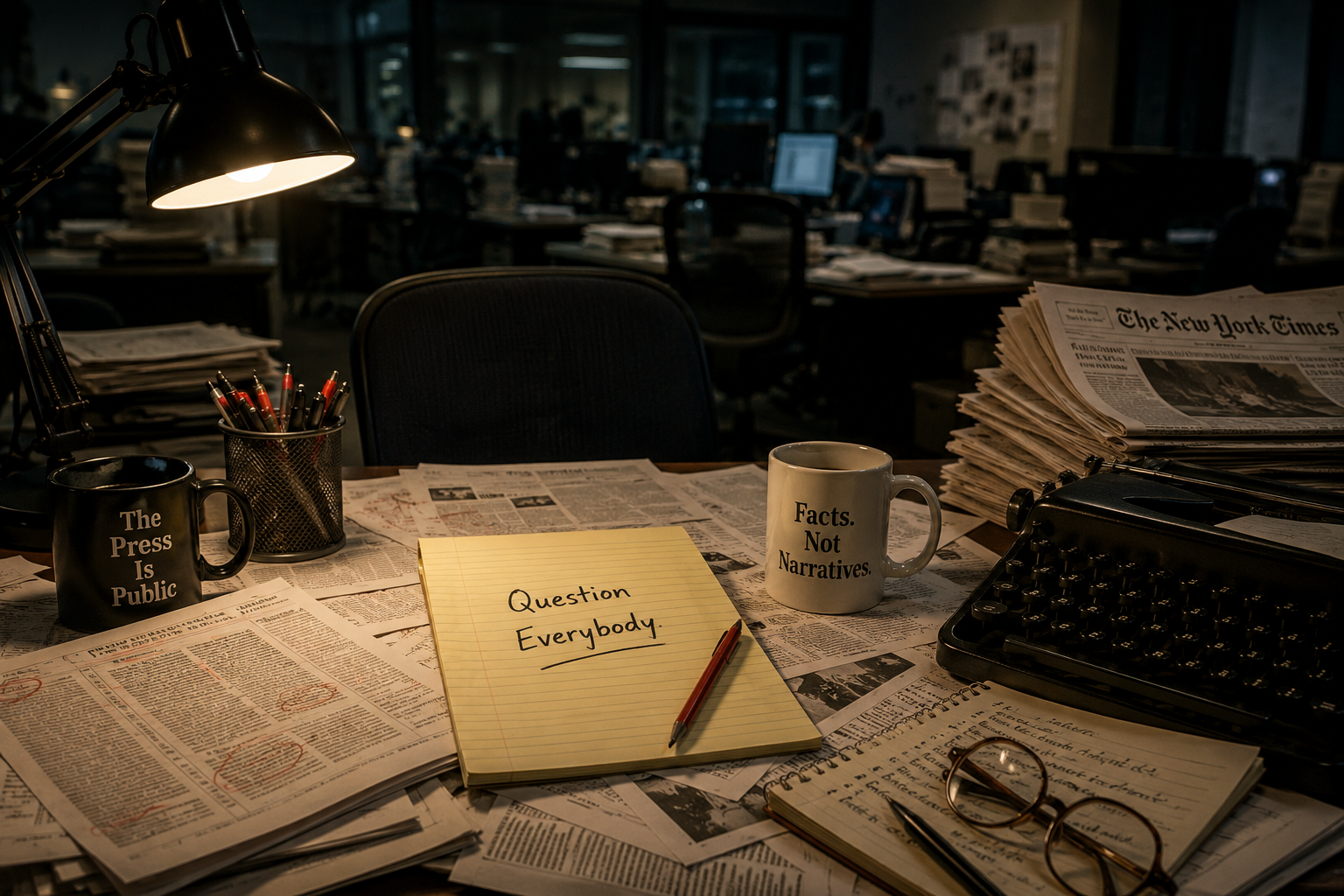
The other was supposed to question everybody.
I am no longer entirely certain that distinction remains as clear as it once was.