

NEW YORK — The anti-Israel boycott passed by New York City’s Park Slope Food Coop this week targeted companies involved in Israeli-Palestinian coexistence initiatives, pro-LGBTQ programs and family-owned firms employing diverse workforces.
The co-op’s membership voted to boycott Israeli products on Tuesday, after a years-long campaign that rocked the progressive community of 17,000.
The co-op is a major institution in the Brooklyn neighborhood and the boycott became a citywide issue, drawing in elected officials, rabbis, street activists and leading Jewish groups.
The boycott campaigners said the effort was meant to “stop genocide,” while opponents said the boycott was discriminatory, divisive and punished independent food producers for the actions of their government.
The pro-boycott effort, led by a group called Park Slope Food Coop Members in Solidarity with Palestine, listed eight companies connected to Israel that sell products at the co-op and would be subject to boycott.
Get The Times of Israel’s Daily Edition
by email and never miss our top stories
By signing up, you agree to the terms
The products were removed from the store’s shelves the morning after the vote, a co-op member told The Times of Israel.
Of those eight companies listed by the boycott campaign, half are run by Arab Israelis or sell products from Arab-owned factories.
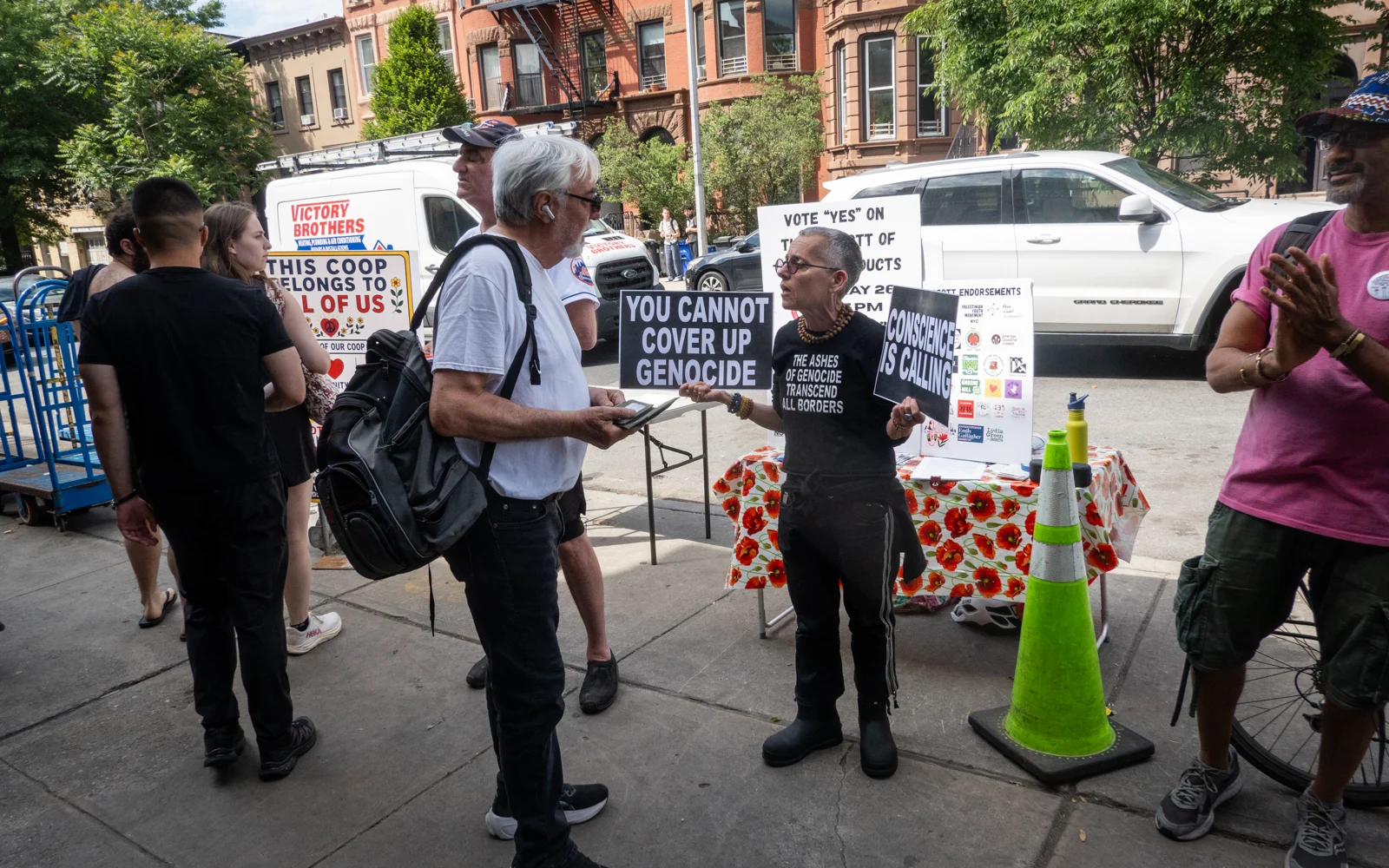
Campaigners for and against a BDS referendum at the Park Slope Food Coop in Brooklyn, New York City, May 26, 2026. (Luke Tress/Times of Israel)
One of the companies, Al Arz tahini, is owned by Arab Israelis in Nazareth and supports LGBTQ causes.
Conservative Arab Israelis called to boycott Al Arz in 2020 after the company donated funds to an LGBTQ support line.
In response, Arab and Jewish Israelis, and Israeli diplomats, pushed back by buying the company’s tahini, driving up its market share.
“We in the Al Arz Tahini family love people without differentiation between religion, sex, gender or color. Food connects people,” the company said at the time.
Another firm targeted by the boycotters, Equal Exchange, sells olive oil from a non-profit run by Arab and Jewish women in Israel whose mission includes “building bridges” and “promoting peace.”
Equal Exchange also sells olive oil produced by Palestinian farmers in the West Bank.
An article last year by Linewaiters’ Gazette, a publication produced by the co-op, said that the store sold olive oil from both the Israeli and Palestinian operations.
It wasn’t clear if the boycott would apply to both the Israeli and Palestinian olive oils produced by Equal Exchange. The boycott group’s list did not specify.
Contacted for comment, the boycott campaign referred The Times of Israel to a press statement released after the boycott passed.
“Tonight’s win is proof that cooperative movements are powerful models for exercising solidarity and participatory democracy,” organizer Taylor Pate said in a statement.
Equal Exchange is a workers’ co-operative based in the US and dedicated to fair trade practices.
Meaningful revenue lost, but bigger hit to morale
Rachel Simons, a co-founder and CEO of Seed + Mill, another company on the boycott list, said the firm was started by three women in New York’s Chelsea Market. They began selling their products in the co-op about six years ago.
Simons described the partnership as “my dream account” because she “loves the mission and values of a food co-op.”
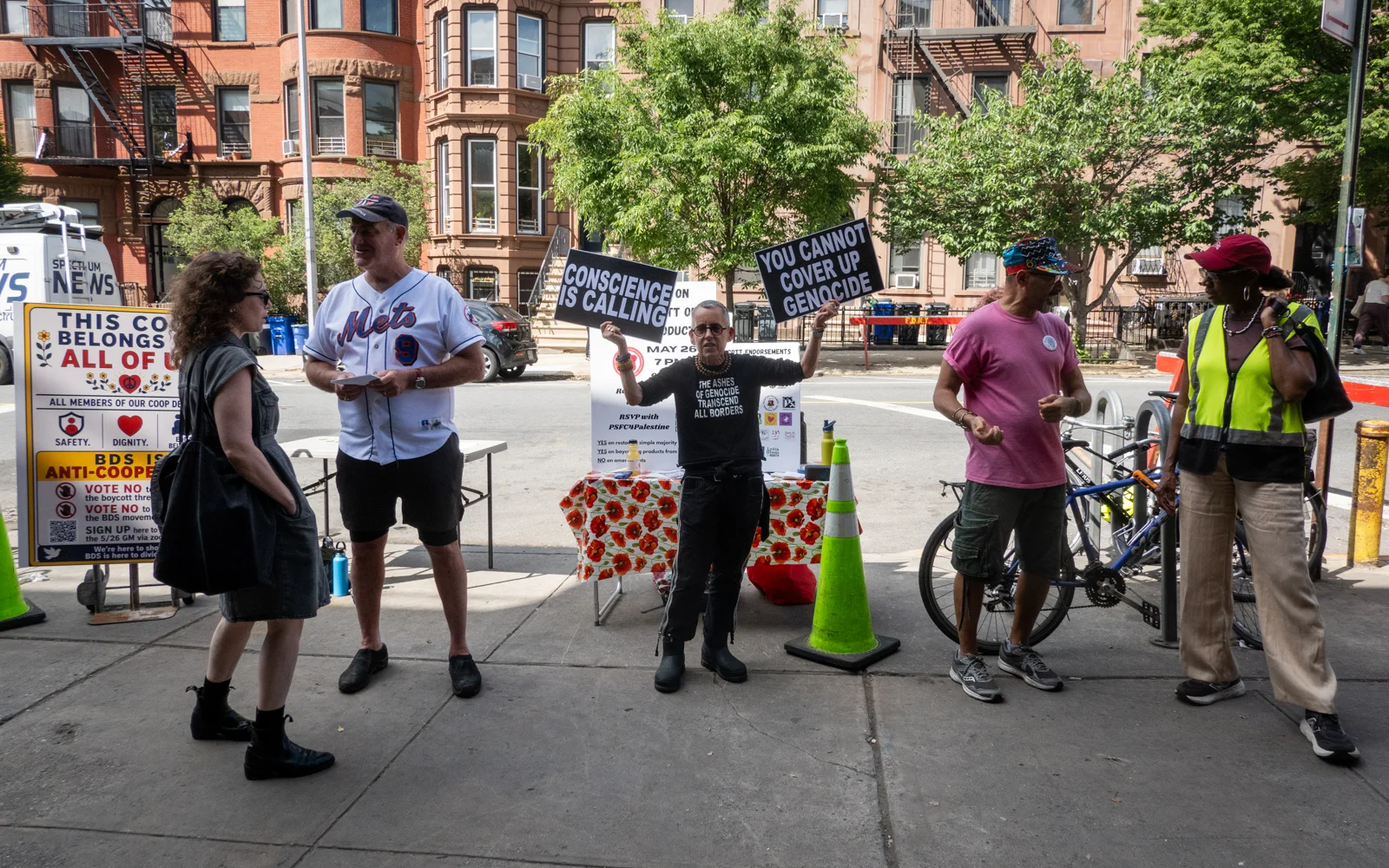
Campaigners for and against a BDS referendum at the Park Slope Food Coop in Brooklyn, New York City, May 26, 2026. (Luke Tress/Times of Israel)
“They could not have found a person or a founder of a brand who is more upset about it, mainly because I really love what they’re doing and I support their mission wholeheartedly,” she said in an interview, referring to the co-op collectively working to provide affordable food to families.
Seed + Mill sells sesame-based products, such as tahini and halva. The tahini is produced by a Muslim father-son team in northern Israel. The operation employs a mixed workforce including Muslims, Jews and Druze, Simons said. She added that the business decisions were not ideological, but that Israel makes high-quality tahini, so she found partners there whom she likes and trusts.
“This is just the reality of working in Israel, where Arabs, Israelis, Jews, Muslims, Druze, Christians — they work together. It’s really more of a fact of life as opposed to anybody making some sort of conscious decision to build a diverse workforce,” she said.
Seed + Mill has not received any communication from the co-op. The company’s products were sold at the store through a third-party distributor, and Simons assumed that the co-op would just not file any more orders.
The co-op sales were “meaningful revenue” for the company, but the bigger hit was to morale, she said, adding that she wished the co-op’s leadership “had asked if I would like to talk to the members.”
“As a brand, we’re humans. We’re not just robots selling things,” she said, adding that most of the team is not Jewish. “They’re just really sad and baffled that this is what’s happened to our brand.”
The company has received abusive messages for years that have escalated recently, Simons said.
“At least give us the chance to discuss it and to humanize this conflict and to come over to our store and have an ice cream and actually hear about the people who make the products,” she said.
Soom tahini, another company targeted in the boycott, said in 2022 that its tahini was produced in a factory owned by an Israeli Arab.
The boycott also applied to Osem, a major snack producer in Israel that has participated in programs to increase Arab participation in the workforce and to boost Arab-Jewish coexistence.
The UJA-Federation of New York, one of the leading Jewish communal groups in New York City, said on Thursday that it would buy 20,000 bags of Osem’s Bamba snacks in response to the boycott.
The Bamba will be distributed at Sunday’s Israel parade in Manhattan, the federation said.
You’re a dedicated reader

That’s why we started the Times of Israel – to provide discerning readers like you with must-read coverage of Israel and the Jewish world.
So now we have a request. Unlike other news outlets, we haven’t put up a paywall. But as the journalism we do is costly, we invite readers for whom The Times of Israel has become important to help support our work by joining The Times of Israel Community.
For as little as $6 a month you can help support our quality journalism while enjoying The Times of Israel AD-FREE, as well as accessing exclusive content available only to Times of Israel Community members.
Thank you,
David Horovitz, Founding Editor of The Times of Israel