
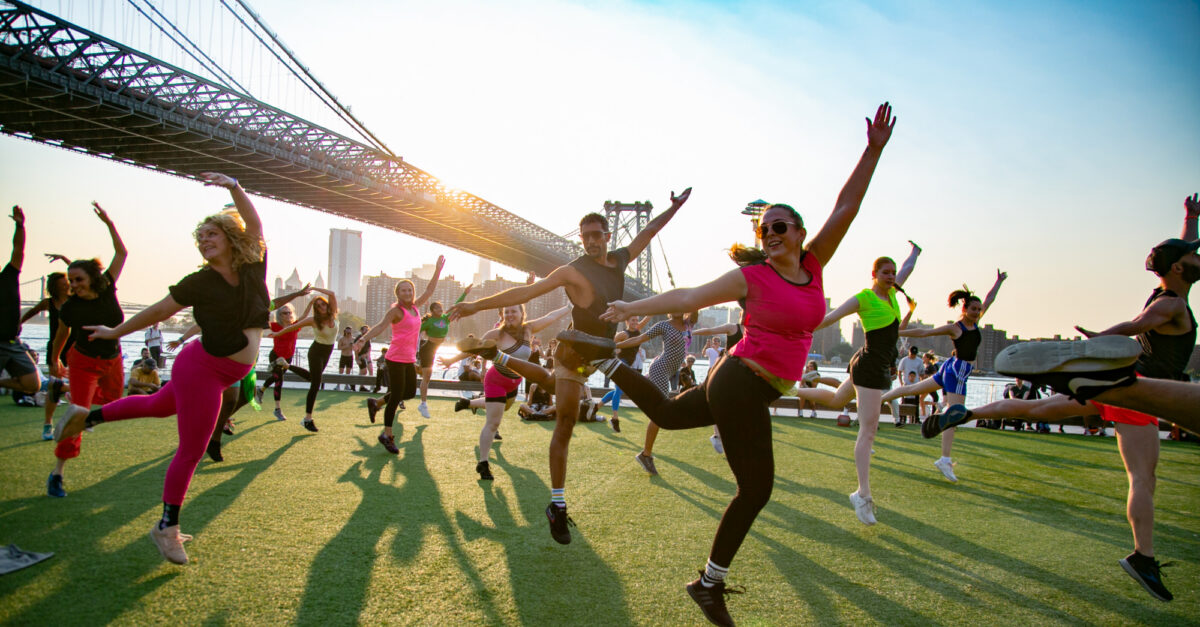
Now in its fifth year, Summer for the City has quickly become one of the premier events in New York for local audiences and tourists, with hundreds of events both indoors and outside, all at various spaces on Lincoln Center’s 16-acre campus and either Choose-What-You-Pay or free.
The latest edition (June 10 to August 8) presents a summer season that’s centered on movement, community, and international artistry. In fact, dance itself, comprising an array of traditions and forms, takes pride of place thanks to the Pasculano Collaborative for Contemporary Dance, an ambitious initiative launched last year to help expand contemporary dance across the Lincoln Center campus. Donald Borror, who in December was appointed the Director of the Pasculano Collaborative for Contemporary Dance, explains its importance to the campus and Summer for the City.
“There was already a very strong commitment to contemporary dance at Lincoln Center,” he says. “What makes this initiative really sing is that there will be a more visible, holistic, and expansive feel of dance on campus than there was before.”
That visibility begins on Summer for the City’s opening night with a triple-header of dance events: Inayat: A Duet for Four, which will merge two ancient north Indian performance traditions on Hearst Plaza; Caleb Teicher & Company and Eyal Vilner Big Band, who will headline a swing dance party on the Dance Floor on Josie Robertson Plaza; and KEIGWIN+ COMPANY’s Rhapsody, the latest in its site-specific community dance works that will feature 30 professional and amateur dancers, all of whom are New Yorkers, also on the Dance Floor. “Rhapsody is a beautiful kick-off to this summer of dance,” Borror says. “The idea for Rhapsody has been replicated in different public spaces, but each iteration is new, created specifically for the community and place where it’s being performed.”
One of the touchstones of Summer for the City’s commitment to dance is the first Lincoln Center Contemporary Dance Festival. This twice-yearly festival (it will return in January) will transform Alice Tully Hall into a home for contemporary dance in New YorkCity. “We will present cutting-edge companies and new voices on campus to share a snapshot that shows where contemporary dance is today,” Borror explains. “We’re putting some elbow grease into Alice Tully Hall to make it accessible for dance. During the festival, it will be transformed into a world-class dance venue.”
Over three weeks in June, the Lincoln Center Contemporary Dance Festival will host five international companies and choreographers alongside a trio of U.S.premieres at Alice Tully Hall, including Yinka Esi Graves’ The Disappearing Act (June 20 and 21), which artfully illuminates flamenco’s African roots. “It’s a progressive take on the typical flamenco structure as well as the one piece that features live music—it’s a really interesting work,” Borror notes.
Also new is Dance Encounters, an outdoor series presented on Hearst Plaza that spotlights New York-based companies. “This is also a really exciting program,” Borror says. “This series has more site-specific and site-responsive works in intimate and organic settings. You can come and be swept away by whatever you encounter—which is how the series got its name.”
One of the Dance Encounters commissions—a new work by Vangeline, whose company, New York Butoh Institute, reflects its founder’s Japanese influences—is stirring particular excitement, Borror says. “Vangeline’s new work will be for the Paul Milstein reflecting pool (which houses the famous Henry Moore sculpture, Reclining Figure), and she’ll be wearing a costume by designer Machine Dazzle. This work exemplifies how we’re looking to use the plaza by seeing its architecture through a new lens of artistic expression.”
Summer for the City will also feature the return of the programming that makes it the must-attend event at Lincoln Center, including the exciting Festival Orchestra of Lincoln Center under the baton of Renée and Robert Belfer Music and Artistic Director Jonathon Heyward (David Geffen Hall, July 8 to August 8), which features several commissions and a world premiere. And, on the heels of Brazil Week and India Week from previous summers, there’s Chinese Arts Week, which is highlighted by a North American premiere (July 22 to 29). Borror points out that “the big headline is that dance is center stage at Lincoln Center this summer, and we’re excited to see it across all programs. The entire Summer for the City festival has a strong international focus, which is really exciting for us to have all of these things mixed together. We’re dancing across borders.”