
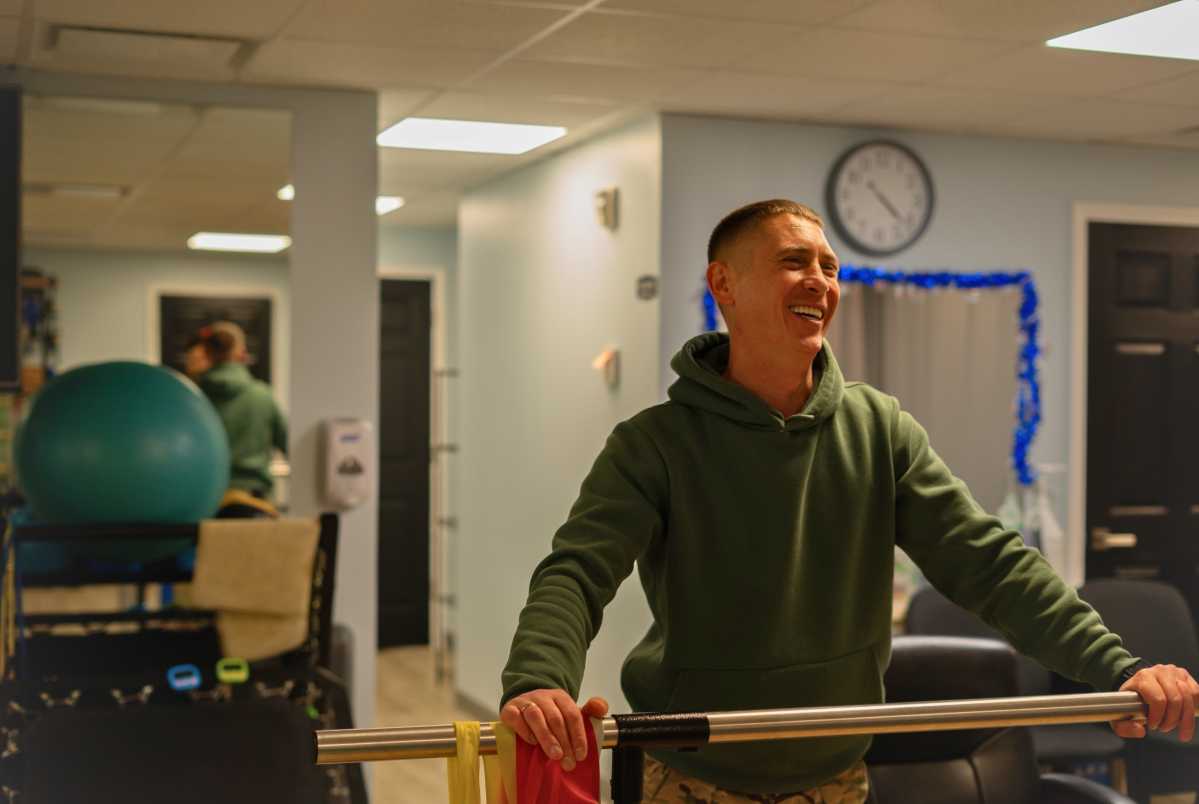
Since the full-scale invasion in Ukraine, a Staten Island-based Ukrainian nonprofit has brought over 50 wounded soldiers to the United States to help them through their rehabilitation.
Kind Deeds originally began with President Oleksandr Rubstov helping Ukrainians cross the border into Poland. However, after witnessing many refugees with missing limbs, Rubstov decided to partner with Dmitry Shevchenko, Clinical Director of ProKinetics Physical Therapy, to create a non-profit with a mission to help wounded soldiers.
“We brought our first soldier in October 2022, and now we’ve had already over 54 patients treated throughout our organization here in New York,” Schevchenko said.
Kind Deeds offers its services completely free to patients, including prosthetics, physical therapy, housing, and food, which are paid for through donations.
However, donations have not been enough to sustain the influx of soldiers in need of treatment.
“We had, you know, 12 soldiers at a time in 2023. Now we have only one, and one joining in December. We had two family houses… Now, we only have half of that house,” Schevchenko told amNewYork in December.
 Many soldiers receive prosthetics before arriving, but they are typically mechanical, whereas Kind Deeds uses bionic-powered prosthetics.Photo by Emma Delahanty
Konstantin Smagliy, 34, originally from Donetsk, Ukraine, had his leg amputated due to the trauma he endured in a night of battle.
After being in the city of Donetsk, he was called to support another unit during a Russian attack, where he ended up under Russian fire.
“I was lying with night vision equipment, and part of my leg was blown off,” he said. “When I opened my eyes, I realized I was alone, 300 (injured), and Russians were close by.”
Smagliy’s leg was dislocated after the attack.
“I laid there and thought that was it. I put the tourniquet on in time,” he said. “I waited for an hour and a half and then our guys picked me up.”
After receiving treatment from doctors in Ukraine and Poland, Smagliy was told he would have to have his leg amputated. But his knee joint was not recovering well. And after months of treatment, he heard of the NYC-based center.
Not long after his wounds began to heal, he came to NY for a prosthetic.
Schevchenko said, “You shouldn’t make a prosthetic within the first three months; you have to make sure the limb shapes properly, everything heals.”
During patients’ stay in NYC, they rotate between Staten Island University Hospital and ProKinetics Physical Therapy in Bensonhurst.
On Smagily’s second visit to the Bensonhurst location, his session focused on cupping therapy, treadmill exercises, lunges, and squats.
Re-adjusting to walking on a prosthetic, Smagily had to walk forward, sideways, and backward for five minutes. But he had difficulty with lunges and squats because of his loose prosthetic, which Kind Deeds was in the process of fixing.
Vladislav Kuzmich, 25, from Kyiv, spent two months with Kind Deeds, receiving treatment after his leg was amputated in 2024.
Kuzmich lived on the front lines for a month in the Donetsk region when his accident occurred.
“We were waiting for a command to relocate to another position, on the edge of the village, where Russians wanted to enter the village,” he said. “And in the garden, in the grass, I didn’t see the butterfly mine and stepped on it.”
Kuzmich hid in a bush after successfully wrapping his leg around the tourniquet, waiting for help.
“I could hear gunshots from Russians, 50 meters from us, and our people fighting back and fighting back,” he said. “I waited seven hours. On the seventh hour, they found me, it started raining. They drove me immediately, took me to Dnipro, and I woke up without a leg.”
After receiving help from Superhumans, a Ukrainian trauma center specializing in prosthetics, he submitted an application to Kind Deeds and arrived in the fall of 2025.
Not long after receiving a new prosthetic leg and going through consistent physical therapy, Kuzmich returned to Ukraine to readjust to life with his wife and eight-year-old son.
“We have to adapt to our new life as a family,” he said.
Many soldiers receive prosthetics before arriving, but they are typically mechanical, whereas Kind Deeds uses bionic-powered prosthetics.
The difference, Schevchenko explained, is like having a mechanical car or an automatic; it’s “a lot easier for them to walk using that type of prosthetic.”
While physical therapy is a core process during Kind Deeds rehabilitation, mental health treatments are not strongly suggested; many of the soldiers do not take up the offer.
“The problem with Ukrainian culture versus Western culture is very different. Talking, you know, discussing your emotions, your feelings, it’s taboo topic, especially among men,” Schevchenko said. “But the more time you spend with them, the more you see them, those signs and symptoms, they show differently.”
A 2025 Wiley study found that out of 590 active duty military personnel, 45.9% were diagnosed with post-traumatic stress disorder.
Schevchenko said he has been told by several veterans, “‘What can she (psychologist) possibly tell me, she’s never been in my shoes, right?’ That’s why talking to someone who’s been in their shoes, experienced something similar and how they overcame similar issues is very therapeutic.”
With many failed fundraisers and a lack of donations, Kind Deeds struggles to maintain its original influx of patients.
Neither Schevchenko nor Rubstov gets paid for the work they do, but paying their volunteers is very important to them so they can build a strong team.
“I think organizing and structuring it properly and having these places for soldiers to get treatment is our biggest barrier right now,” Schevchenko said.