
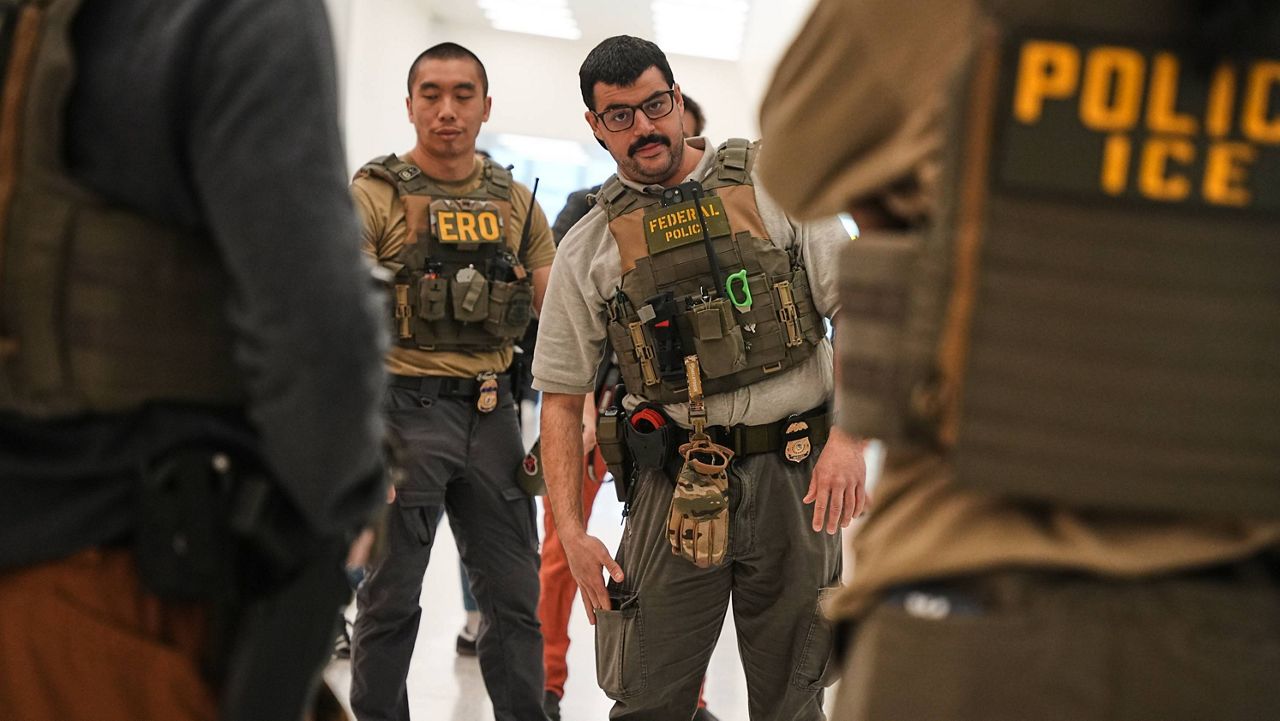
Gov. Kathy Hochul on Friday signed several immigration protection measures into law as part of the state budget, aimed at curbing the powers of U.S. Immigration and Customs Enforcement (ICE).
The legislation prohibits local jails from holding individuals on behalf of ICE and bans formal agreements between local governments and ICE, known as 287(g) agreements.
The measures also prohibit ICE agents from wearing masks and protects sensitive locations — including hospitals, childcare centers, schools, polling places and churches — from ICE enforcement activity without a judicial warrant.
“Police officers are taken off their jobs to do civil ICE enforcement, civil immigration enforcement,” the governor said. “Not fighting crimes, not protecting the city, but to do ICE’s job for them. That’s what we’re ending as well.”
The package represents one of the primary actions taken by Hochul and the Democratic-led state Legislature to push back against the Trump administration, as promised by state lawmakers in the aftermath of the 2024 election.
But Pace University Law professor Bennett Gershman says the law may not hold up in court.
“Now you have tension,” Gershman said. “You have the conflict between the federal government, ICE and state government.”
He said that states cannot create laws that would interfere with how federal agencies like ICE operate because federal law pre-empts state law. If federal officials sued New York, Gershman says he would have a hard time seeing the state win.
“The federal government runs the show. States don’t run federal operations and if federal operations want to target immigrants and abuse the rights of immigrants and deport immigrants on and on and on, states have no say in that really.”
The state Legislature passed the legislation last week and defended the package as an important step, framing the move as an effort to stop local resources from being utilized for an immigration enforcement operation they characterized as chaotic and dangerous, and not focused on its stated goal of removing dangerous criminals who are in the country illegally and conducting routine enforcement.
While a longstanding effort among progressives, the current legislative momentum reached a fever pitch in the wake of the deaths of Alex Pretti and Renee Good in Minneapolis earlier this year.
Hochul said local law enforcement officers would still be able to help federal officers with situations that put New Yorkers in harm’s way.
Xaver Kandler, political director for grassroots group For The Many, said he’s glad to see that after a lot of advocacy, these laws got passed. However, he says New York state needs to ban informal collaboration between federal and local law enforcement as well.
“You see things like traffic stops where a local police officer might pull someone over for a routine traffic stop hold, then call ICE and then wait for ice to come and pick them up and deport them,” Kandler said.
But the New York State Sheriffs Association says not allowing local departments to share information on non-criminal matters will rollback a 25-year effort to break down agency “silos” and build trust between all levels of law enforcement.
In a statement, the association said, in part:
“Where required for the safety of the public, we will continue to cooperate with our fellow law enforcement officers at every level, in every way, that we legally can.”
A spokesperson for DHS referred to Hochul as a “sanctuary politician,” and said, in part, that this law would make New York less safe.
“New York is not a sanctuary for criminals and we will cooperate when crimes are being committed, going after dangerous criminals, not the act of crossing the border, but dangerous criminals,” Hochul said Friday. “We’ll help them there, but we are not going to be partners with them in carrying out unlawful actions that literally just deprive our neighbors of their rights.”
The governor said she hopes the package is a model for other states.