
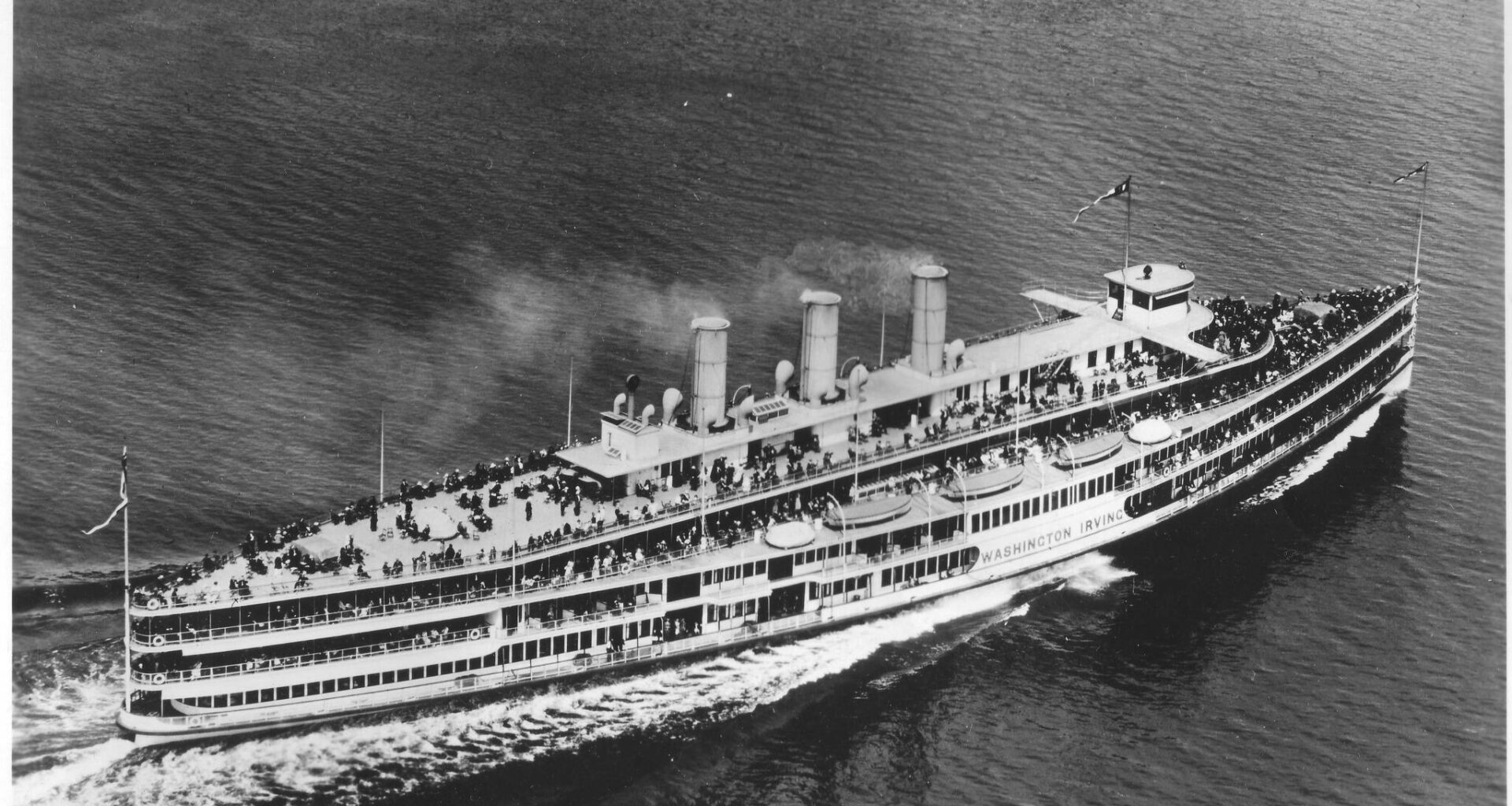
On May 13, 1926, the million-dollar steamer Washington Irving took more than 1,000 passengers up and down the Hudson River to celebrate the 100-year anniversary of the Hudson River Day Line company.

The transit company’s flagship passenger liner — named for the 19th-century author of “The Legend of Sleepy Hollow” — was in its 13th year of service and outfitted with the latest luxuries and Hudson River-themed art.
Less than a month later, the Washington Irving arrived at its final destination, the bottom of the Hudson River 100 feet from the Jersey shoreline.
Article continues below this ad
This is how the disaster occurred, according to newspaper reports.
An undated photo of the Washington Irving passenger steamship docked at Kingston Point Park. The boat sank in the Hudson River after it was rammed on June 1, 1926.
Provided by Hudson River Maritime Museum
Rammed, sunk
There was a dense fog the morning of June 1, 1926 that the Times Union described as an “almost impenetrable haze” as the Washington Irving left the Desbrosses Street pier in New York City at 9 a.m. on a routine trip to Albany with about 200 passengers and a crew of 105 aboard.
Article continues below this ad
Make the Times Union a Preferred Source on Google to see more of our journalism when you search.
Add Preferred Source
Within minutes of its departure, the steel sidewheeler was rammed on its port side by a mysterious oil tanker that sailed off into the fog before it was identified. Water immediately began rushing into the vessel through a large hole.
A drawing showing the collision between the Washington Irving passenger steamer and the oil tanker being towed by the tugboat Thomas E. Moran.
Times Union archive
Frantic rescue
Immediately after the collision, the passenger liner’s crew sprang into action, led by an Albany resident, Captain David H. Deming. A Troy native and veteran Hudson River Day Line captain, Deming was credited with leading the rescue effort as passengers began to panic.
Article continues below this ad
“Many passengers were prevented from leaping overboard by the coolness of the captain,” Mrs. Addie Sarent was quoted as saying.
The Times Union described crew members distributing life preservers and launching lifeboats as the boat’s whistle sounded the distress signal.
While the crew acted professionally, some passengers said the old sea law of “women and children first” was ignored by some men who fought with women for life preservers.
Just like the Titanic, which sank more than 14 years earlier, the Irving’s onboard orchestra played as the boat was sinking, drowning out some of the screaming from panicked passengers. Unlike the Titanic, the band did not go down with the ship.
Article continues below this ad
Nearby ships and tugboats heard the Irving’s distress calls and rushed to take passengers and crew aboard as the vessel moved slowly toward the shoreline.
It was reported that Deming was the last person to leave the ship before it sank in 30 feet of water, 100 feet from the Jersey shore. The shallow depth meant its top deck was still above water as it rested on the riverbed.
The Irving’s final resting spot was directly above the Holland Tunnel that was being built underneath the river from New York to New Jersey. Officials said the wreck did not jeopardize construction of the tunnel.
The cover of the Times Union announcing the sinking of the Washington Irving on June 1, 1926.
Times Union archive
Aftermath
Initial reports said there were no casualties and few injuries from the disaster. That turned out to be incorrect: Three missing people among the estimated 305 people on board the ship were killed. There was no explanation for what happened to Mrs. Arthur Lynn Hoag and her 3-year-old daughter Mary, or mess boy B.M. Woods, who worked below deck. The United States Steamship Inspection Board’s investigation into the incident, reported 10 days later in the New York Times, said the crew checked the entire vessel before exiting themselves.
Article continues below this ad
The probe did discover the identity of the boat that rammed the Irving, the tugboat Thomas E. Moran, which was hauling two oil barges. Longtime Hudson River boater Captain William O. Benson analyzed the crash like this for the Hudson River Maritime Museum and Daily Freeman:
“Because of the ebb tide, the tugboat was in close to the ends of the piers to escape the full brunt of the tide, effectively hiding her from view while the Irving was still at her pier.
“On leaving the slip, the paths, of the Washington Irving and the Thomas E. Moran with her two oil barges rapidly converged. If it were not for the strong ebb tide, probably all would have been well. The Irving — just getting up to speed — was caught broadside by the tide and was borne down towards the tow. Captain Deming threw his wheel hard over in an effort to throw the Irving’s stern away from the oil barges. The maneuver, however, failed and the corner of the starboard oil barge cut a hole in the hull of the Washington Irving’s after boiler room. The Irving moving ahead caused a gash about 20 feet long which also ripped through a water tight bulkhead into the steamer’s galley. It was a mortal blow.”
Article continues below this ad
Hudson River Day Line decided not to raise the Irving because the cost would be greater than the ship was worth. However, the location of the wreck was a huge inconvenience for other boats navigating the river. The Irving was finally raised in February 1927 after the federal government put a contract out and it was eventually scrapped.
Captain Deming died about a year and a half after the Washington Irving disaster following a brief illness at age 70. His Times Union obituary described him an experienced riverman and kindly man … “who had but one accident.”