
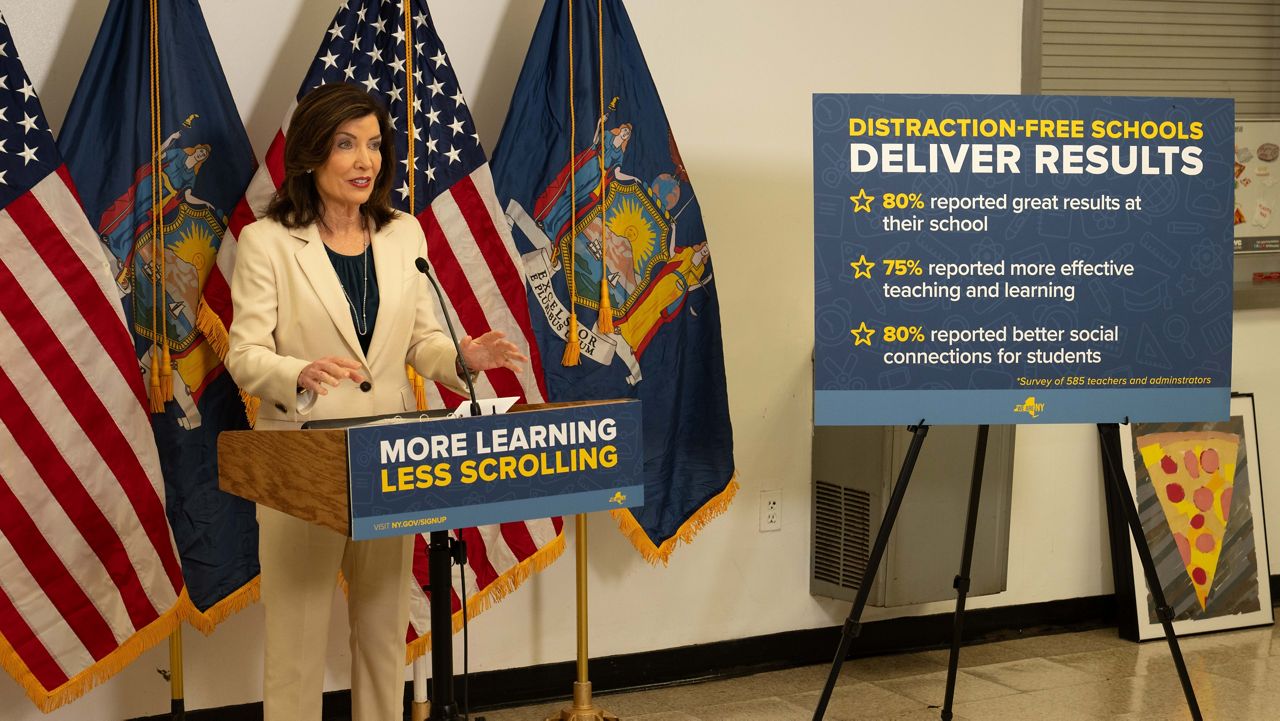
Gov. Kathy Hochul says her office surveyed 600 educators across the state about how the first year of the bell to bell smartphone ban has gone.
“Eighty percent reported that the students are behaving better, in a more engaged way. They’re collaborating more. They’re talking to each other. Basically, I read all the comments. They’re acting like kids again,” she said.
What You Need To Know
The first school year with a statewide ban on cellphones in schools is coming to an end
Gov. Kathy Hochul, who spearheaded the ban, says a survey shows the ban has been a success
There’s not yet data on how it has affected students’ academic performance
Hochul spoke with students and teachers at the Philippa Schuyler School for the Gifted and Talented, a middle school in Bushwick.
“When students are bored, without the phone ban they would have taken out their [phones]. But now class is like the only thing that will give them that attention,” one student said.
“So you had no choice — you had to actually learn,” Hochul replied.
While educators reported reductions in bullying and an increase in students engaging in class, Hochul acknowledged there’s not yet data on any academic impact of the ban.
“I think logic would tell us that that is a result we expect to see at some point,” she said. “I don’t know that it follows at the end of the very first year, but it is data that I’ve asked for.”
After a year without smartphones in schools, some parents and educators are starting to wonder about the use of other screens during the school day, things like iPads, and of course, the rise of artificial intelligence technology in schools.
The governor says those are issues she wants to examine.
“Some of the early schools are saying not for younger ones, keep the kids off the screens overall. And so I think, that’s, my gut tells me that’s the way to go,” Hochul said. “But I also don’t want to interfere with a way to educate our students that teachers may be wanting to do.”
The city, meanwhile, just finished receiving public comments from parents and educators about its own proposed AI policies.
“I want to make sure that as we talk about AI, that in a school setting that students are not being subjected to the negativity that we’ve identified. There’s a lot of positive aspects [to] it, but there’s negativity. But I want to work like I did last time. I spent a year going around the state gathering information and assessing it, analyzing it, and coming up with a really solid policy,” she said.