
Josef Albers commenced his “Homage to the Square” paintings in 1950 and continued his series for the final twenty-six years of his life. They were composed using a simple template, which, once identified, he never modified.
Personal art practices that are sustained over long durations have been a staple of modern and contemporary art ever since. The phenomenon, however, is hard to pin down. The subject can quickly skate into a discussion about creative lives and what maintains them.
I’m less interested in the art of living. But I am fascinated by a line of artists who have produced bodies of work that endure for long enough to have shaped portions of their lives. These individuals go on with their art, and they go on with life; the art becomes a mode of life.
Ways of living become audible through work patterns: they have their measure and their tonality. They can be all-encompassing, as in Linda Mary Montano’s Fourteen Years of Living Art (1984–98), for which she immersed herself in disciplined rituals, informed by her admiration for Asian religious practices. Or they can be specific: for over twenty years, Kathrin Hilten has spent each summer creating abstract line drawings inspired by a view from her studio in Maine. Her work is an exercise in prolonged attentiveness, revealing subtle evolutionary shifts in formal priority from one season to the next.
If durational practices are like songs, then the refrain is often about living. The philosopher Jean-Luc Nancy once wrote an essay on his friend, the painter François Martin, who, in 1987, chose to make one work a day, six days a week, for a year. The motto was “a painting a day, no matter what.” Nancy observed that in Martin’s painting sequence, there’s no progression: the artist has a daily rendezvous with the blank surface and then waits for an image to show up. The content is always different and always the same, always miraculous and always prosaic, just as one day follows the next. Martin’s capering subject matter sings of life as an unsynthesized, orderless experience—a cacophony.
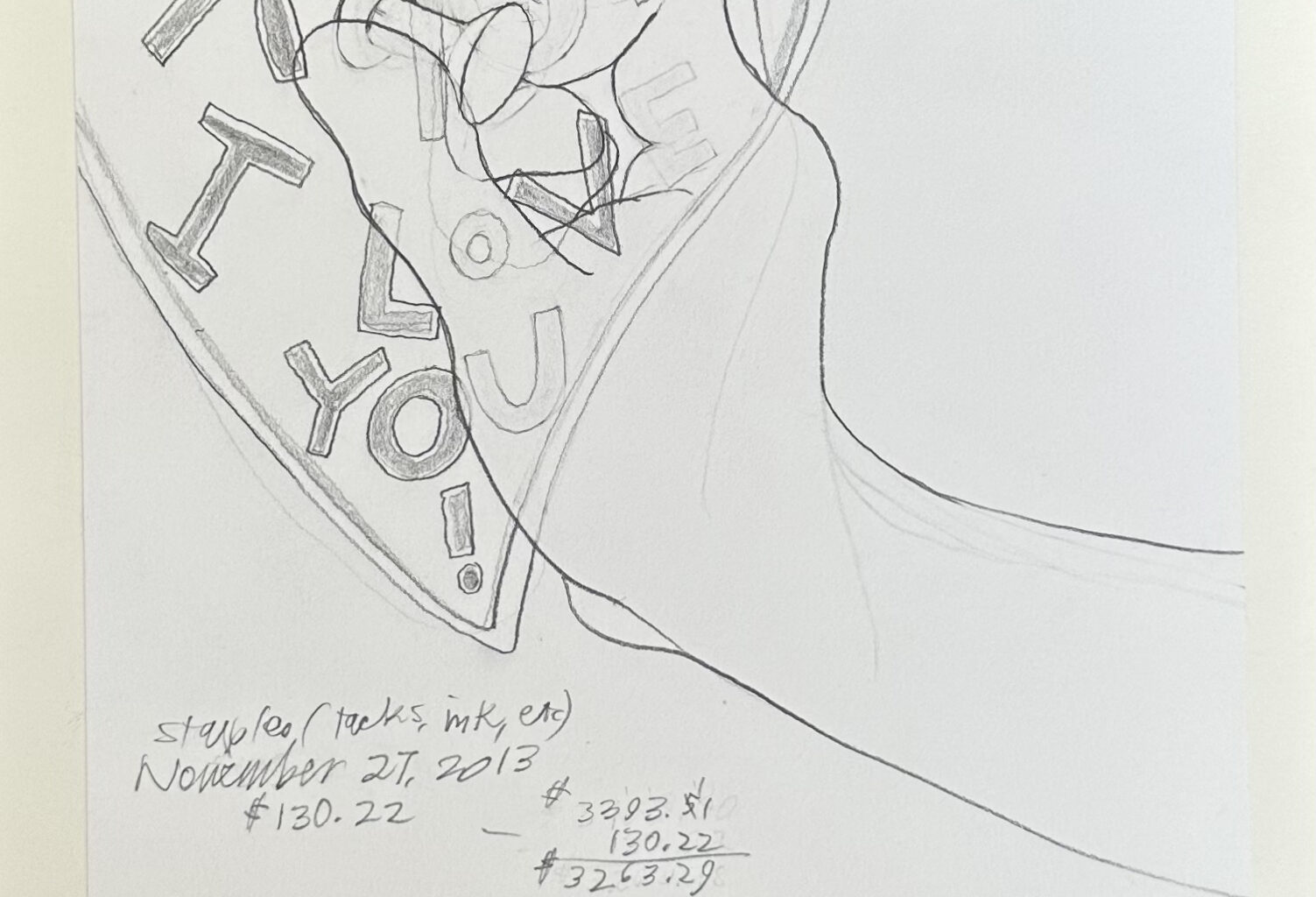
Living, of course, is also social, and it would be mistaken to infer that sustained art practices are solipsistic. Since 1995, Danica Phelps has developed an elaborate accounting system for tracing the flow of money through her life. She makes drawings to track everything she spends. The sinuous, economic line of her pencil often registers the profiles of friends and people she’s encountered, mostly busy in some everyday activity. Their contours overlap with those of other individuals, or with the things they happen to be with. These drawings are then appended with charts, timelines, and diary captions chronicling the passage of every dollar through her hands. When an image sells, she makes a tracing of it and records information about the sale; the result may be sold in turn. What the body of work reveals, though, is a repudiation of normative societal expectations regarding personal finances. Phelps’s economic system is less invested in the conventional indices of wealth than in disclosing the rich sociability of everyday connections that accompany transactions.