
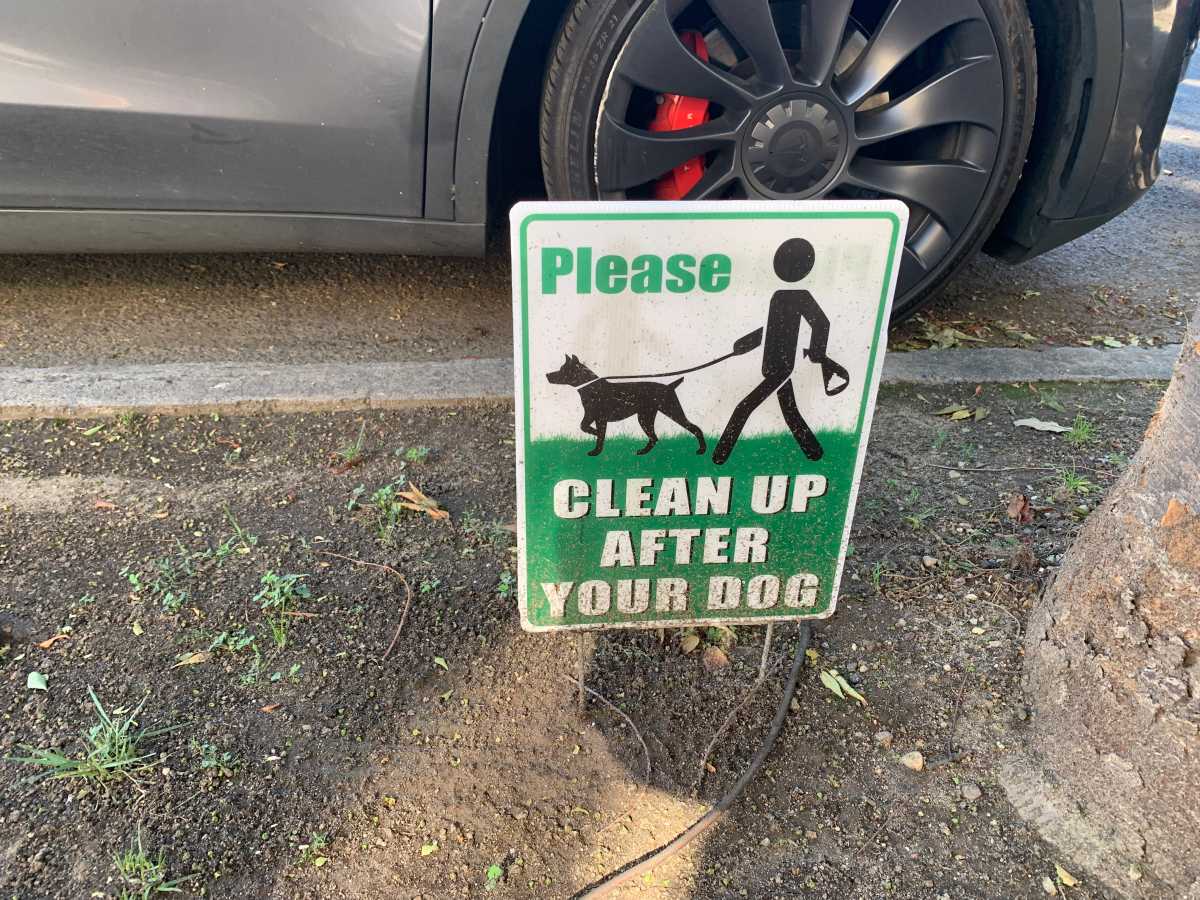
Manhattanites are not scooping up their dog poop in record numbers, according to a new pup poop report card issued by the borough president’s office on Tuesday.
Following the worst winter in NYC this year for dog waste complaints in six years, Manhattan 311 reports have hit record highs, the report from Borough President Brad Hoylman-Sigal, his staff, and Beta NYC found.
Dog waste complaints have been making up a growing share of Manhattan’s 311 reports since mid-2022. In February this year, they jumped well above that already increasing trend, the report notes. In fact, it was the highest month for dog waste complaints in six years of data.
A single day in February 2026 set an all-time record for dog waste complaints in a 24-hour period, the report noted.
Digging deeper into the poop scoop, which assigned a letter grade to each of Manhattan’s 12 community boards, there was a disproportionate number of 311 complaints between Upper and Lower Manhattan. Community Board 12, which includes Inwood and Washington Heights, received the worst grade, a D (as in doody), with a dog waste complaint rate 17.3 times higher than the best-performing neighborhoods.
An often-discussed solution to this historically crappy problem has been to provide more bag dispensers and public litter baskets throughout the city. For example, Upper Manhattan, which includes Community Board 12, has zero bag dispensers and an “inadequate” number of litter baskets, the report uncovered.
“While, of course, dog owners must do more to pick up after their pets, our report shows other strategies that can be effective, too,” Hoylman-Sigal said. “For example, there is a correlation between Upper Manhattan having the most dog waste 311 complaints and there being fewer trash bins and virtually no dog waste bag dispensers available for the community’s use.”
The Pooper Scooper Law
Through the Pooper Scooper Law, dog owners and dog walkers are responsible for cleaning up dog waste in all public areas. But, it is a law that is difficult to enforce, according to reps at the NYC Department of Sanitation (DSNY).
“While our enforcement officers and agents are always on the lookout for inconsiderate dog owners who do not clean up, the reality is that dog owners do pick up after their dogs when they are being watched,” said Vincent Gragnani, a spokesperson for DSNY. “In order to issue a summons, DSNY needs to catch people in the act of failing to remove canine waste.”
The agency has even conducted targeted enforcement in the past, including inside Community Board 12, but it yielded no summonses.
“We would also note that only about 30 streets citywide saw more than 10 complaints in a calendar year, suggesting that we do not see heavy amounts of repeat conditions,” Gragnani said.
Still, the report found that blocks with few or no public litter baskets have dog waste complaint rates nearly three times those of well-served blocks.
DSNY installed dog waste bag dispensers through a pilot program, but the agency lacks the resources to keep them stocked at all times, Gragnani said, adding that it would need support from community groups and City Council members to keep them full.
More legislation is in the works
The search for a solution to the ongoing quality-of-life problem has been ongoing. Just last month, City Council Members rallied at the Tompkins Square Park Dog Run in the East Village to promote the Safe and Clean Outdoor Ownership Practices (SCOOP) Act, a package of five bills targeting rising complaints about dog waste across the city.
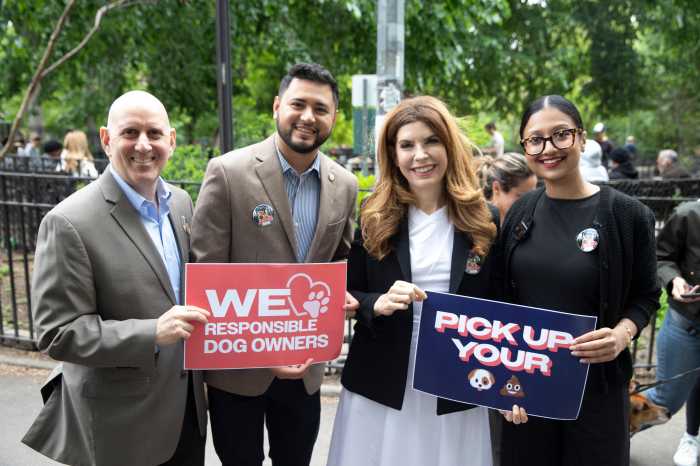 The sponsors of the City Council SCOOP Act: Council Members Harvey Epstein and Justin Sanchez, City Council Speaker Julie Menin, and Council Member Shahana Hanif.John McCarten/NYC Council Media Unit
Though more legislation is a possible solution, many officials said the first responsibility is on dog owners and dog walkers to consider being…considerate.
“Dog owners know their responsibilities under the law — it is just common courtesy,” Gragnani said. “They only leave piles behind when they know no one is watching, so it makes it very difficult for us to enforce.”
In the meantime, Hoylman-Sigal said he is looking forward to working with DSNY and the City Council to fix the puppy poo problem.
“I’m eager to tackle this problem with DSNY and the City Council, both of which have prioritized the collection of dog waste to keep our streets and sidewalks clean,” he said.