
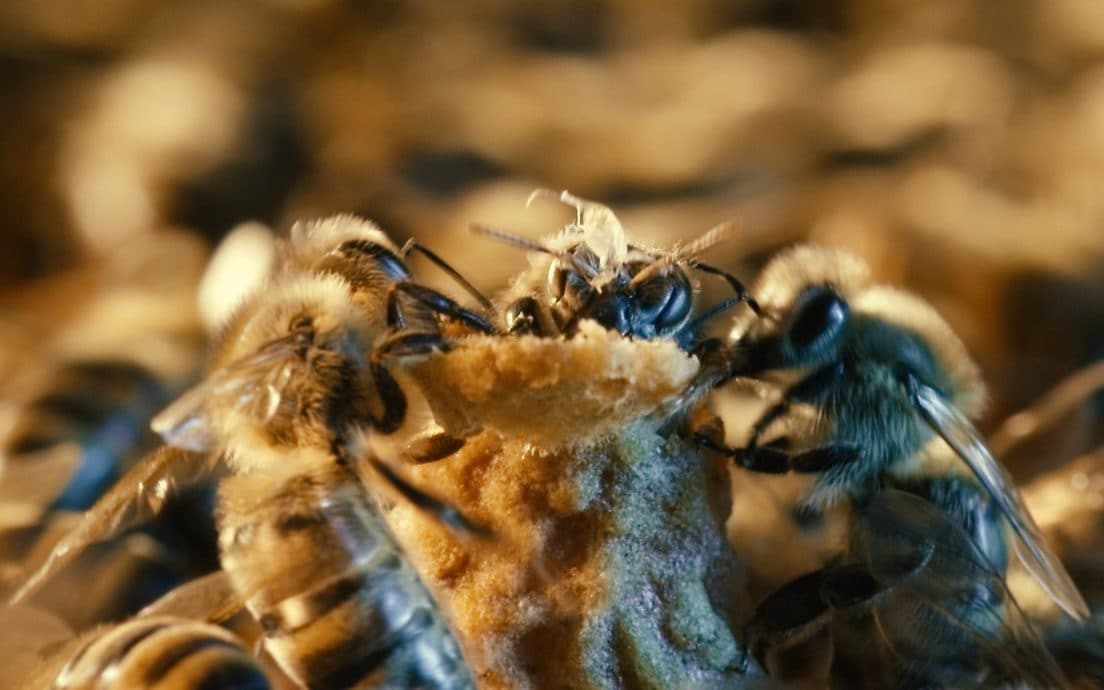
Royal cribs and ladies-in-waiting may seem the exclusive preserve of the monarchy. But scientists have found that queen honeybees also have special attendants who construct heated nurseries to keep them warm, safe and nourished as they grow.
It was previously thought queens only differed from regular honeybees because they were fed royal jelly – an ultra-rich secretion packed with proteins, amino acids, fats and vitamins.
Now scientists have uncovered a new kind of honeybee, called a “queen cell builder”, whose job it is to pamper the growing queen and build royal chambers with custom wax.
“You can think of it as something like Buckingham Palace,” said Prof Boris Baer, entomologist and director of the Centre for Integrative Bee Research at the University of California.
“There is a dedicated group of bees focused entirely on raising the queen, and if they don’t get it right, the colony cannot reproduce.”
Prof Baer said the process of raising a queen was “much more sophisticated” than anyone had imagined.
He added: “The old idea was relatively simple: take an egg, move it into a queen cell, feed it royal jelly and you get a queen.
“What we found is that there’s an entire machinery behind this process.”
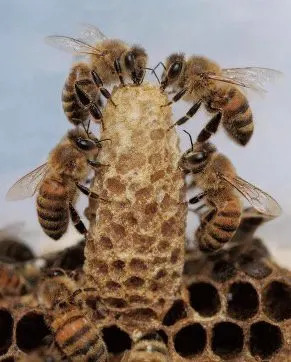
The ‘queen cell builder’ is responsible for constructing a warm and moist ‘royal crib’ – Markus Imhoof/More than Honey
When a hive needs a new queen, worker bees select an ordinary, newly hatched female larva that is around one to three days old and modify normal hexagonal cells into spacious, peanut-shaped structures which hang down from the comb.
Normal bees are fed on “bee bread”, a fermented mix of pollen and nectar, but queens get royal jelly, which contains proteins that activate the ovaries and extend lifespan.
Once mature, the queen becomes the colony’s sole egg-layer, responsible for producing the next generation of bees.
To find out more about how queens are raised, scientists at the University of California used thermal imaging, behavioural tracking, materials and chemical testing, and found that queen cells differ sharply from the hexagonal chambers used to rear worker bees.
The large queen cells are built using specialised wax that has distinct physical and chemical properties and produces chemical signals.
Scientists said it showed the cell is not a “passive container” but an “engineered bioactive micro-environment” that helps the queen to develop.
To test whether the nursery itself mattered, the researchers raised developing queens in cells made either from queen wax or ordinary worker wax.
Larvae raised in worker wax were more likely to die and grew into smaller queens, even when fed the same diet, suggesting that the surrounding environment plays a critical role in development.
The study also revealed the workers behind the specialised cells, queen cell builders, were typically younger than other hive workers and had a higher body temperature when tending future queens to keep their charges warm.
The extra warmth appears to speed development: queen bees mature in about 16 days, compared with roughly 21 days for worker bees, an advantage when a colony urgently needs a new ruler.
Scientists said that the process resembles something closer to a royal court than a simple insect nursery. It is clear that bees execute a tightly coordinated effort devoted to producing the colony’s next ruler.
“This work highlights how much sophistication exists inside insect societies,” added Prof Baer.
“Honeybee colonies are not simply collections of individuals. They function as integrated biological systems capable of engineering their own environments.”
The researchers found the same pattern in both Asian and European honeybee species, suggesting the strategy may be deeply rooted in honeybee evolution.
The findings were published in the journal Nature.