
 3 min read
Here’s what you’ll learn when you read this story:
Archaeologists made some surprising finds in seven-hundred-year-old graves at the Royal Monastery of St. Mary of Pedralbes in Spain.Archaeologists unearthed the remains of Queen Elisenda, the monastery’s founder, clad in monastic garments.Investigations revealed multiple remains scarred by stab wounds, leaving unanswered questions.
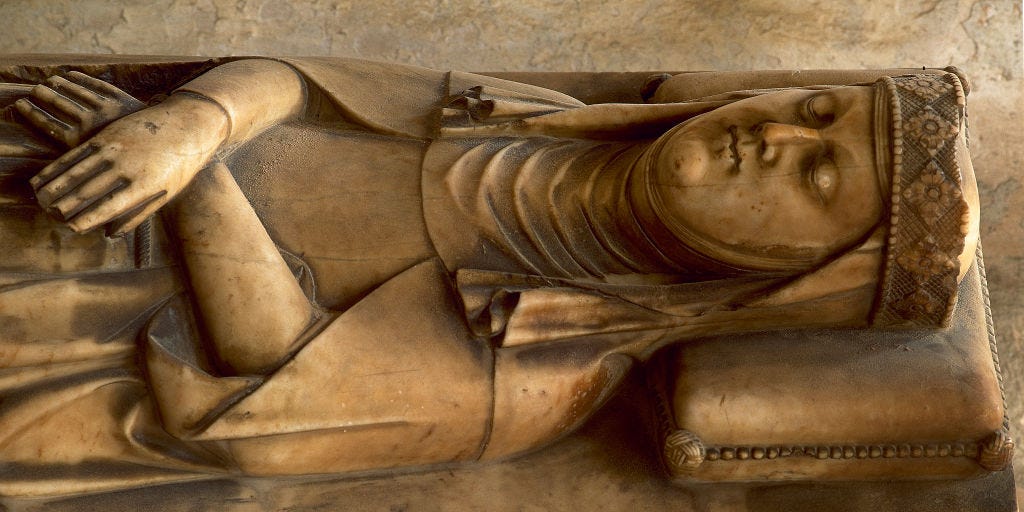
The Royal Monastery of St. Mary of Pedralbes in Barcelona, Spain, was founded in 1327 by Queen Elisenda de Montcada, the wife of King James II of Aragon and Valencia. After King James II’s death, Queen Elisenda moved to the Royal Palace in Barcelona, which she had built next to the monastery in 1328. When Queen Elisenda died in June of 1364 at around the age of seventy, she was laid to rest in the monastery she founded.
Recently, as part of the official preparations for the monastery’s seven-hundredth anniversary, a research team examined eight of the oldest tombs inside it from archeological, anthropological, and genetic perspectives for the first time, according to a translated statement from the Barcelona City Council. What the team found was far stranger than anyone expected.
The eight graves revealed 25 skeletons—far more than anticipated. Some of the discoveries came as a complete surprise, and officials are now promising further research to shed further light on the history of the monastery during the 1300s.
Using a combination of historical documentation and physical examination of funerary goods and practices, the team confirmed that the remains of Queen Elisenda were placed in a wooden medieval whip box. Archaeologists discovered her pushed into a corner of a large space sandwiched between the church and the cloister—possibly a symbolic location reflecting her dual roles as both queen and monastery founder. She was buried in a plain monastic habit, although the team found gold-embroidered silk within her coffin, along with rosemary and myrtle. Experts believe she suffered from osteoarthritis.
While the queen’s life is well chronicled in history, many of the other findings present more questions than answers, including remains covered with stab wounds. Sobirana Olzet, the monastery’s first abbess, was discovered with an injury to her face that could be a knife wound inflicted around the time of her death. The tomb that researchers originally thought belonged to the monastery’s second abbess, Francesca Saportella, actually contained the remains of nine people—including four males with stab wounds on their skulls. For the time being, the events that led to those knife wounds remain a medieval mystery.
One tomb, previously attributed to the famous knight Artau de Foces, actually contained the remains of two adult women (one with a ponytail still visible) and three infants. There was no evidence of the knight at all.
The finds revealed that older women of high social status were often buried at the monastery. There was also evidence of tomb reuse over time, as well as clues about the funerary practices inside the monastery. These included a range of textiles, the use of candles and cords, and aromatic and medicinal floral offerings common in the 14th century.
The research team aims to resolve key questions about the identity of the people who were buried at the monastery, the reuse of tombs, the funeral rituals, and the treatment of females in the 14th century. They plan to turn next to DNA evidence to establish genetic relationships among those in the monastery, and to more precisely understand who they were and where they came from—all in a quest to understand medieval Catalan society.
“The challenge for the next year,” according to the Culture Institute of Barcelona, “will be to transform these first findings into a complete historical interpretation that allows us to better understand not only who these people were, but also how they lived, how they died, and how they were remembered.”

Tim Newcomb is a journalist based in the Pacific Northwest. He covers stadiums, sneakers, gear, infrastructure, and more for a variety of publications, including Popular Mechanics. His favorite interviews have included sit-downs with Roger Federer in Switzerland, Kobe Bryant in Los Angeles, and Tinker Hatfield in Portland.