
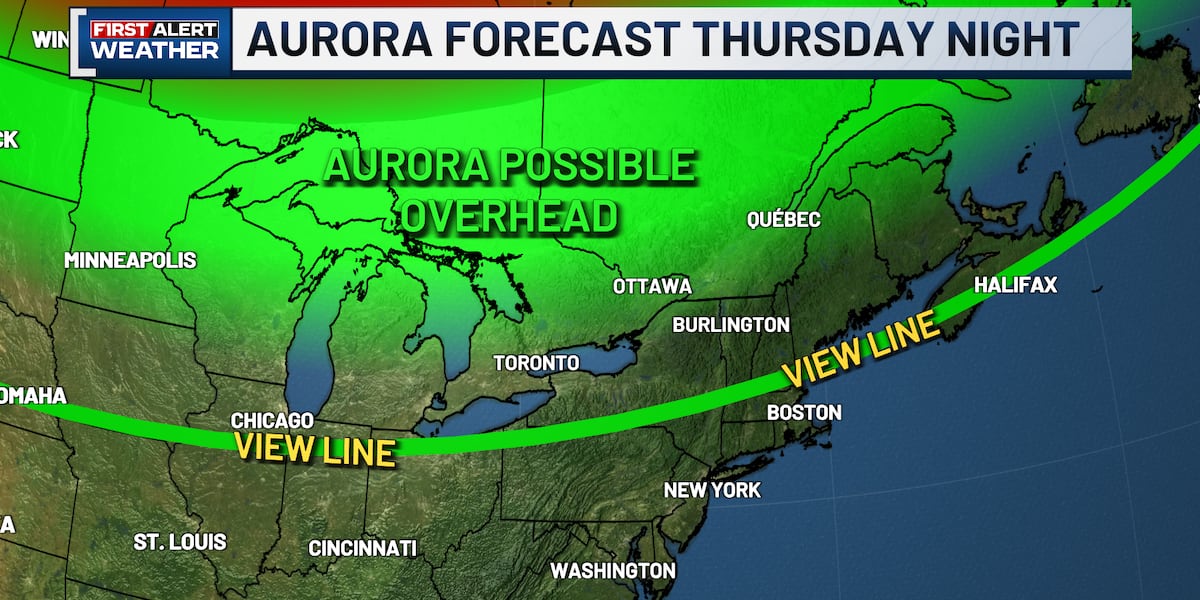
BURLINGTON, Vt. (WCAX) – The northern lights could put on a show across the region Thursday night into early Friday morning, with a strong geomagnetic storm expected to push the aurora well into our viewing area. If you’ve never seen the northern lights from Vermont or the North Country, Thursday night will provide one of the best opportunities since a very impressive auroral display this past January 20.
WHAT TO EXPECT
The northern lights—also called the aurora borealis—happen when a burst of energy from the Sun sends charged particles streaming toward Earth. When those particles interact with gases high in our atmosphere, they light up in brilliant greens, pinks, and purples.
The strength of a geomagnetic storm is measured on a scale from 0 to 9. The higher the number, the stronger the storm and the further south the aurora can be seen. Thursday night’s forecast peaks at 7—a “Strong” storm—which puts our entire region well within the viewing zone Burlington sits comfortably above the view line, meaning the aurora won’t just be a faint glow on the northern horizon. It could be visible across a large portion of the sky. That is IF conditions are conducive.
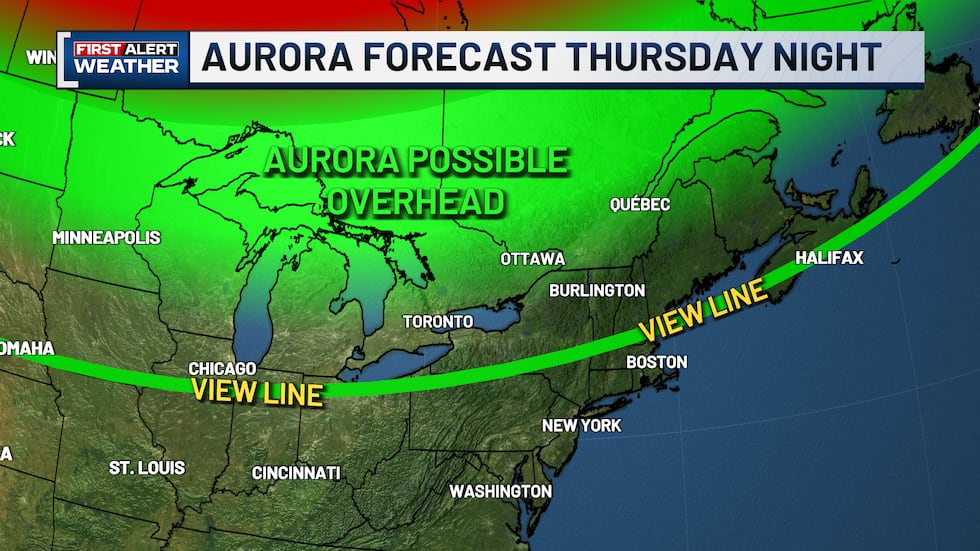 Placement and expectations of where aurora could be visible(Gunnar Consol)
TIMING
The strongest activity is expected between 8 p.m. and 11 p.m. Thursday, with elevated storm conditions continuing through 5 a.m. Friday.
However, with sunsets as late as 8:30 p.m. nowadays, conditions won’t be dark enough to view any aurora IF they appear until closer to 10 p.m. when true nighttime begins.
Then, at 12:06 a.m. the wanning gibbous moon rises and it’s increased light will mask the faint glow of the aurora making any potential light displays harder to see.
Your best bet is aiming between 9:30 p.m. to midnight to try and catch the northern lights.
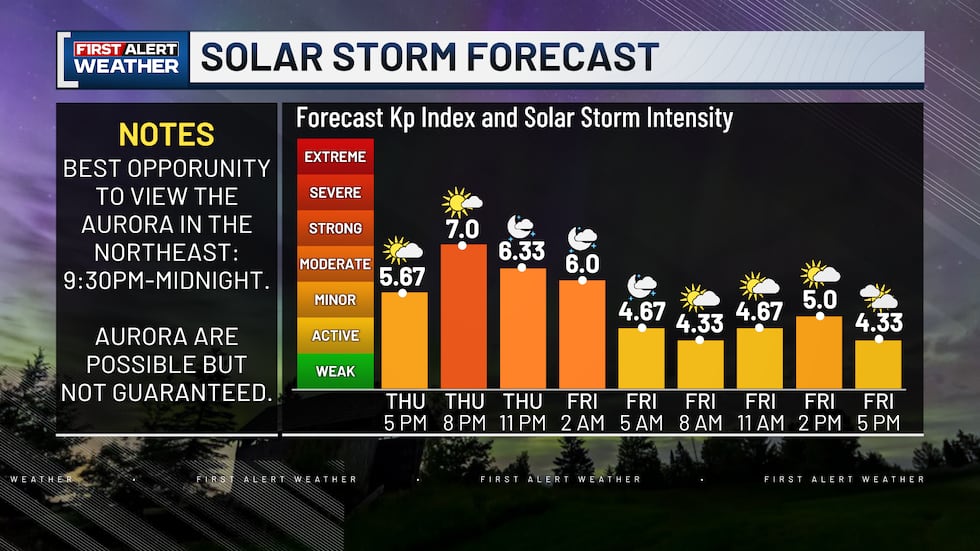 Forecast Kp Index and Solar Storm Intensity(Gunnar Consol)
HOW TO SEE IT
Get away from city lights. Light pollution is the biggest obstacle—find a dark spot outside of town with a clear, open view of the sky.
Look north first, then scan upward. With a storm this strong, the aurora could extend well beyond the northern horizon and into the overhead sky.
Give your eyes time to adjust. It takes about 20 minutes for your eyes to fully adapt to the dark. Avoid looking at your phone screen during this time.
Try your phone camera. Modern smartphones often pick up the aurora better than the naked eye. Point it at the sky and snap a photo—you may be surprised at what shows up even when it’s hard to see with the naked eye.
SETTING EXPECTATIONS
If you don’t see anything, just wait and be patient. From personal experience, I have waited outside for hours some nights only for the aurora to only be visible for a few minutes.
Solar storms behave in a few ways like thunderstorms. We can have a chance for thunderstorms all day, but only have a few minutes with actual stormy conditions.
Because of their fickle nature, having chased the aurora many times, I’ve only managed to see them a few times.
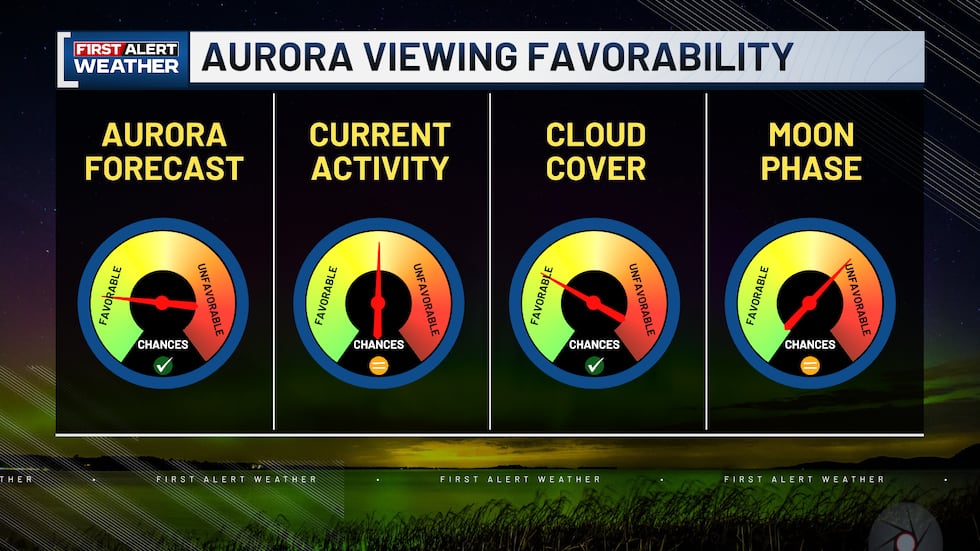 For Thursday, June 4th into Friday, June 5th(Gunnar Consol)
Ahead of tonight, the forecast looks favorable, that’s the most important part. But whether we’ll absolutely see the aurora or not happens mostly in the moment. We do this by looking at various variables like hemispheric power, the solar wind, proton density, and direction of the Earth’s magnetic field. The lead times on those metrics is only about 30 minutes to an hour. So if conditions aren’t good for aurora when you check, they could change suddenly very quickly.
Stay with us on air, online, and on the First Alert Weather App for the latest on Thursday night’s aurora chances.
Copyright 2026 WCAX. All rights reserved.