
Bartlesville is home to the tribal government, food pantry and child education center, and where on a recent afternoon a group of elders were throwing a stomp dance for this year’s teenage “Powwow Princess,” who would serve as an ambassador for the tribe at native ceremonies and events. For Leslie Jerden, the chief executive of Teton Trade Cloth, Lenapehoking sounds wonderful, but Bartlesville is where they now belong. “I’ve never touched the water, I’ve never climbed the mountains,” she said. “Yes, we were displaced, but Oklahoma has been home.”
A Return to Lenapehoking
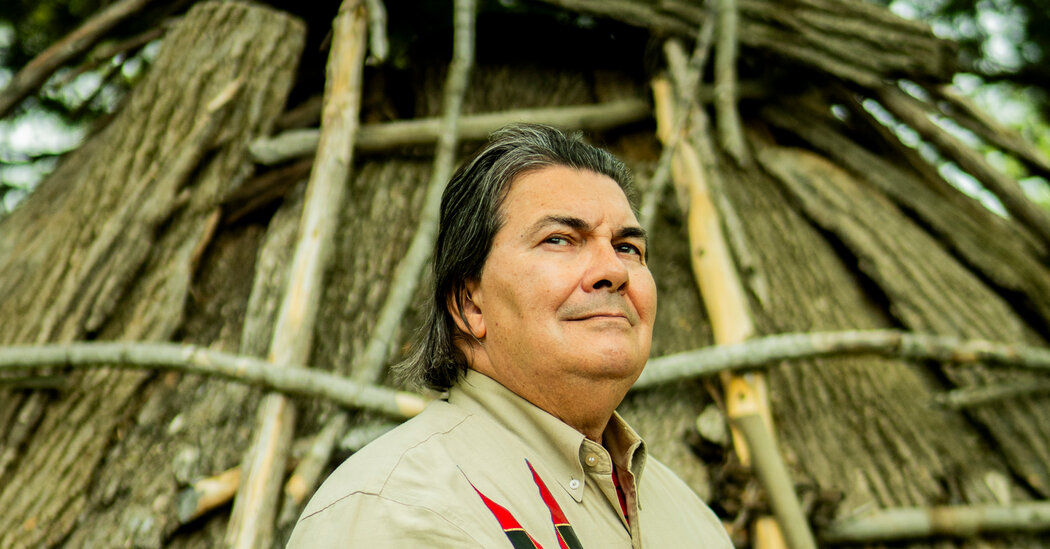
But for Curtis Zunigha, an outspoken former chief of the Delaware, the homelands exert a near-mythical force.
When he was chief, his main focus was on restoring federal recognition, which was revoked twice, and last restored in 2009, but these days he spends his time looking back east. Four years ago he moved for a time back to Lenapehoking — to Kingston, N.Y., an artsy town up the Hudson River from Manhattan. Nearly 20 years ago, he helped found the Lenape Center, a New York City-based nonprofit that promotes the tribe’s culture, and he was back to cultivate a Lenape seed garden. In Kingston, amid the rows of blue corn his ancestors would have planted, Mr. Zunigha said, he was able to reckon with his own his past.
His father and grandfather had grown up out West at the notorious Indian boarding schools sponsored by the U.S. government as part of a late-19th-century initiative to stamp out Native American culture. The brutality, he said, was brought home to his family — he recalled being punished by his father, who used the same words he had been told at school: “You are nothing.” It is a legacy that he vowed would end with him. In Kingston, he said, he was able to acknowledge that trauma for the first time.
“I’m there in that valley, all those years later, putting the same seed in the ground, digging my fingers into the earth,” he said. “The same earth that my ancestors lived on. The same earth that their bones are buried way below.”