
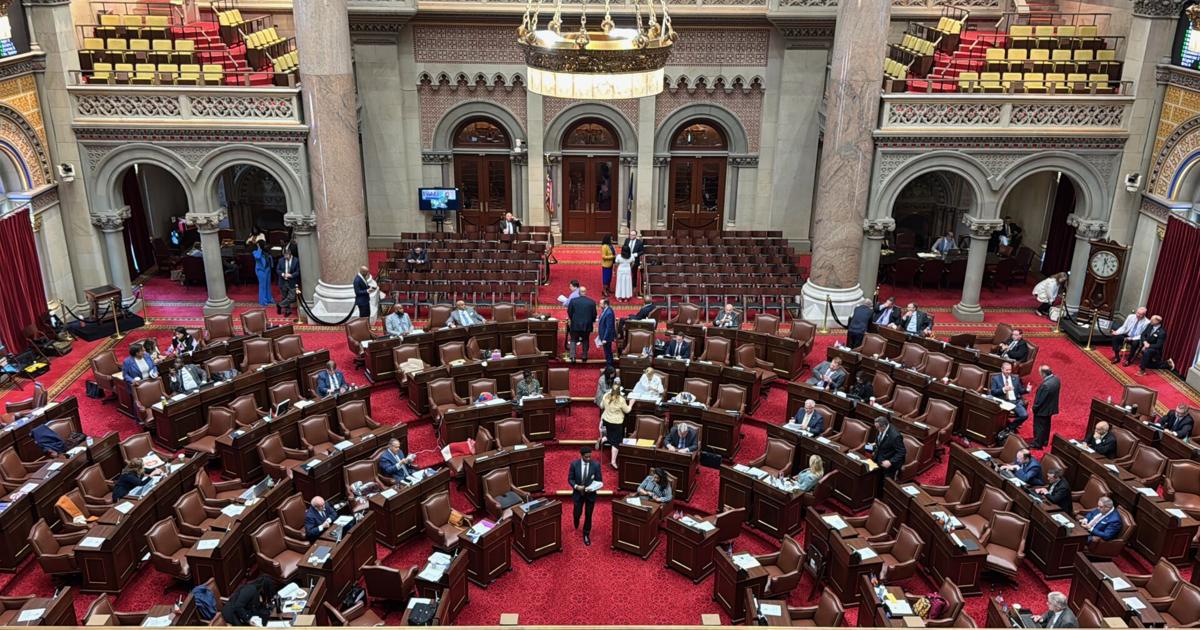
ALBANY — The state legislature approved another bill to adjust the judicial districts in upstate New York this week, sending the bill back to Gov. Kathleen C. Hochul after she issued a rare pocket veto of the legislation last year.
Echoing the way the bill moved last year, lawmakers in both chambers approved the measure in the last few days of the voting session this year. Voting largely along partisan lines, the Senate and Assembly passed the bill that would create two new judicial districts in central and western New York, and adjust the other districts around them to compensate for the changes. The basic plan is to isolate the three big cities in the region — Syracuse, Rochester and Buffalo — into their own judicial districts separate from the rural regions around them.
In New York, justices run for election to seats on the bench in their judicial district, meaning a candidate in the Fifth Judicial District, who lives and works in Syracuse and hopes to hear cases in Syracuse, will appear on the same ballot as a candidate who lives and works in Watertown, hoping to hear cases in Watertown. A so-called “gentleman’s agreement” by members of the political parties that nominate judges have kept the district’s judicial ballots largely representative of the major population centers, but there’s no mechanism in law to ensure that a judge will be elected from every major population center in a judicial district.
Under the plan laid out by the legislation, Syracuse and Onondaga County would be cut from the Fifth Judicial District, which would be redrawn to add Cayuga, Ontario, Seneca, Wayne and Yates counties. The district would retain Jefferson, Lewis, Oneida and Oswego counties.
The Seventh Judicial District would be reorganized to include only Monroe County and Rochester, and the Eighth Judicial District would be redrawn to include only Erie County and Buffalo.
Onondaga County would be added to a newly created 14th Judicial District of its own, and a 15th district would be formed to include Allegany, Cattaraugus, Chautauqua, Genesee, Livingston, Niagara, Orleans, Steuben and Wyoming counties.
The legislation also lays out changes to the number of state Supreme Court justices for each district; the fifth district would lose five justices, dropping to 14; the seventh district would lose seven justices, dropping to 13, and the eighth district would lose 10 justices, dropping to 18.
The new districts to be created would add the same number of justices cut from the three existing districts; the 14th district would have nine justices and the 15th would have 13.
The bill also lays out special dispensation for the state Supreme Court justices who are serving in elected positions in the current district layout, or potential successors to those justices, to serve in their existing capacities in the new districts. In the new and the adjusted districts, the judges would be up for reelection in November of next year — terminating what was supposed to be a 14-year term for those justices.
It comes with an overall anticipated cost of about $14 million to update informational systems and secure appropriate office spaces.
The bill passed both houses of the state legislature last year, but it didn’t become law. Instead, Hochul did not ask to be sent the bill for review, and instead used her power of a “pocket veto” to kill it.
In New York, the governor typically has 10 days, not counting holidays and Sundays, to review a bill after the legislature has provided it to their office for review. The legislature typically waits for the governor to request the bills before sending them to her, but that’s not required. If the governor fails to act on the bill within that 10-day period, it automatically becomes law.
But things change at the end of a calendar year. If the governor hasn’t been given a bill by Dec. 31, it rolls over into the next year, and the governor instead has 30 days to act on it. If the governor doesn’t sign or move to negotiate amendments to the bill within that period, the clock runs out and the bill is automatically rejected.
Hochul doesn’t use this process frequently; this judicial districts bill was her only pocket veto of 2025 legislation. She quietly pocket-vetoed a 2024 bill to increase reimbursement rates for after-hours busing for private school students in New York City last year, and in 2022 she used the pocket veto on two bills.
Pocket vetoes don’t come with explanations; the memo indicating the 2025 bill was pocket vetoed lists no reason for why the bill was rejected. A spokesperson for the governor did not immediately return a request for comment on why the bill was rejected.
Lawmakers this year passed the bill with changes compared to last year, changing how justices are allocated compared to the previous bill and how the ultimate district makeups will look.
Republicans in the state legislature were opposed to the changes; Sen. Anthony H. Palumbo, R-Suffolk, said it amounted to gerrymandering.
“This is purely political,” he said in debate on the Senate floor.
He said that this restructuring will open up a number of new judicial seats that the Democratic leaders in the three major cities would be able to fill with Democratic appointees and nominees, pushing the judiciary further toward Democratic control.
He also criticized the way the changes would cut the number of justices in the rural counties that surround those big cities, leaving them with the weaker court infrastructure that has been built in them while residents rely at least partially on the courts in the bigger cities.
But Sen. Mike R. Gianaris, D-Brooklyn, who co-sponsored the bill, which has the approval of the state Office of Court Administration, said passing the bill would help provide more representative justice to upstate residents.
“By creating these three new districts that are predominantly rural, you can expect to see … the representation for those counties on the bench increase,” Gianaris said.