
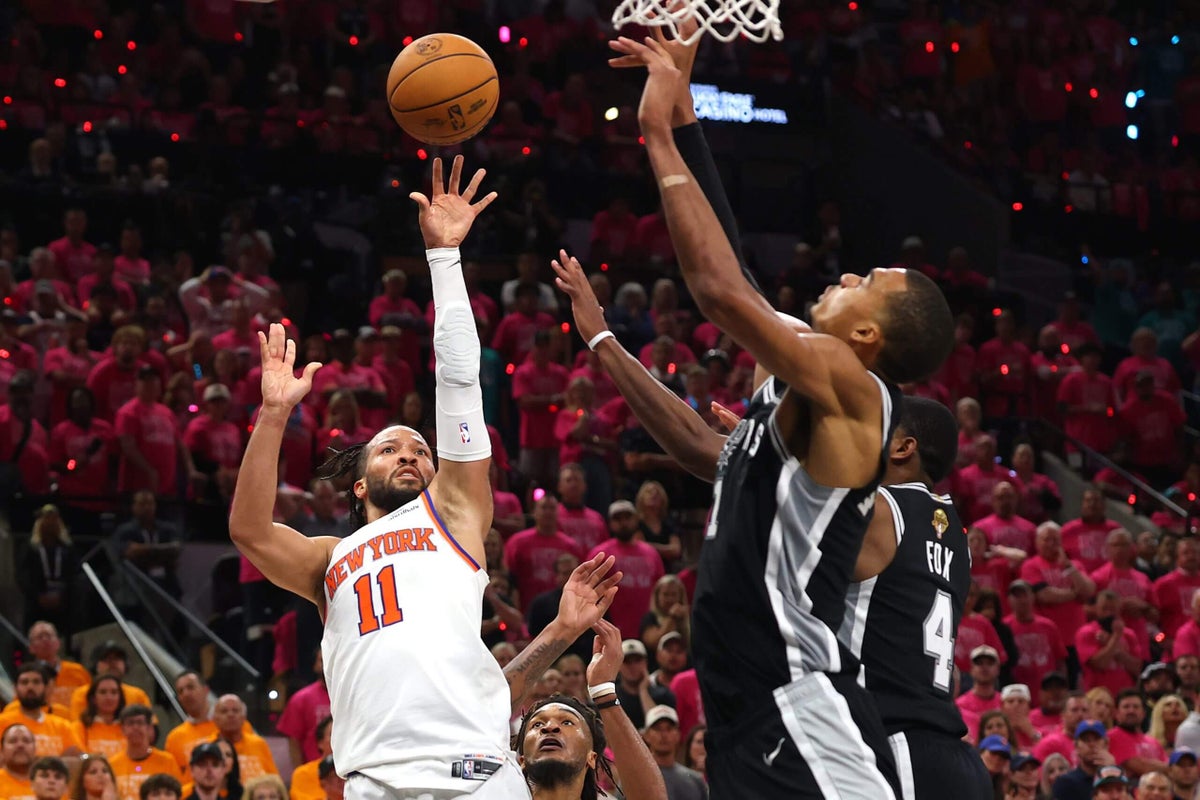
As it turns out, big markets in sports do draw big audiences. New York is America’s No. 1 media market, and the Knicks are the basketball pride and joy of the city. (Sorry, Nets.)
So people have come to their television screens by the tens of millions to watch Jalen Brunson lead the Knicks in the franchise’s first NBA Finals appearance since 1999, with a chance to win its first championship since 1973.
ESPN released the viewership numbers from Wednesday’s Game 1, and its average of 16.93 million viewers on ABC made it the most-watched NBA Finals Game 1 since 2018. A peak audience of 19.63 million tuned in to watch Brunson lead a 105-95 victory over the San Antonio Spurs in San Antonio. It represented a 90 percent year-over-year increase from Game 1 between the Oklahoma City Thunder and Indiana Pacers last season.
This past Wednesday’s matchup between the @spurs & the @nyknicks was the most-watched #NBAFinals Game 1 since ‘18
🏀 16.93M avg. viewers
🏀 19.63M peak
🏀 Up 90% YoY
Details: https://t.co/kjD9TJvJk9 pic.twitter.com/ToVIBz2BCw
— ESPN PR (@ESPNPR) June 5, 2026
The higher viewership numbers have been driven by widespread interest in the Knicks’ Finals run. The Big Apple attracts big attention. Ticket prices for Game 3 in New York soared past $4,500 for the cheapest nosebleed seats as of Monday before Game 1. Knicks celebrity supporters such as Fat Joe, Spike Lee and Ben Stiller have traveled to Cleveland during the Eastern Conference finals and San Antonio for the NBA Finals, making their presence known.
The noncelebrity fan contingent has also made considerable noise, invading opposing arenas in support of the Knicks, and their cheers have often been clearly audible to those in attendance, piercing through the home crowd.
The expanded audience has been a theme throughout the Knicks’ playoff push, a surge now at 12 consecutive wins. The NBA posted on Twitter that these playoffs have been the most watched in 28 years, averaging 5.3 million viewers per game across the broadcast and streaming services carrying the games.
The NBA Playoffs are the most-watched in 28 years with an average of 5.3 million viewers per game across ABC, ESPN, NBC, Peacock and Prime Video. https://t.co/MoQxJNbPB7 pic.twitter.com/iMTZng3smd
— NBA Communications (@NBAPR) June 2, 2026
With New York on the verge of history, millions are craning their necks to watch, whether through television screens or by attending in person. In the city that never sleeps and beyond, the Knicks have captured the spotlight.
Analysis
In this week’s edition of The Athletic’s MoneyCall sports business newsletter, I took a look at some NBA Finals TV comps to try to get a sense of how big this number could get, given that it involved a franchise that drives tons of fan interest and a player easily tabbed as the NBA’s most intriguing.
In 1999 (call it “Knicks-Spurs I”), that series averaged 16.1 million viewers. Big, but then again, it was an entirely different media era, if not multiple media eras, ago.
The gold standard is 2016 and 2017 – peak Warriors-Cavaliers rivalry, with the two most popular NBA players of the 21st century: LeBron James and Steph Curry. That averaged 20.3 million, the highest since the end of the Jordan Era in the late 1990s.
I thought a potentially good comp was Celtics-Lakers in 2008, which featured the league’s best historic rivalry, was slightly ahead of our social media-powered, attention-atomized era and delivered a solid average of 14.9 million viewers.
This mighty 16.9 million number for Game 1 speaks to the truly unique convening power between the can’t-miss narcissism of the New York basketball experience and fans’ first (finals) contact with Victor Wembanyama — a combination that, if only briefly, cuts through the clutter and reminds us all of the NBA’s annual June position within a bygone monoculture.
I fully expect that Game 2 will top Game 1, and that Game 3 in New York — with all of its attendant vibes, celebrities and $8,000 “cheap seats” — will soar even higher. Whether the series runs short or all the way to Game 7, the perfect storm of sports TV will continue. — Dan Shanoff