
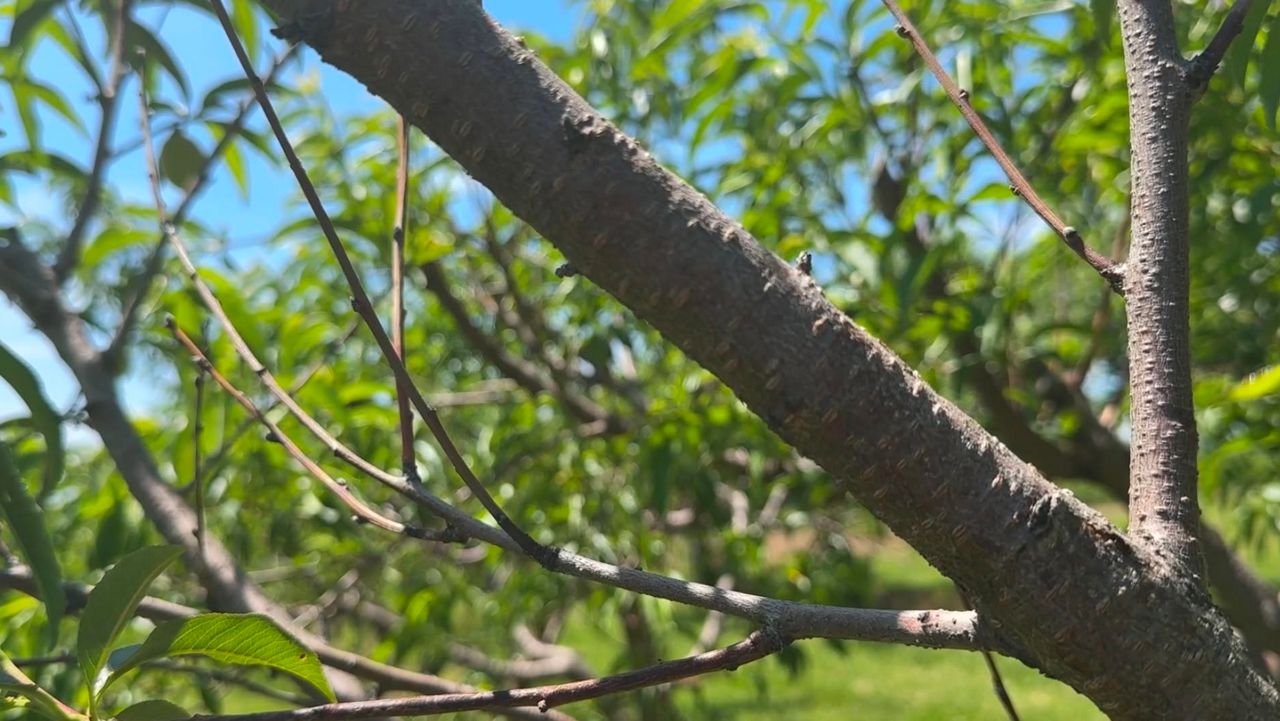
It’s nearly the summer season at New York’s “u-pick” farms, but this year, the branches will be barer than usual.
“We think we approximately have a third of a crop,” said Weed Orchards Owner John Weed. “We think we lost approximately two-thirds of the crop.”
Weed said his peach and apple crop was knocked out after 80-plus degree days in April kickstarted growing. Then, a freezing cold night followed right after those record highs. The combination devastated the farm.
“We’re hoping we can squeak through this year,” he said. “We’re not sure how we’re gonna do it.”
He tried everything he could.
“We did hire a helicopter to fly over and the helicopter tries to push that warm air down,” Weed explained. “Every time the helicopter went over, the thermometer would go up three degrees. But it wasn’t enough.”
Weed says that helicopter manuever cost $14,000.
“I should have went to the casino with the $14,000,” he said.
He’s not the only farmer dealing with mass crop loss. Farmers from the Capital Region down to the Hudson Valley, and even through New Jersey and Pennsylvania, are suffering through this.
The Northeast Regional Food Bank relies on local farmers to get food to those in need while also running its own farm. Food Bank COO Nick Pisani says they got lucky they planted their crop early. But for wholesale farmers this could create a trickle down effect.
“When there’s impacts at large devastation events, it impacts financial ability of our agricultural friends,” Pisani said. “Products costs more, when products cost more that puts heightened pressure on you and I and anybody else that’s going to a grocery store.”
Local elected officials are trying to head off potential economic impact. The executives of Orange, Dutchess, and Ulster counties were joined by U.S. Rep. Pat Ryan in calling for the federal government to issue a disaster designation. That designation would free up emergency relief for farmers. Ryan said that crop loss damages could total over $30 million.
On Thursday, U.S. Agriculture Secretary Brooke Rollins told U.S. Rep. John Mannion that this designation will come soon.
“It’s important that all of our organizations, as well as state and local government, support agriculture and really stand behind it because quite frankly, this is what feeds people,” Pisani said.
Weed is personally not excited about the idea of needing assistance. But he says this year, farmers may not have a choice.
“Some of them may have to take a handout or they won’t be here next year.”