
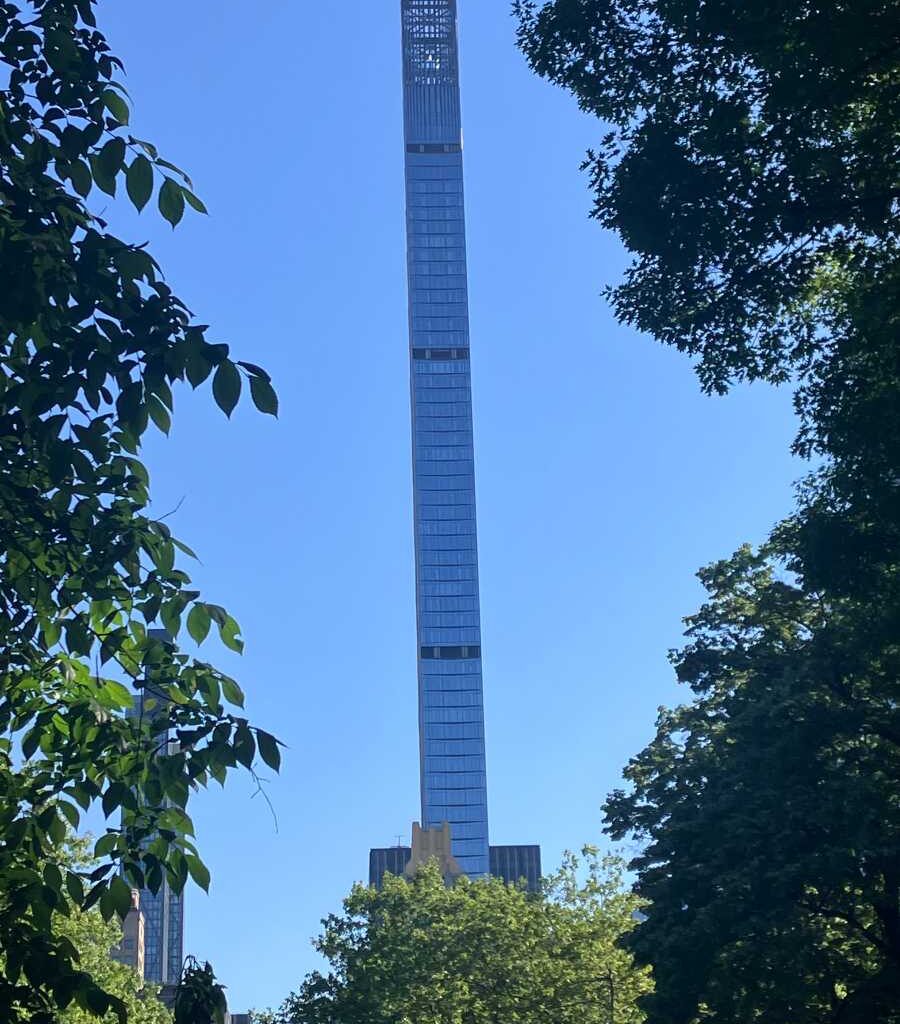
New York’s highest court recently created a path forward for a lawsuit from an investor in Midtown Manhattan’s supertall, super-skinny Steinway Tower, that claims their lender sabotaged them out of equity in the luxury tower through a “backroom deal.”
In 2018, 111 W. 57th Inv. LLC, a subsidiary of the AmBase Corporation, sued private equity lender Apollo for breach of the covenant of good faith and fair dealing. Apollo had sold the loan that AmBase had taken out to another real estate investor in a move allegedly devised to wipe out AmBase’s equity in the project.
The May 28 court decision, which split the New York Court of Appeals judges four-to-three, could have wide ramifications in the world of real estate contracts. In the decision, written by Chief Judge Rowan Wilson, the court ruled that parties cannot use a “sole discretion” clause, which gives one party exclusive right over to make contract decisions, to deliberately harm a borrower and usurp their equity.
The court is reversing a lower court decision that dismissed AmBase’s breach-of-contract claim and remanding it to the Manhattan Supreme Court for further proceedings.
“We hold that plaintiff has sufficiently alleged that Apollo colluded in a scheme to deprive plaintiff of the benefit of its bargain,” wrote Wilson in the majority decision.
The outcome has the possibility to shake up legal dynamics in New York courts, which have historically been highly deferential to the strict textual wording of real estate contracts.
In the dissenting opinion, Associate Judge of the Court of Appeals Anthony Cannataro argued that New York’s appeal to the business world is through its legal predictability and raised concerns that the ruling compromises that reputation and could open the floodgates to frivolous lawsuits.
“Today, we abandon that institutional regard for stability and predictability,” Cannataro wrote. “This majority’s reimagining of New York law will disrupt the expectations of contracting commercial parties, making uncertain the rights and liabilities in billions of dollars of outstanding loan agreements, and may well affect whether similarly situated parties will choose to subject themselves to New York law.”
Ramifications of Manhattan supertall decision
 In the majority decision, written by Chief Judge Rowan Wilson, the court ruled that a lender cannot use a “sole discretion” clause, which gives one party exclusive right over to make contract decisions, to deliberately harm a borrower and usurp their equity. Photo by David Handschuh/OCA
New York Law School real estate law professor Marshall Tracht said the decision is likely to move New York courts away from their strict focus on contract wording toward an interpretation of the law more common in states like California, which takes into account the parties’ intentions.
“What the majority is saying is… a party in a contract has a right to expect that the other party won’t use the contract to deprive them of the fruits of the deal,” Tracht said.
In the days following the decision, attorneys in other high-profile real estate lawsuits involving fair dealing have urged judges to consider the high court’s ruling for guidance.
The lawsuit originated in 2013, when the AmBase subsidiary invested $65 million in building the Billionaire’s Row tower, known as the world’s thinnest skyscraper. To fund the rest of the project, they took out hundreds of millions in loans from two major lenders, American General Life Insurance Company and Apollo.
By 2017, the project was in financial trouble. The loans were “out of balance,” meaning the project was running out of money due to overruns, and lenders began demanding payment.
Apollo agreed to pause and give the borrowers some extra time to figure things out. However, AmBase claims that Apollo and the project’s developers used this time to devise a plan to bring in a new company, Spruce Capital, and cut AmBase out, according to court documents.
Apollo sold part of its loan to Spruce and conspired to give the new buyer a greater share of equity if they foreclosed on the new loan in a legal process that avoids a public auction or sale. After Spruce took over the loan, they demanded payment from AmBase, which the investor didn’t have the funds for, according to the court papers. Spruce was then able to take over the property, completely wiping out AmBase’s $65 million investment.
AmBase sued both Spruce and Apollo to try to stop the takeover, claiming it was an “internal deal” designed to steal their equity. On appeal, the First Department ruled in Apollo’s favor, stating that Apollo had the “sole discretion” to sell or assign the loan to whoever they wanted, for any reason.
Wilson wrote that even if Apollo had the sole discretion to reassign the loan, doing so as part of “an alleged backdoor deal to appropriate the value of plaintiff’s equity by conspiring with others to facilitate the scheme” meets the burden to move forward in court.
The high court did, however, throw out AmBase’s claim against Spruce and Apollo for tortious interference.
Tracht said the decision is likely to move the needle in the real estate world. While this may not change how businesses write contracts, it “opens the door for claims that were harder to prove before this, and it does say that a sole discretion clause nonetheless may require you to explain your discretion down the road.”