
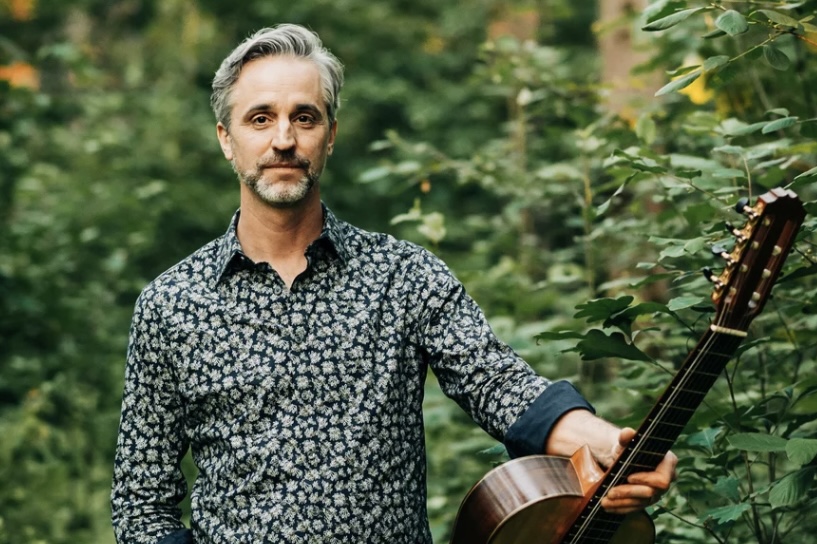
Pittsfield — Jason Ennis’ summer itinerary traces a path from Lenox and Williamstown to New York City’s Jazz at Lincoln Center, but the guitarist sees it less as a tour than a continuation of long-running musical conversations. Whether performing with his improvisation-driven trio Tone Forest, collaborating with Chilean vocalist Natalia Bernal, or leading his own jazz trio, Ennis brings together influences from jazz, blues, Brazilian music, and classical guitar into a voice that is distinctly his own. With two recording projects currently in production and a schedule that includes appearances at The Mount, Dizzy’s Club, Studio 9, and the Clark Art Institute, the Pittsfield musician is entering one of the busiest and most creatively fertile periods of his career.
I interviewed Ennis by email last month. Our conversation has been edited for length and clarity. Check out his summer itinerary here.
You have new recordings in the works with both Tone Forest and Natalia Bernal. What can listeners expect from those projects, and how do they differ from one another?
The big difference is that the Tone Forest project really features longer improvised sections that are a bit more open-ended. Natalia’s project is based on the presentation of songs and is a bit more structured, with more involved arrangements for the group. That’s a distinction that gets pretty blurry, though.
Every tune on the Tone Forest project will feature just the trio, with the only variable being whether I’m playing arch-top jazz guitar or classical guitar, so it’s a pretty unified sound throughout. Natalia’s recording—though it’s an outgrowth of La Voz de Tres, our long-time collaboration with pianist Mike Eckroth—features a variety of groups on the different tunes. In December, we recorded three songs with a quintet (Natalia, me, Mike, bassist Gregg August, and drummer Mark Walker) plus a string quartet. These were arrangements that we had written eight years ago or so to perform at the Geneva Music Festival in Geneva, N.Y., with legendary oboist and multi-instrumentalist Paul McCandless. We dug those arrangements up past year and reworked them to play with strings players from Kids 4 Harmony at a concert at the Linde Center at Tanglewood, which inspired us to get the ball rolling on this project. We did a separate session last month with just the quintet, except with electric bassist Itaiguara Brandão. I suspect a duo tune and a trio or two might end up on the final project, as well.
How have the Tone Forest recordings evolved since the release of ‘Tone Forest’ in 2024?
One of first gigs as a trio was in late 2019, when we subbed for the wonderful bassist Ike Sturm at the Jazz Vespers at Saint Peter’s Church in NYC. We played with two amazing singers, Melissa Stylianou and Catherine Russell. Afterwards, Catherine said a really funny thing that we’ve been tempted to use as a promo blurb ever since: ‘I get it, you guys are like half serene, pastoral, and meditative and half downright grooving!’ That’s paraphrased, but more or less accurate. I think she hit the nail on the head with that one.
Our first album leaned more toward the meditative side, with core of the album being long-form and slowly evolving pieces like Miro’s ‘Quiet Lake,’ Marty’s ‘The Mother Tree,’ and my ‘A Wave Away.’ This one seems to be a bit more swinging, bluesy, and straight ahead. We’re even going to include a couple of standards, and I’m playing as much if not more arch-top guitar with a pick as I am the seven-string classical guitar. It’s really fun for me to play that guitar, which is more what people think of when they think of jazz guitar, with this group. We often fall into heavy, swinging grooves where I’m playing four-to-the-bar rhythm guitar, which I love to do. With this group, it retains its openness, hopefully evoking the way Jim Hall plays with Bill Evan on ‘Undercurrent.’
What has your collaboration with Natalia Bernal taught you about composition, arranging, and storytelling through music?
My collaboration with Natalia has been a central part of my musical for about 18 years now. As an arranger, composer, and co-leader, working with her has allowed me to develop in a lot of different ways. First of all, though we met through our shared love of Brazilian music, she introduced me to other Latin American repertoire and styles, like Andean Huayno, Peruvian Waltzes, and Argentinian and Chilean folk styles like Cueca, Chacarera, Zamba, etc… She’s open enough to my crazy ideas that I’ve been able to develop my concept of arranging, whether for La Voz de Tres, En Diablada, or our duo work. We always try to honor the song when we put our spin on a known standard, so that anything we do to it is meant to support our interpretation of the melody, lyrics, and intent of the tune. I think we’ve been fairly successful with that, whether it’s an Andean folk tune like ‘Ojos Azules,’ a North American standard like Irving Berlin’s ‘How Deep is the Ocean,’ or the beautiful ‘Sueño con Serpientes‘ by Silvio Rodriguez.
Collaborating on songwriting with Natalia has been especially rewarding. I love the fact that our process is that there is no process! We have some tunes, like ‘Sol de Pisco,’ that Natalia brought to me almost complete, having written the melody and lyrics a cappella—her melodies always imply a fair amount of harmony, even if she came up with it away from the guitar or piano—so all I needed to do was suggest a few tweaks, write an intro, come up with some chord voicings for guitar, and arrange the tune for larger ensembles; some tunes, like ‘Más Alllá,’ grew out of jamming on a concept; recently, we wrote a song I’m very happy with, ‘Es Hora,’ which started with a melody, lyrics, an idea Natalia was exploring with the guitar, while doing Friday writing retreats at The Mastheads studios at Arrowhead, during the pandemic. We jammed on that idea a bit and recorded it on one of our phones and rediscovered it late last year. Natalia decided she didn’t care for the lyrics or melody, but I dug the vibe and some of the harmonic and melodic ideas I was getting at. I ended up starting with that and writing a whole new tune and form based on pretty much just the feeling of her original idea. She wrote some beautiful lyrics to my melody, and now it’s a song that will most likely end up on our next recording.
Looking at this summer’s schedule, from The Mount to Dizzy’s Club and Studio 9, are there performances you’re especially excited about?
Do I have to choose? I feel very lucky to have such wonderful projects in the works and to have the opportunity to play this music with such amazing bands. The Tone Forest recording sessions—both the studio session and the live concert recording on August 2 at Studio 9—and concerts will certainly be a highlight of the summer. I’m especially looking forward to playing at Dizzy’s at Lincoln Center on June 25.
Playing with Natalia’s band (The Mount in Lenox on June 11 and The Clark Art Institute in Williamstown on July 22) is another ‘pinch me’ moment. The band is amazing and super versatile; Mark Walker has been Paquito D’Rivera’s drummer for 30 years, he was in one of my favorite groups ever, Oregon, with the late Ralph Towner, and he can play just about any style you throw at him. Itaiguara Brandão is one of the top-call Brazilian bassists in NYC, having performed with Diane Reeves, Romero Lubambo, and many others. I used to go check him out playing with the Brazilian pianist Cidinho Teixeira at the Zinc Bar in NYC when I was just getting into Brazilian jazz, so it’s an honor to now consider him a friend and colleague. Mike Eckroth is our long-time collaborator in La Voz de Tres, and saxophonist Michael Zsoldos has one of the most beautiful sounds you could hope for, on both tenor and soprano saxophones.
I’ll also have some more lowkey gigs with various groups, including a trio date with Conor Meehan and Adam Coté at the Lion’s Den in Stockbridge on July 8. Guitarist Michael Junkins has done an amazing job programming the jazz nights in the Den (Wednesday and Sunday) and other music at the Red Lion Inn and cultivating a nice scene that allows local and regional jazz musicians to play in a club environment.
The Studio 9 event combines a live concert with a recording session. Does the presence of an audience change the way you approach recording?
I’ve been listening to a some Clifford Brown CDs in my car recently (yes, my car still has a CD player!), one is ‘Study in Brown’ with Max Roach, recorded in 1955, and the other is a Pacific Jazz/Blue Note box set, which culminates with two live sets at Birdland in 1954 with an early incarnation of Art Blakey’s Jazz Messengers. (I’ll try not to go on too much of a tangent here, but it’s amazing to compare these two recordings and to hear the growth and development in Clifford Brown’s playing in that one year! It really puts in perspective what a towering genius this 24-year-old was and underlines the tragic loss his death a year later was.) Anyway, at the end of one of the Blakey tunes, Art Blakey pics up the mic and exclaims, ‘First time I enjoyed a record date!’ Recording in the studio is a challenge. I mean, it’s great because we get to capture subtleties of our instruments that get lost in a lot of environments, things we get used to hearing when alone in the practice room. It’s also a powerful and sometime necessary way to put the music under the microscope and figure out what’s working and what isn’t. But often, it can feel inhibiting, uncomfortable, and energetically very different than live performance.
We came up with the idea of doing this live recording session last fall, after a week in which we played Mezzrow jazz club in NYC, then did a day at a wonderful studio n Paramus, N.J., called Trading 8s, and then played the Northampton Jazz Festival and another concert, all within five days. In the studio, we recorded some very nice takes, some of which might possibly end up on the next album. But the set at the Northampton Jazz Festival was just amazing! Feeling the energy of an amazing audience in a beautiful space really elevated the music and allowed us to take all of that detailed work we had done in the studio earlier that week and just have fun with it. To finish the recording, we’re going to try to get the best of both worlds; we’re going to do another day at Trading 8s, in the midst of a string of gigs in late June, then reconvene a month later for the concert at Studio 9, where we can have a live audience, but be recorded through their beautiful gear. Since we’re pretty confident we’ll have really good take of all the tunes on tape by then, we’re going to try to treat that just as a normal concert and be in the moment with the audience and see what happens!
Your playing draws from jazz, blues, Brazilian music, and classical guitar traditions. How did those influences come together into your own voice?
The first thing that really got me excited about playing guitar was blues. At the end of high school and going into college, all I wanted to do was play and listen to BB King, old Buddy Guy, Albert King, Robert Johnson, etc… A concert I heard at the beginning of my sophomore year at Middlebury College really blew things wide open for me, which was a trio by saxophonist Fred Haas (who was teaching jazz at Middlebury at the time), pianist Don Friedman, and guitarist Atilla Zoller. I blame that concert on the ‘D’ I got in my Animal Behavior course, which encouraged me to drop my biology major and switch to music! I was lucky, at a school with a small music department, to have a wonderful first jazz teacher like Fred Haas. The next fall, he brought the great Gene Bertoncini to the school to do a concert. Gene immediately became not only a friend and mentor, but one of my biggest influences. He inspired me to start studying classical guitar repertoire and technique and really got me excited about bossa nova, which really got me rolling with my love for music from Brazil.
I didn’t grow up immersed in any of these musical traditions, so my approach has always been to be respectful of the traditions and to diligently study the many facets of them. At the same time, I’ve never wanted to pretend I’m something I’m not. I try to learn from the wisdom of these great traditions and then put that in the blender and see what comes out of my guitar!
Brazilian music has been a significant part of your career. What continues to inspire you about that tradition?
When we say ‘Brazilian music,’ we need to keep in mind that there are numerous styles of music from that country. Like many jazz musicians, what I’ve been mostly interested in are mostly styles that I got into by tracing the web back from bossa nova, like samba and choro, plus some other styles that become intertwined in the global jazz language, like Baião and Ijexá. When I think of the music of my favorite Brazilian musicians (Antonio Carlos Jobim, Chico Buarque, Garoto, Guinga, Rosa Passos, Joyce Moreno, João Bosco, etc…), I always feel there is an amazing and very special blend and balance of musical elements: beautiful and surprising melodies (check out this Guinga tune, ‘Ramo de Delirios,’ that La Voz de Tres recorded); amazing lyrics (one of the joys of having studied Portuguese is that I can almost, with some work, understand the lyrics of Chico Buarque, Aldir Blanc, etc…); harmonies that not only heighten the beauty of the melody and lyrics, but are super fun to explore as an improvising jazz musician; and some of the most exhilarating rhythms one could imagine. Plus, they play some serious guitar in that country!
How would you describe the chemistry between you, Marty Jaffe, and Miro Sprague?
The three of us have been friends and collaborators for a couple decades now. And yes, that does mean that I first played a jam session with Marty when he was 12! For years, most of the playing we did together was work for other bandleaders, like Sonya Kitchell, Samirah Evans, Karrin Allyson, etc… We always had a nice, natural chemistry on stage and enjoyed exploring musical (and life) concepts off the bandstand, often in a very fun and silly way. Finally, in 2018 or so, Miro suggested that we do a trio concert on his next trip to the East Coast (he lives in LA these days). That first concert was pretty magical, built on a strong foundation of trust, shared rhythmic sense, and deep listening that allowed the music and our musical personalities to really take off.
In a trio setting, where there is nowhere to hide, what does trust look like musically?
I have three trios that I work with fairly regularly: Tone Forest, my longtime collaboration with pianist Mike Eckroth and Natalia Bernal, La Voz de Tres, and my first call lineup for a more standard guitar trio format, with drummer Conor Meehan and bassist Adam Coté. The thing each of these groups has in common is that the music just clicked right off the bat, leaving us feeling like ‘Wow, this is easy!’ With each of these lineups, I feel like each musician is listening and reacting to what’s happening in the moment, in a supportive and ego-free way, while still playing with such rhythmic and harmonic integrity that the individual parts could stand alone. This goes for a bass player like Adam, but it also holds true for a singer like Natalia; we do a lot of duo gigs, and I find that her sound, pitch center, rhythm, and musical intent are so strong that I certainly don’t need to prop her up with my chords. If each musician is able to carry the music forward individually and is listening and responding in a creative way, then the music can really breathe and go to unexpected places.
You balance an active performing career with teaching at Dartmouth and Williams. How do those roles inform one another?
It’s tricky to find time to work on my own music and to book and prepare for concerts with the teaching schedule and other responsibilities of adulting, for sure. However, I feel very lucky that my day-job involves teaching and playing music that I love. I certainly have some students at both schools that keep me on my toes, and I find I’m constantly learning by teaching music, no matter at what level.
What skills do young musicians need today that previous generations may not have needed?
A friend and former Dartmouth College student, Andrew Brozek, just sent me an amazing track last night for me to check out. It was his composition, and he sang, played guitar, banjo, fiddle, and bass. He also did an amazing job recording and mixing the song. He’s a very clear communicator, photogenic, and a very good teacher (he was my TA for a beginning guitar class at Dartmouth). He’s getting traction and gigging/teacher opportunities through his effective social media activity, supported in part by the fact that his sister did her masters thesis on the TikTok algorithm. This is all to say, musicians basically need to do it all these days!
What are you listening to these days?
As I mentioned before, I’ve had Clifford Brown in heavy rotation recently. I’ve also been listening to a CD by the great Brazilian singer/songwriter/guitarist João Bosco’s record called ‘Afro Canto.’ We just saw him play at Birdland last month, which was phenomenal! He was celebrating his 80th birthday and was still blowing us away! (I hope to be like him when I grow up.) I’ve also been cycling through three CDs that include the guitarist Peter Bernstein: Bernstein’s ‘Monk,’ Larry Goldings Trio ‘Moonstone,’ and Joshua Redman’s ‘Freedom in the Groove.’ Three great recordings, and I always love the clarity of ideas, beautiful sound, and soulful feel Peter Bernstein brings to everything he does. Of course, I had to pull out ‘Saxophone Colossus’ by Sonny Rollins, after he passed away last week. Another one that I’ve been revisiting is by two recently departed heroes: ‘Oracle,’ by guitarist Ralph Towner and bassist Gary Peacock. The record is gorgeous throughout, and Towner’s opening notes on the first track, ‘Gaia,’ by Peacock, always knock me out.
Is there a piece of music you wish more people knew?
‘Elis e Tom,’ the 1974 recording by Antonio Carlos Jobim and the great singer Elis Regina. It’s just kind of a perfect recording in all ways and something I’m always thrilled to turn folks onto.
What’s next for Jason Ennis?
In addition to these projects for which I’m leader or co-leader, there are a few projects that I’m involved in as a sideman; I recorded last summer with a band led by Bassist Fumi Tomita. He composed music inspired by Japanese Yokai, which are demons and other mythological figures. That record is very cool and should be coming out in mid-fall of this year.
I also play in a band led by bassist and part-time Berkshires resident Mary Ann McSweeney. Her project is inspired by Portuguese Fado music. No new recording on the way, but I just heard that we’ll be playing the Lulu Fest on September 19. Lulu Fest is a jazz festival featuring women band leaders, produced by vocalist Suzi Stern and pianist Peggy Stern (no family relation!).