
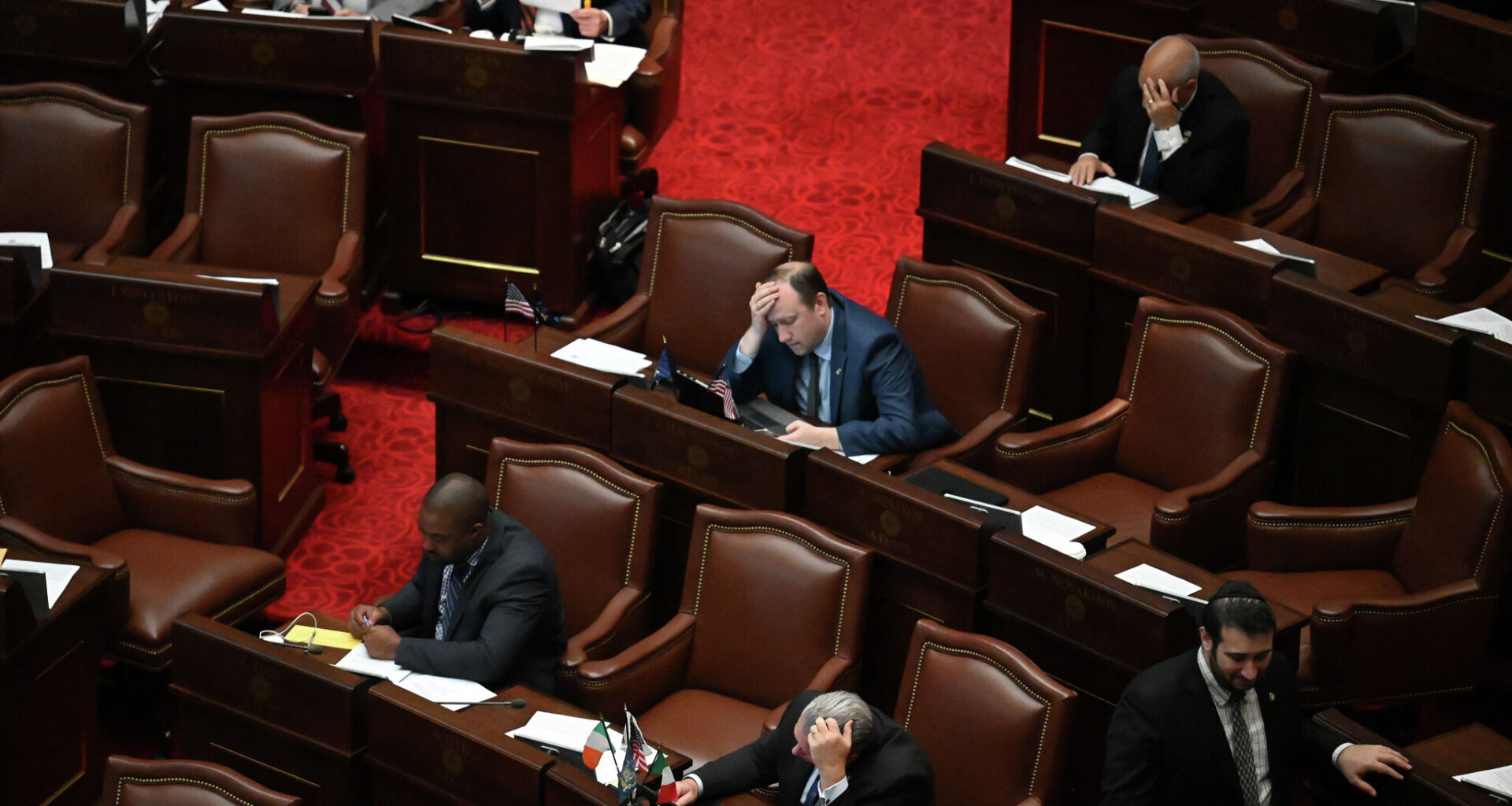
Assemblyman John T. McDonald III, bottom, in the Assembly chamber in the final days of the legislative session. Lawmakers on both sides of the aisle said they were again frustrated by a budget process that left them out of the discussions on top policy measures.
Will Waldron/Times Union
ALBANY — The six-month legislative session wound to a close Friday with lawmakers scrambling to get their priorities to the finish line after Gov. Kathy Hochul’s top policy wishes had consumed months of negotiations that delayed passage of the $268 billion state budget.

The budget deal reached by the governor and other Democratic leaders last month followed a script that has long frustrated rank-and-file lawmakers on both sides of the aisle: it was negotiated largely behind closed doors and subsequently voted on with little public discourse. And because it was late, it left just two weeks for the Legislature to rush through hundreds of bills with debates on their merit and necessity often stretching past midnight.
Article continues below this ad
Despite the convoluted process, Democrats in the state Legislature came together in the final days and ushered through many of their own priorities, including measures to upend the state’s congressional redistricting process and enact a one-year moratorium on large data centers that can strain the state’s ailing power grid.
But they also lamented the legislative system that draws abundant criticism annually but never seems to get fixed, although Assembly Speaker Carl E. Heastie, long a critic of dumping policy bills into the spending negotiations, had pledged to “never do this again.”
“The budget dominated a good part of the session,” said Heastie, a Bronx Democrat. “It did strain the Legislature’s ability to legislate.”
Gov. Kathy Hochul, despite the latest budget of her tenure, got most of the policy proposals she wanted.
Will Waldron/Times Union
Hochul, who’s up for reelection in November, packed per proposed budget in January with several controversial policy items, many of which were intended to help curb the state’s high cost of living.
Article continues below this ad
Make the Times Union a Preferred Source on Google to see more of our journalism when you search.
Add Preferred Source
While she met with resistance from Democrats in the state Legislature on several of those measures, Hochul was ultimately successful in securing significant swaths of her agenda and $14 billion in additional spending without raising income or corporate tax rates. But fees and regulations continue to increase in New York, where overall spending in the state budget during the modern era has never declined.
“The two-month-late, $268 billion budget left no time for measures to substantially improve the lives of New Yorkers,” said Assembly Minority Leader Edward P. Ra. “Democrats spent $14 billion more than last year, with $30 billion in out-year budget gaps and $2.5 billion in tax increases, all stemming from one of the most dysfunctional budget processes I’ve witnessed in my 16 years in the Assembly.”
Sprint to the end
The final push included a package of new policies in response to federal immigration enforcement from the administration of President Donald J. Trump and slowing of the state’s aggressive strategy toward reducing emissions from fossil fuels.
Article continues below this ad
New York will now be required to enact regulations in 2028 that seek to reduce carbon emissions 60% by 2040, instead of having to comply with a more aggressive mandate that had been set for 2030 under the 2019 Climate Act.
The immigration and emissions issues triggered numerous protests at the Capitol, many ending with dozens of arrests that result in minimal legal consequences for those who engage in what’s become an annual rite of passage.
The spending plan also included changes intended to lower the cost of auto insurance, streamline the state’s environmental review process for housing development and provide more aid to cities facing significant financial crises.
Several cities outside of New York City, including Albany, were facing multimillion-dollar budget deficits. The state dolled out a fiscal lifeline to help close those gaps.
Article continues below this ad
But those municipalities, as well as school districts, will also be saddled with increased costs from a deal that will sweeten public pensions for state and local government workers and teachers hired after 2012.
School districts and local governments will bear hundreds of millions of dollars each year, which could ultimately fall on property taxpayers. Local government groups have said that recent increases in state aid may merely help offset years of underfunding and do not cover the long-term financial burden of richer pension benefits.
All of these major policy measures were wrapped into the state budget. It was the tardiest budget of Hochul’s tenure and the latest spending plan approved by the state Legislature since 2010, when lawmakers extended talks into August.
Discussions at the state Capitol quickly pivoted toward what lawmakers could accomplish before leaving Albany for the year. They approved hundreds of bills over the course of the final week.
Article continues below this ad
That included a measure to prohibit companies from using consumers’ personal data to set different prices for the same products and an omnibus bill to pause and place strict regulations around large data centers.
While the legislation this year didn’t go as far as some progressives wanted, it continued to push the state farther to the left on certain issues.
Senate Majority Leader Andrea Stewart-Cousins at a news conference at the conclusion of this year’s legislative session on Thursday. A former teacher, she gave lawmakers an A+ for their efforts.
Will Waldron/Times Union
Hochul will now have until the end of the year to decide if she’ll sign each of the bills approved by the state Legislature, veto them or request changes from lawmakers.
Article continues below this ad
It’s become common for Hochul to negotiate changes to bills with lawmakers in exchange for her approval. Those changes are then approved by the state Legislature at the start of the following year before the laws take effect.
State Senate Majority Leader Andrea Stewart-Cousins said Democrats in the upper chamber don’t pass legislation they don’t support as its written but that they anticipated engaging in those kinds of discussions with the governor in the coming months.
“Do we know, by best practice, that there may be conversations around these things?” Stewart-Cousins said. “Yes, and because we are committed enough to whatever the policy is, we’re willing to have those conversations and get to a space where everyone feels that the objectives are still being achieved.”
Still, several other measures that were thought to have had momentum in the final days failed to pass.
Article continues below this ad
Environmental advocates join state legislators and health care professionals in urging passage of the Packaging Reduction and Recycling Infrastructure Act in May. The bill failed again this year.
Will Waldron/Times Union
That included a heavily lobbied bill meant to shift the financial burden of managing packaging waste from taxpayers to large corporate producers. This was the third year it failed to gain traction.
Also on that list was legislation sought by hospitals intended to push back on efforts from pharmaceutical companies to push higher costs on healthcare facilities that participate in a federal program to receive discounted drugs.
‘I’m never doing this again’
Lawmakers also declined to take steps that would address their frustrations over how Hochul used her executive leverage to hold up a deal on the state budget until her major policy demands were met.
Article continues below this ad
For much of the budget process, the governor, the Senate majority leader and the Assembly speaker or their top aides met behind closed doors, away from the rank-and-file legislators, and hashed out which bills would be passed and which would be set aside.
The governor holds more power than lawmakers in state budget talks. She sets the agenda with her spending proposal and, as evidenced over the last five years, Hochul hasn’t been averse to having a late budget as she negotiates to obtain her priorities.
Assembly Speaker Carl E. Heastie speaks to reporters shortly after Gov. Kathy Hochul unveiled details of the state’s budget. He was frustrated by the power imbalance in the state budget process.
Timothy Fanning/Times Union
Lawmakers, on the other hand, aren’t paid after April 1 if the budget is late. After eight weeks, a deal was finally struck.
Article continues below this ad
Heastie fumed at the fact that Hochul holds more power than lawmakers during those discussions and suggested that Democrats in the state Legislature could take steps to change that dynamic in the future.
“I’m never doing this again,” Heastie told reporters in May, as he also accused the media of not covering the issue enough.
That imbalance is the result of a decades-old decision by the state Court of Appeals that essentially affirmed the governor’s power to negotiate policy unrelated to spending as part of the state budget.
That could change through a lawsuit or an amendment to the state constitution brought in front of voters. Lawmakers left Albany on Friday without taking action on either of these avenues.
Article continues below this ad
Self assessment: A+
Stewart-Cousins said she was proud of the work they did this year. If Stewart-Cousins, a former high school English teacher, could give lawmakers a grade, it would be an “A+,” she said.
“We never lost sight of what we were doing,” said Stewart-Cousins. “We pushed forward every day, even under very difficult circumstances, even without being paid. People came and never, ever lost the focus of trying to get to a budget deal that would be helpful for New York and New Yorkers.”
Her counterpart had a different take.
Article continues below this ad
Senate Minority Leader Robert Ortt said lawmakers failed to address New York’s high cost of living.
Will Waldron/Times Union
Republican Robert Ortt, the Senate minority leader, criticized Democrats, who control all levers of state government, for doing little to address New York’s high cost of living.
“At the start of this session, the buzzword was ‘affordability,’” Ortt said. “New Yorkers are facing an affordability crisis, and we had a real opportunity to provide relief from skyrocketing costs that are burdening New Yorkers, but as we leave here, New Yorkers are not seeing more money back in their pockets.”
New York’s redistricting fight
Democrats in both chambers last week delivered first passage to a measure that could ultimately be considered by voters to change the state’s redistricting process.
Article continues below this ad
They framed it as a response to similar efforts in other states, like how Republicans in Texas redrew their state’s congressional districts last year at Trump’s encouragement to boost their party’s influence in Congress.
“We cannot ignore the reality that Republicans have repeatedly sought to undermine democracy through various attempts to gain political advantage,” Stewart-Cousins said.
And while that process will continue to be managed in New York by an independent commission, the proposed changes would give Democrats more power in that process.
The intent of those changes is to allow New York’s congressional districts to be redrawn before the 2028 elections. There’s nothing they can do about those maps this year.
Article continues below this ad
That’s because New York’s redistricting process is governed by an amendment to the state constitution approved by voters in 2014. Another amendment is required to change it.
Before such an amendment can be placed on the ballot, it needs to pass twice — once by a sitting state Legislature and again by the next class of state lawmakers seated after an election.
Because the current state Legislature has now approved the amendment, it can receive second passage after the next Legislature is seated in January. It could then be placed on the ballot in November 2027.
The amendment would allow the state Legislature to reopen New York’s redistricting process beyond the current limit of once each decade and make new maps easier for lawmakers to approve.
Article continues below this ad
It would also remove a prohibition on districts being drawn to favor or disfavor an incumbent, specific candidate or political party, which Republicans said will open the door for blatant gerrymandering in New York.
“This is the latest in a long line of attempts by Albany Democrats to rig the rules in their favor and protect their grip on political power, and New Yorkers should be paying close attention,” Ortt said.
Because the amendment would be presented to voters for approval, it’s not among the hundreds of bills Hochul will consider through the end of the year.
Data centers paused
Lawmakers also approved an omnibus bill that, if approved by Hochul as passed, would prohibit the state from granting permits for new large data centers for one year.
Article continues below this ad
The state would also be required to conduct a study on the energy use of data centers, the amount of water used to cool them, how much land they occupy, the volume of pollution they cause and the electronic waste they produce in New York.
The bill would also set new guardrails around how those facilities are approved at the local level and how their operations impact demand on the state’s energy grid.
Developers would have to hold at least one in-person public hearing on those projects before a permit could be approved for them to move forward. They would also have to invest in residential energy infrastructure.
Environmental advocates and progressive lawmakers at a rally in support of legislation that would put a moratorium on new data centers in the state.
Will Waldron/Times Union
But they would also face new energy-related mandates. Utility companies would have to create a new customer class for data centers that would allow any costs associated with connecting them to the grid to be paid for by their operators.
Article continues below this ad
Data centers would also be required to be powered by renewable energy sources over time, starting with a mandate that at least a third of their electricity be produced without fossil fuels between 2030 and 2034.
The bill was introduced in the final week after months of discussions between lawmakers and industry stakeholders, who opposed it, said state Sen. Kristen Gonzalez, who sponsored the measure.
“I think there has been significant investment in lobbying from big tech because for so long they have enjoyed writing the rules for themselves,” Gonzalez said. “Big tech has wanted us to do nothing because nothing benefits them.”
While tech groups had opposed the measure, it was also met with resistance from utility companies, like National Grid.
Article continues below this ad
“Large load projects can lower electric bills, advance grid modernization, drive economic growth, and strengthen energy reliability for New Yorkers,” said Sally Librera, president of National Grid NY. “A statewide moratorium discourages investment in New York.”
Librera said the company supports a proceeding currently underway before New York’s energy regulatory agency to analyze how new large-load facilities, like data centers, should be treated in terms of their energy use.
Immigration
New York will provide noncitizens with a slate of new protections against federal immigration officers, while imposing new restrictions and accountability measures on law enforcement agencies that assist with federal civil immigration enforcement.
Article continues below this ad
Among the most significant changes included in the legislation is a new ban on agreements between New York law enforcement agencies and the U.S. Department of Homeland Security.
The federal statute that authorizes the agreements — Section 287(g) of the Immigration and Nationality Act — was added to the Illegal Immigration Reform and Immigrant Responsibility Act of 1996, which was adopted during the administration of President Bill Clinton. The federal legislation was amended in 2002 to authorize the secretary of the Department of Homeland Security — which was created after the 9/11 terrorist attacks — to enter into written agreements with state and local agencies “so that qualified personnel can perform certain functions of an immigration officer.”
Those agreements allow local officers to be deputized to help with detaining migrants targeted for deportation, including making arrests and holding them in county jails, in exchange for federal funding. Rensselaer County Executive Steve McLaughlin and Rensselaer County Sheriff Kyle Bourgault have said they will not comply with the law. They intend to file a lawsuit against challenging the measure, saying New York lawmakers overstepped their authority.
Dozens of protesters were arrested at the Capitol this session protesting immigration and climate issues.
Will Waldron/Times Union
The package is intended to limit the reach of ICE in New York, where Democrats at both the state level and in large cities have been critical of the agency’s tactics over the past year.
Article continues below this ad
However, the package stops short of the broader New York For All measure sought by immigrant-rights advocates, who wanted a statewide sanctuary limiting cooperation between local agencies and federal immigration authorities.
Immigrant-rights groups, lawmakers and protesters argued New York’s patchwork of local policies left many communities vulnerable to immigration enforcement. Dozens of demonstrators were arrested at the Capitol after attempting to block entrances to the Senate and Assembly chambers.
Hochul and legislative leaders ultimately backed a narrower compromise that adopted several of the movement’s priorities while preserving cooperation with federal authorities on criminal matters.
Auto insurance
Changes in the state’s auto insurance law was a major component this year, with Hochul championing the cause as a lodestar for affordability in the state. New Yorkers pay some of the highest auto insurance premiums in the nation.
Article continues below this ad
Throughout the year, Hochul asserted that tightening the rules to prevent insurance fraud, such as staged accidents, would cause insurance companies to pass on savings to consumers, as well as create a more competitive insurance market that would also reduce costs.
Legislators had expressed skepticism that her proposals to crack down on insurance fraud would result in cost reductions for consumers. That disagreement had contributed to the delay in passing this year’s budget.
While not everything Hochul proposed made it through, Hochul succeeded in getting changes to the state’s insurance law in the final budget. That includes expanding the definition of insurance fraud to anyone who “hires, requests, encourages, orchestrates, or invites another individual to stage a motor vehicle accident.”
Article continues below this ad
Alexander MacDougall contributed reporting.