
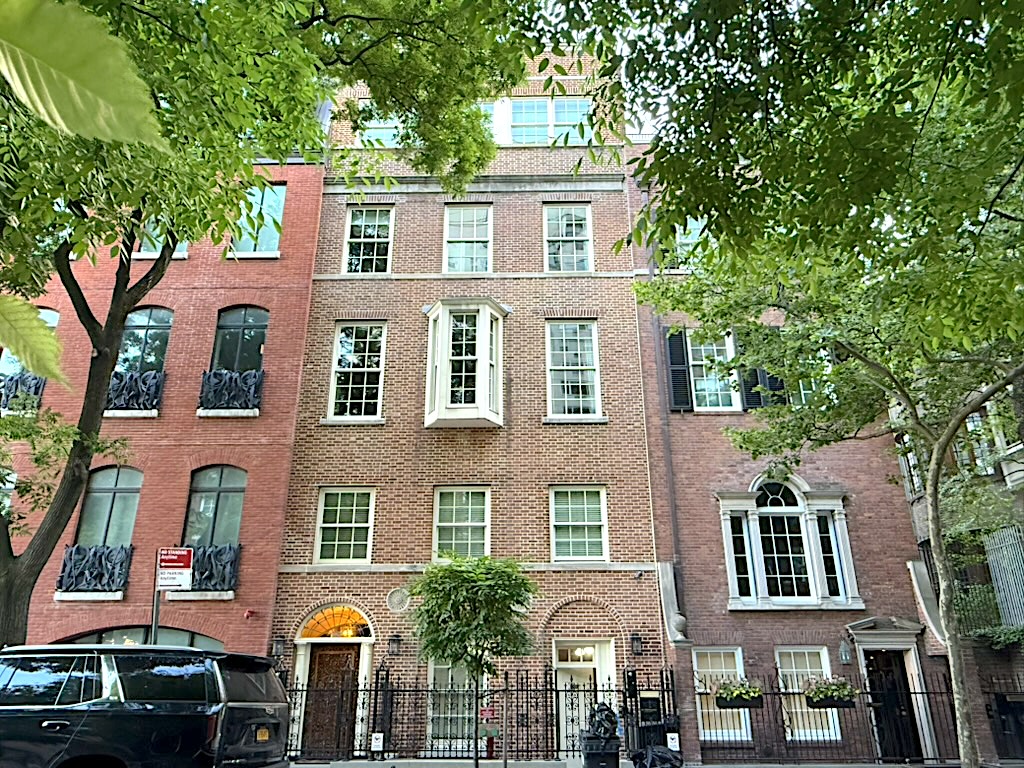
At the foot of East 58th Street is Sutton Square—a jewel box of a cul-de-sac overlooking the East River and flanked by luxurious townhouses.

All of the townhouses—they share a private garden with another group of homes on Sutton Place, one of which is the official residence of the secretary-general of the United Nations—are architectural gems.
Most were 19th century middle-class brownstones redeveloped and fancied up in the 1920s for elite New Yorkers with last names like Vanderbilt, Morgan, and Havemeyer.

But 6 Sutton Square, on the south side, has something special. Behind an iron fence and framed by a Georgian-Neoclassical entryway is an elaborately carved door made of solid teak.
The carvings, done by an Indonesian craftsman, according to a sales document written by the current owner—set a scene. There’s a regal-looking man and woman, peacocks, pigs, and mythological creatures—all set against a backdrop of swirling flower stems, petals, and rosettes.

What story is the door telling?
These carvings come from a legendary Sanskrit epic called Ramayana, a story about an exiled king, Rama. In the story, Rama must save his wife, Sita, who was kidnapped by a demon.
After 14 years, Rama and Sita return to their kingdom, though like many ancient epics the legend ends differently depending on where its told, according to the Asia Society, which has a more detailed story synopsis.

The man and the woman on the door must be Rama and Sita; the other figures and animals I’m not sure. The Ramayana contains 22,000 verses, and the choice of what to carve and why might only be answered by the craftsman.
The information about the door comes from the owner of 6 Sutton Square, who wrote about the backstory of the house and many of its details as part of an effort to sell the house—which is apparently on the market for $20 million.

The document is a love letter of sorts, and the owner points out that above the story of Rama and Sita “are two barongs which are supposed to protect the house.”
A barong is a mythological panther-like creature in Indonesian culture, per Wikipedia. See if you can spot these two faces above the peacocks in the fourth photo.
There’s not a lot of teak in New York City, as this wood is native to South Asia. But if the gorgeous teak carvings on 6 Sutton Place looks familiar, you might be thinking of this townhouse at 7 East 10th Street, owned by a decorator who hired Indian artisans to decorate his facade in teak.
Tags: 6 Sutton Square doors, Doors that tell stories New York City, Front door 6 Sutton Square NYC, Ramayana Sutton Square Door, Teak carved door Sutton Square NYC, Teak carvings NYC houses, Townhouses Sutton Square
This entry was posted on June 8, 2026 at 3:55 am and is filed under art, Upper East Side. You can follow any responses to this entry through the RSS 2.0 feed.
You can leave a response, or trackback from your own site.