
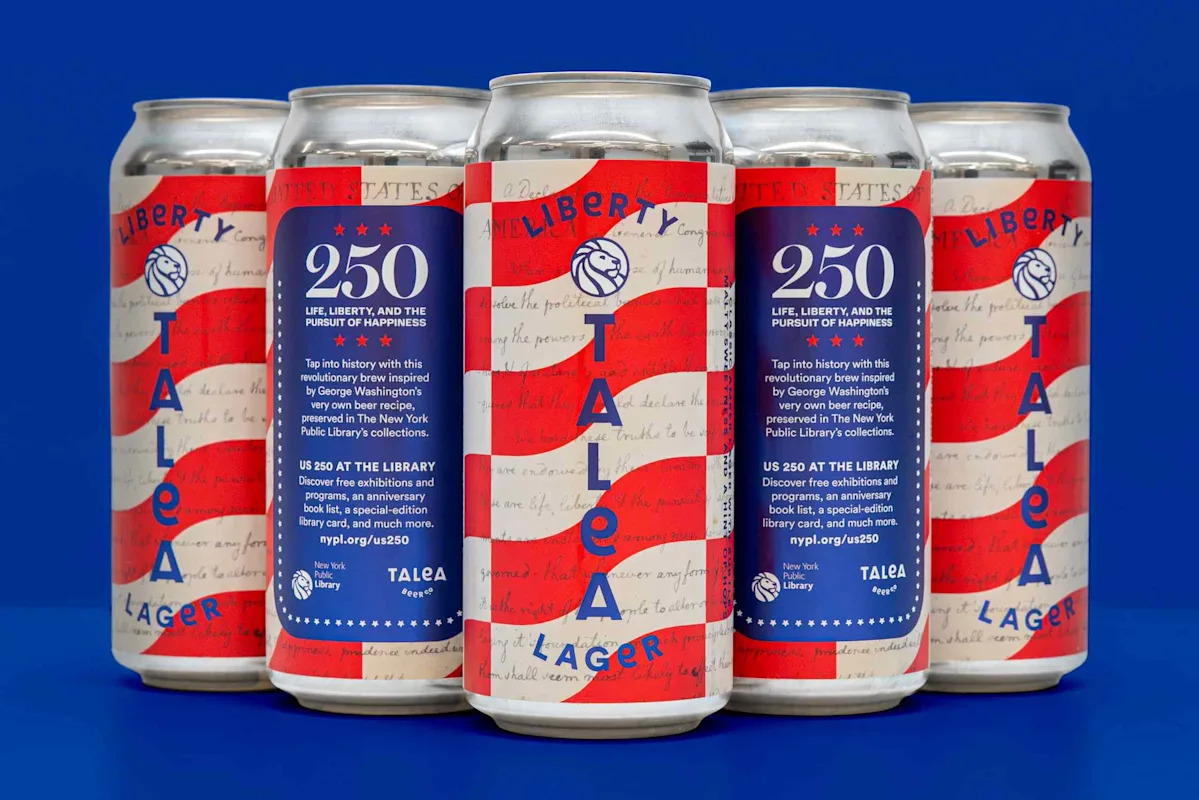
Talea Beer Co. wants to give you a taste of history this summer. Inspired by George Washington’s handwritten recipe for making “small beer,” the Brooklyn-based and women-owned brewery has partnered with the New York Public Library (NYPL) to release a limited-edition amber lager that’s simply titled the Liberty Lager
Washington’s original recipe was recorded in a notebook that the Founding Father kept while serving as a colonel in the Virginia militia. The journal has found its long-term home at the NYPL and is in the library’s digitized archives. Brent Reidy, director of the research libraries at the NYPL, says the Liberty Lager will allow New Yorkers to “literally tap into history” and get a “flavorful peek at life in pre-revolutionary times.”
The beer launch coincides with the NYPL’s series of events, exhibitions, and educational opportunities this summer that will commemorate the United States’ 250th birthday on July 4. The library’s patriotic initiative includes the debut of a limited-edition library card, a special anniversary book list, book giveaways, instant digital access to audiobooks and e-books, and a weekly release of ticket reservations to view the Declaration of Independence, which will be on display from July 1 through 7 at the NYPL’s flagship location.
Related: We Tried 6 of America’s Top-Selling Light Beers, Sight-Unseen — One Clear Winner Emerged
Small beer was historically a low-ABV fermented malt beverage that served as “an answer to the problem of non-potable water,” according to Talea’s head of production, Eric Brown. He says that “by boiling the water, adding hops, which are naturally antiseptic, and lowering the pH during fermentation,” small beer offered a relatively safe, shelf-stable, and palatable source of hydration and nutrition at a time when clean drinking water was difficult to come by. Small beer wasn’t just consumed by soldiers. It was enjoyed by people of all ages and demographics and was likely a staple for both Washington’s army and his household.
Constraints such as no refrigeration, a lack of lab-isolated yeast strains, and the cost of bottling meant that “in the mid-1700s, beer was still hyperlocal, drunk where it was made,” Brown explains. He tells Food & Wine that community businesses like taverns often made their own beer, and brewing was a common at-home activity, where it was regularly produced by women, staff, and people who were enslaved and performed the majority of domestic food preparation in the 18th century.
According to The Oxford Companion to Beer, a comprehensive reference book by Brooklyn Brewery Brewmaster Garrett Oliver, small beer’s alcohol content typically falls between 1% and 3% ABV. It was often produced from a second or third mash extraction, which results in lower sugar concentrations and, consequently, a lower alcohol content.
Related: Mid-Strength Beer Is Emerging as Craft Beer’s Most Compelling Next Act
Serving as an homage rather than a copy, the Liberty Lager is not a traditional small beer, and, unlike Washington’s original recipe, it isn’t brewed with molasses. Instead, Brown says the Talea team was inspired by the historical beer’s core characteristics, replicating its amber color with German caramel malts and producing its slight residual sweetness by adding drum-roasted malts and a base of rustic heritage barley.
Because it isn’t a small beer, the Liberty Lager has a more standard ABV of 5.5%. “We liked the overall perception that it was hearty and restorative,” Brown details. “We made sure it had a solid, medium-plus body and naturally carbonated it for a super creamy mouthfeel.” Although the Liberty Lager will have a broader release and be more easily accessible, consumers can sample a near-replica of Washington’s original recipe at some of the NYPL’s 250th anniversary events this summer.
The Liberty Lager is available in all five Talea taprooms and at select New York City restaurants and retailers, including Wegmans grocery stores, the historic Fraunces Tavern, and beer and cheese specialty shop Malt & Mold.
Fast Facts: Liberty Lager
Hops: Saphir, Hallertau Mittelfruh, and Tettnang hops
Read the original article on Food & Wine