
New Yorkers are accustomed to waiting for the train. But Harlem residents have waited a century for the Q.
Plans to extend that subway line to 125th Street in Manhattan were first dashed in 1929 by the Great Depression. Then, in the 1970s, New York City’s fiscal crisis halted tunnel work. In the 2000s, construction began on an extension as far as 96th Street, but dragged on and on.
Now, after the latest setback — a monthslong funding fight with the Trump administration — the northward expansion is finally moving forward.
On Monday, Gov. Kathy Hochul, wielding a golden shovel, broke ground on the latest stage of the project, a nearly $7 billion extension of the Q line to East 125th Street and Lexington Avenue.
“We’re not going to let the president, or his administration, stand in our way,” she said, vowing to finish the project.
The three new stations — at 106th, 116th and 125th Streets — are expected to be completed in 2032, adding new service for about 100,000 daily riders and a connection to the Nos. 4, 5 and 6 trains and the Metro-North Railroad.
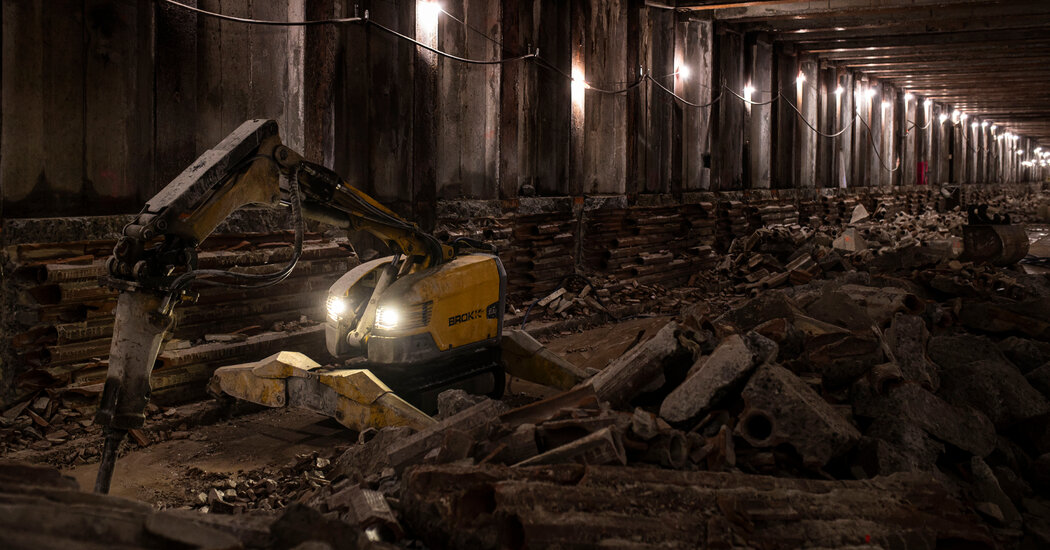
On Thursday, Ms. Hochul toured part of the incomplete train tunnel beneath East 116th Street and Second Avenue that was started in the 1970s but abandoned years later when the city nearly went bankrupt.
“This has been talked about for longer than people’s lifetimes,” Ms. Hochul said during the tour, standing on a damp and cracked concrete platform. “This is going to be absolutely transformational.”
In recent months, the fate of the project was once again in limbo. The Metropolitan Transportation Authority, the state agency that runs the subway, sued the federal government in March for withholding close to $60 million in promised funding for the expansion.
New York is ultimately counting on roughly half of the project’s funding, $3.4 billion, to come from Washington. But the federal government suspended payments in October in an apparent attempt to pressure Democrats during a government shutdown.
The U.S. Department of Transportation said the funding had been paused because of a review of the M.T.A.’s diversity and inclusion policies. In April, citing changes to those rules, the federal government agreed to release the money.
On Thursday, Ms. Hochul said, “We’re ready to build, and the money’s now in place.”
Representative Adriano Espaillat, whose district includes Harlem and who has pushed for the subway extension for years, said in an interview that the project would not only bring better transit to an underserved area but would also create 16,000 jobs.
“This is not just about three subway stops — this is about being the economic engine for Harlem,” he said.
During the tunneling in the 1970s, Harlem residents suffered through years of disruption, noise and pollution with nothing to show for it, said Dan McNichol, the author of “Second Avenue Subway: Building New York City’s Most Famous Thing Never Built.”
“It was a heartbreak,” he said, and a waste of resources. He marveled that, after decades, “New York City has the chutzpah to persevere” and proceed with the project.
But many challenges remain.
The M.T.A. is in the complicated process of connecting the long-abandoned tunnel beneath 116th Street with new construction to the north and south, while digging through some of the most finicky soil conditions in the city.
Streets between East 105th and East 110th Streets on Second Avenue will be cut open to connect the most recent expansion of the Q line with the remnants of the 1970s tunnel further north, and beyond.
Matthew Zettwoch, a project executive for the construction, called that integration “the linchpin” of the entire expansion.
Two hulking, custom-made tunnel boring machines are being built in Germany and will arrive in Harlem next year to drill a 20-foot-wide underground path to 125th Street. But parts of Upper Manhattan are on a high water table, so digging will require redirecting gushing groundwater. Mr. McNichol described some of the soil conditions as “quicksand-like.”
To stabilize the site for excavation, a towering drilling rig near East 120th Street on Thursday was pumping a cement mix deep into the dirt, to harden the soil and prevent flooding during the tunneling. A boring machine is expected to be lowered into the existing tunnel and begin drilling in March.
At a third construction site, near East 125th Street and Lexington Avenue, the terminus for this phase of construction, workers were welding and hauling massive metal sheets designed to catch any flying debris. This week, the M.T.A. will start setting off explosives to deepen a pit that will eventually become an entrance to a new subway station.
Nearby, more than 100 concrete columns called secants, some as tall as 100 feet, were being prepared to create a watertight wall around an excavation site.
The first phase of the Second Avenue subway expansion, adding three stations from 72nd to 96th Streets, was completed in 2017 after a decade of cost overruns and delays. Critics panned it as one of the most expensive rail projects, per mile, in history.