
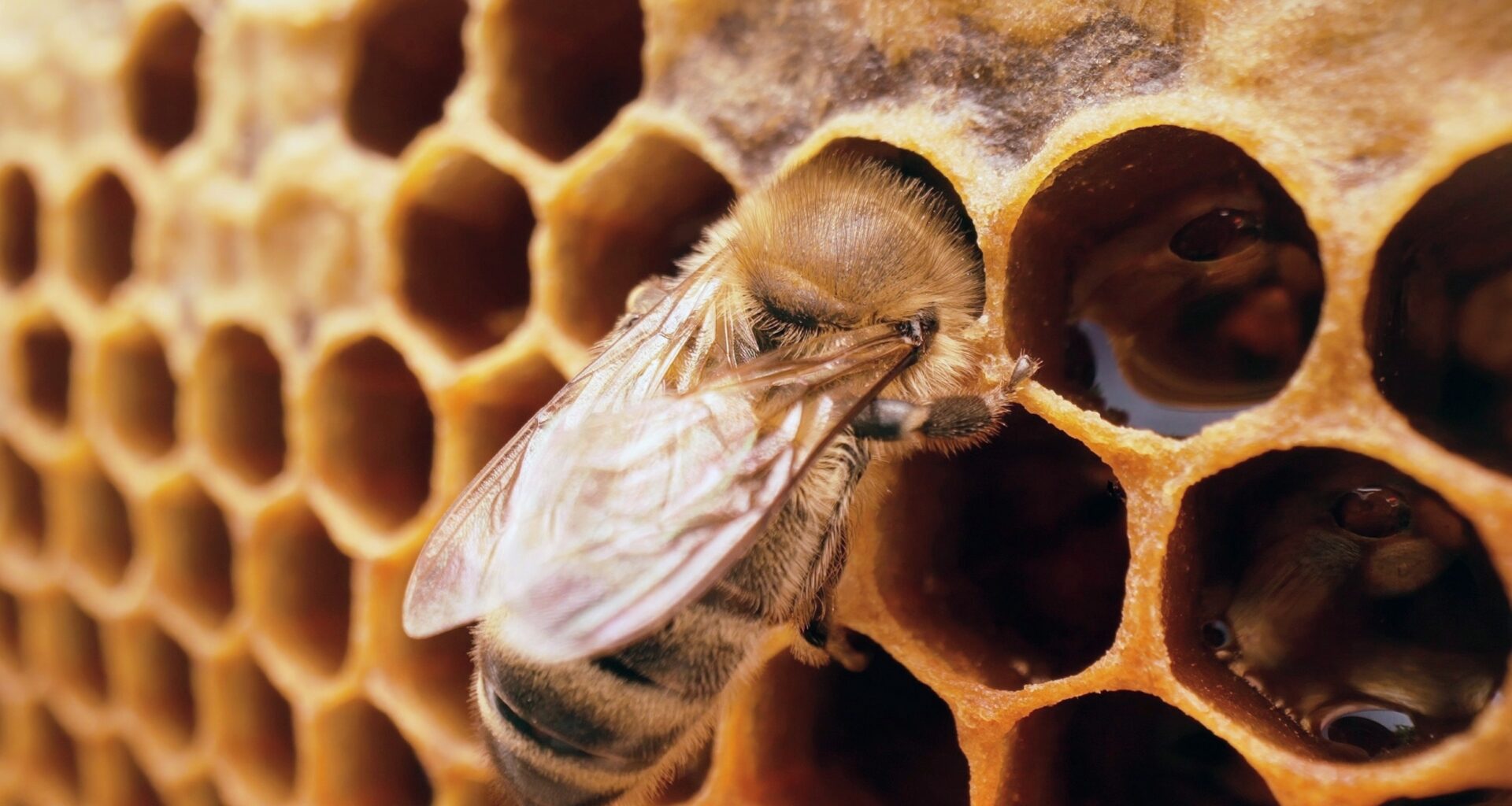
For years, one idea dominated the story of how a honeybee queen is made. Give an ordinary larva enough royal jelly, and it becomes royalty.
It seemed straightforward – a special diet created a special bee.

New research now shows that the process is far more complex. A future queen does not grow up in just any part of the hive.
She is raised inside a carefully prepared environment built by worker bees that appear to have one job: making sure the colony’s next ruler develops properly.
A nursery built for a queen
Honeybee queens and worker bees begin life almost identically. Both come from nearly the same type of egg. Yet the differences that emerge are remarkable.
Queens grow larger than workers. They mature more quickly and can live for years, while worker bees typically survive only weeks or months.
Most importantly, the queen becomes the colony’s primary egg layer, producing the next generation of bees.
Scientists have long believed royal jelly was the main reason for this transformation. The nutrient-rich substance is fed to developing queen larvae throughout their early growth.
Inside the royal cribs
The new study suggests food is only part of the equation.
Researchers discovered that queen larvae develop inside specialized chambers known as queen cells, sometimes called royal cribs.
These structures are very different from the familiar hexagonal cells where worker bees grow.
Using thermal imaging, behavioral tracking, materials science, and chemical analysis, the team found that queen cells create a unique developmental environment.
The wax used to build them is less dense, more flexible, and better at holding warmth and moisture than ordinary worker-cell wax.
The chemical makeup is different, too. Queen-cell wax contains distinct fatty acids and signaling compounds that help create the conditions needed for healthy queen development.
The workers behind the throne
The study identified a previously unknown group of young worker bees that researchers call queen cell builders.
These bees do much more than construct nursery chambers. They maintain higher body temperatures than many other workers and undergo physiological changes while caring for future queens.
Their efforts help speed up development. A queen bee reaches adulthood in about 16 days, while a worker bee typically takes about 21 days to mature.
The discovery changes how scientists think about queen production.
Boris Baer is director of the Center for Integrative Bee Research (CIBER) at the University of California, Riverside, whose laboratory contributed to the work.
“The old idea was relatively simple: take an egg, move it into a queen cell, feed it royal jelly, and you get a queen,” said Baer.
“What we found is that there’s an entire machinery behind this process. It’s much more sophisticated than we imagined.”
Why the wax matters
To find out whether the nursery itself influences development, researchers conducted an important test.
They raised developing queens in two types of cells. Some larvae grew inside chambers made from queen-cell wax.
Others developed inside chambers built from ordinary worker-cell wax. Both groups received the same food.
The results were striking. Larvae raised in worker wax were more likely to die. Those that survived developed into smaller queens.
The role of environment
The findings suggest that the physical surroundings play a major role in determining whether a queen develops successfully.
The worker bees responsible for building these chambers are equally selective.
Rather than simply reusing available wax, they gather materials from different parts of the hive, modify them, and enrich them before incorporating them into queen cells.
Researchers even added trace amounts of graphite to standard honeycomb wax.
Later, that altered material appeared in queen cells, showing that workers actively collect and transform materials for royal use.
A colony-wide effort
The process looks less like a simple insect nursery and more like a coordinated social project.
“You can think of it as something like Buckingham Palace,” Baer said. “There is a dedicated group of bees focused entirely on raising the queen, and if they don’t get it right, the colony cannot reproduce.”
The same pattern appeared in both Asian and European honeybee species. That consistency suggests the strategy evolved long ago and may be deeply embedded in honeybee biology.
The project brought together experts in behavior, physiology, chemistry, genomics, and materials science. It was led by former UC Riverside postdoctoral researchers Yu Fang and Yahya Al Naggar.
“In its collaborative nature, this project reflects the broader CIBER philosophy of bringing different disciplines together to tackle complex biological questions,” Baer said.
Rethinking how living systems develop
The findings have implications beyond bees.
Biologists increasingly recognize that development is influenced not only by genetics and nutrition but also by surroundings, social interactions, and environmental conditions.
Honeybees now provide another powerful example of that principle.
For decades, the queen bee seemed to represent one of biology’s simplest stories. Special food produced a special insect. The new research paints a different picture.
A queen emerges from a carefully managed environment created by an entire community working together.
“This work highlights how much sophistication exists inside insect societies,” Baer said.
“Honeybee colonies are not simply collections of individuals. They function as integrated biological systems capable of engineering their own environments.”
The full study was published in the journal Nature.
—–
Like what you read? Subscribe to our newsletter for engaging articles, exclusive content, and the latest updates.
Check us out on EarthSnap, a free app brought to you by Eric Ralls and Earth.com.
—–