
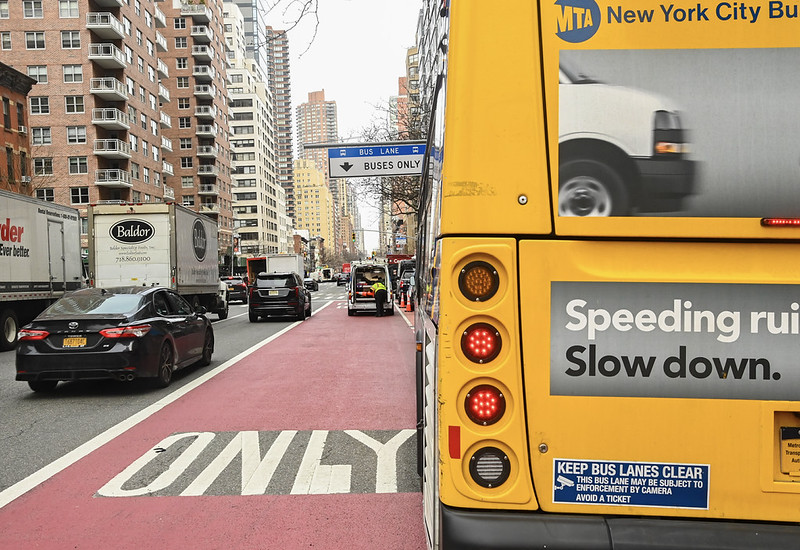
An MTA bus in a bus lane in Manhattan.
(Marc A. Hermann / MTA)
Drivers could get slapped with hefty fines for obstructing two more bus routes in Brooklyn and Manhattan beginning this Friday, June 12, the MTA announced on Tuesday.
The transit authority is expanding its Automated Camera Enforcement (ACE) program to the B15 in Brooklyn and M31 in Manhattan, the agency said. The routes go from Bedford-Stuyvesant to East New York and between East Harlem and Randall’s Island respectively.
The program, which the MTA rolled out in June 2024, will see cameras attached to buses on both routes, issuing fines to drivers caught riding or parking in busways and bus lanes. It is part of the MTA’s and the city Department of Transporation’s (DOT) broader efforts to speed up the city’s sluggish buses, which are among the slowest in the country.
Under the program, fines for drivers caught using busways or bus lanes, blocking bus stops, or illegally double parked will start at $50 and increase by $50 increments for repeat offenses until reaching a maximum $250. The violations, which are issued every two hours, are civil penalties and do not effect the offenders driving record.
Once it collects video, images, license plate information, location, and time stamp information from drivers, it sends it to DOT and the city Department of Finance for review.
With the two new routes included, the MTA will have ACE cameras on 64 bus lines, the agency said. Over 1,900 buses are now outfitted with ACE cameras, covering 810 miles, and benefitting over one million riders.
DOT counts the addition of ACE cameras to routes toward new protected bus lane miles it is required to produce ach year under the city’s Streets Plan. Year after year, the city has fallen far short on number of both bike and bus lanes that it is mandaed to bill each year.
The MTA touts the ACE program as a resounding success.
The agency says that when paried with other improvements, such as bus lanes and street enhancements, ACE cameras have been shown to improve bus speeds. On parts of some routes where ACE has been installed, buses are moving as much as 30% faster.
The MTA earlier this year also reported a 40% drop in instances of drivers blocking bus stops accross ACE routes, 50 at the time, since it launched the program.