
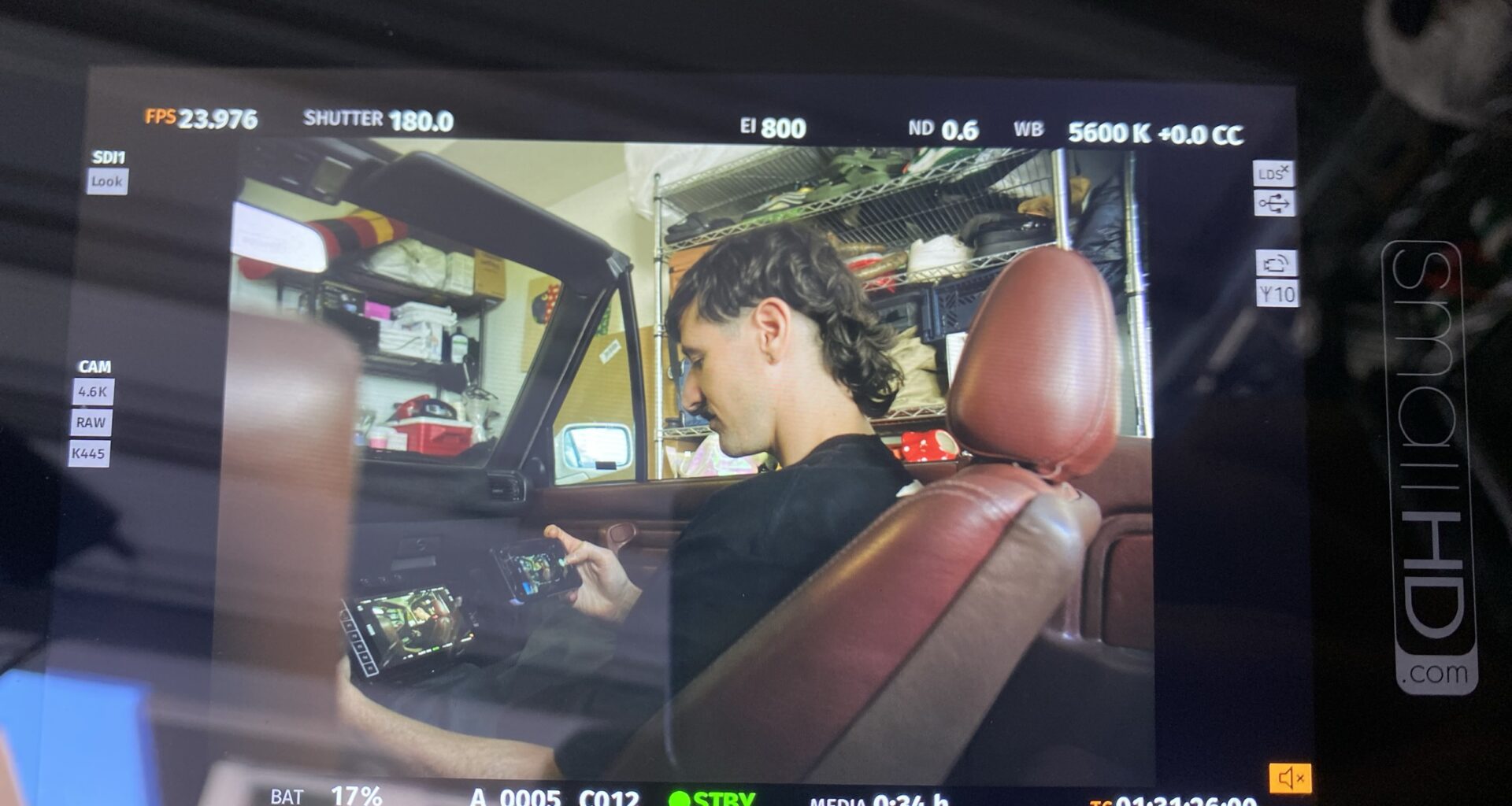
Serious People (2025)
Directed by Ben Mullinkosson and Pasqual Gutierrez
Written by Pasqual Gutiérrez
I first met director Ben Mullinkosson when I interviewed him for The Last Year of Darkness (2023), his intimate, fluorescent documentary about the underground club scene in Chengdu, China—my hometown. He has always struck me as someone who meets life where it is, with equal parts determination and whimsy.
That same playful conviction carries into Serious People (2025), co-directed with his longtime friend Pasqual Gutierrez, who had already made his name directing music videos with his CLIQUA teammate Raúl “RJ” Sanchez.
Most people in this acidic comedy play parallel-universe versions of themselves. It follows Pasqual (Gutierrez), a Los Angeles music video director, as he approaches the birth of his first child with his wife Christine (Gutierrez’s real-life wife, Christine Yuan, who’s also a successful director). When a major opportunity to direct a Drake music video collides with the baby’s imminent arrival, Pasqual hires his lookalike Miguel (Miguel Huerta), an earnest local actor, to take his place on set.
The film starts as a self-deprecating joke about working in the entertainment industry, complete with lines like “Our thematic focus is strippers.” It then grows increasingly real and unexpectedly tender—and ends up becoming an all-encompassing commentary on ambition, parenthood, and agency.
Beneath the satire is a sincere question about what it means to “make it,” for creatives in Los Angeles, and for us all. Mullinkosson’s films tend to revive the lost art of the tagline: The Last Year of Darkness has “From throwing up to growing up;” Serious People says, “Life’s a movie.” We may dream of living life like a movie, or of making movies for a living, but life itself should always be the end goal.
Weiting Liu (Rail): I know the film started as a dream of Pasqual’s. Ben, how did you get involved with this project?
Ben Mullinkosson: Pasqual had this dream that he landed a big music video gig on the eve of Christine giving birth, so he hired a doppelgänger to direct the video while he got to be there for his family. He called me to go to LA and help turn that dream into a feature.
Pasqual and I go way back: we met in film school, were roommates, got repped by the same company afterward, and had talked for years about making a feature together. We just didn’t have the right idea for it; instead, we kept collaborating on shorts, experiments, commercial work, etc.
Fast forward to 2023: I had just finished The Last Year of Darkness around the same time that Christine got pregnant. Pasqual was understandably going through an existential crisis about becoming a father and a new version of himself. His sense of urgency set the film in motion.
From his dream to our premiere at Sundance, it only took about a year and a half.
Rail: How long did the actual production take?
Mullinkosson: We developed the script loosely in a Google Doc and pulled together minimal financing. In total, we shot about twenty-four days over two months, just a few days each week. The production was piecemeal and came together through favors. For example, our producer Ryan Hahn got us the strip club location for free, but only from 8 to 10 a.m. on a Wednesday. We just took what we could get and built our schedule around these economical constraints.
Rail: That makes sense. It’s Wednesday morning from 8 to 10. Who’s even at a strip club then, other than an indie film crew? [Laughs]
Given its small budget, the film feels surprisingly cohesive, finding its rhythm in these offbeat conversations where people bounce random ideas off each other at parties, on sets, and, of course, in strip clubs. It’s refreshing to see a character-driven film about LA without spectacle or gloss, but full of chemistry and pulse.
Mullinkosson: Everyone in the film is smooth and funny. I’ve known many of them for over ten years, so I felt confident that whenever I pointed the camera at them, something interesting would happen. We also took an affected approach with Roy Andersson in mind: what if he made an absurdist documentary about music video directors in Los Angeles? He was our guiding light.