
Scores for Coming Storms
Sikkema Malloy Jenkins
May 14–June 20, 2026
New York
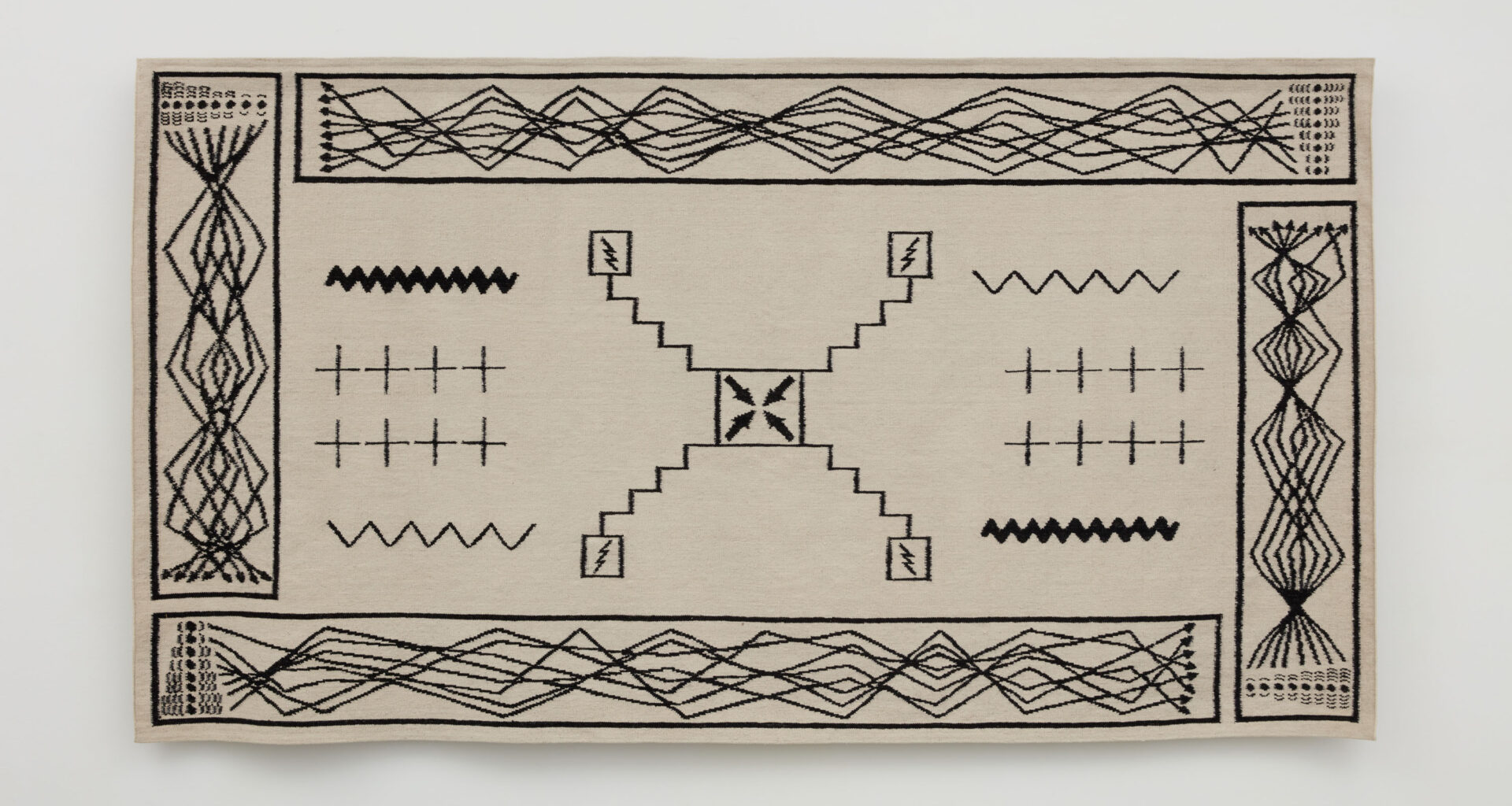
Raven Chacon: Scores for Coming Storms is a layered installation of sonic and visual works that encompasses both Euro-American and Navajo worldviews. Raven Chacon is a Diné (Navajo) Pulitzer Prize-winning composer and artist born in Fort Defiance, Arizona, in the Navajo Nation. Currently based in Albuquerque, New Mexico, he made strong impressions in New York in the 2022 Whitney Biennial and a one-person exhibition at the Swiss Institute in 2024. Scores for Coming Storms is Chacon’s first solo exhibition at Sikkema Malloy Jenkins and is made up of a large graphite wall drawing, framed ink drawings, a sound installation, and a wall textile. As a succinct reprise and recontextualization of earlier work, it allows gallery-goers to see and listen to the breadth of this artist’s multivalent vision.
In the first of two rooms, American Ledger No. 1 (2018) fills an entire wall with a diagrammatic narrative drawn across and down seven precisely penciled rows. A literal musical score for percussion and woodwinds as well as coins, an axe, a police whistle, and a struck match, American Ledger No.1 encompasses music, sound, performance, and graphic pictograms to chronicle the origin story of the United States. While the score wasn’t performed for this exhibition, the wall drawing is accompanied by a written description and legend that explains the performative and pictographic components of the artwork, which can be realized as a flag, a blanket, a billboard, a door, or a wall. Viewers, perhaps unaccustomed to deciphering a musical score in the context of a gallery exhibition, can nonetheless “read” Chacon’s narrative symbols from top to bottom and left to right, as they correspond to sounds conceived to represent the founding of this country. The work begins with the blank vastness of prehistory and the evolution of Indigenous thought. It then portrays colonial contact with and violence towards Native Americans and the forced assimilation and attempted erasure of a land and culture.
Chacon’s lexicon of notations in the wall drawing speak to and harmonize with lines, marks, and symbols in the adjacent ink drawings. Several of the drawings are part of an ambitious musical score called Tiguex that was performed in twenty movements across the city of Albuquerque throughout a single day: September 27, 2025. Looking for a way to tell a personal story as well as the complex history of Albuquerque, Chacon created a musical score in the form of a map that depicted all the day’s events, guiding over two hundred musicians and the audience through the mountains, volcanos, waterways, conquistador trails, and pueblos of the city. In Volcano Choir (2026), lines and dots along two musical clefs and a zigzag line elsewhere on the page chart with simple eloquence the progress of a choir of singers along different elevations on the side of Black Volcano. Another drawing describes several discrete events, one of them “The Teaching of the Wind,” with a hot air balloon and individual notes separated by slash marks. A third drawing combines three different movements including “Ballad for Two Cellos,” in which a cellist laments a second cello floating down the Rio Grande. This episode is portrayed by two wobbly lines with arrows that connect two drawn cellos to a series of parallel, horizontal lines articulated with dots—suggesting both the river and a musical staff—while three squiggly lines below allude to the movement of the water.