
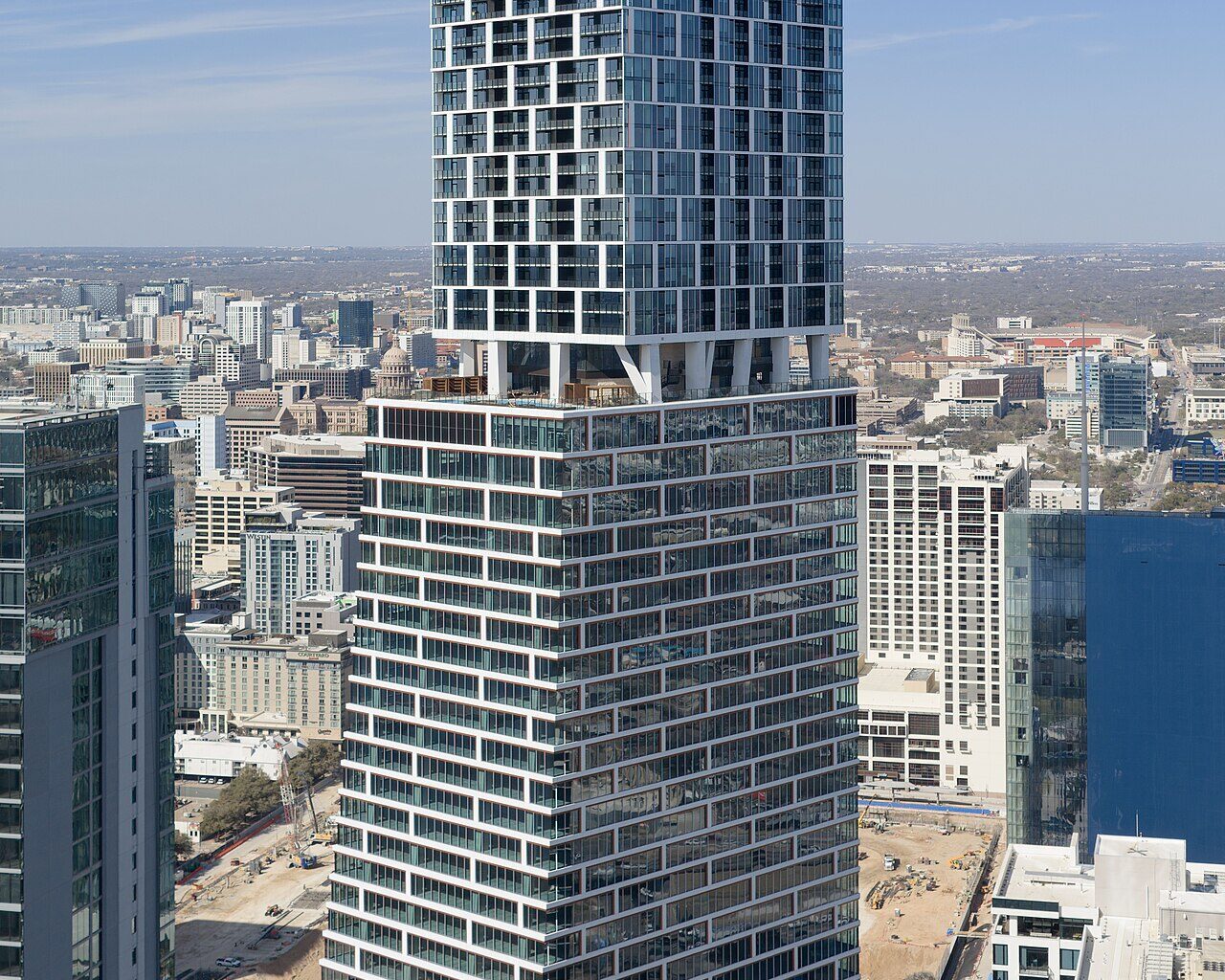
It feels safe to say that Waterline, the City of Austin’s first supertall and the new tallest building in Texas, takes its name from its environs: Red River Street to the east, Waller Creek to the west, the Colorado River both west and south. It’s even located within the Rainey Street Historic District—don’t mind the extra “e.”
The 1,025 foot tall, Kohn Pedersen Fox–designed, privately funded behemoth contains multiple programs. From bottom to top, it’s a parking lot, a retail square, a hotel, an office building, and an apartment complex—all of which will open to the public in piecemeal fashion throughout the year. The building follows a previous attempt to manifest a similar mixed-use project in the same location—the biggest difference was that the previous project, Waller Center, would have entailed three towers instead of one.
The multiplicity and the backstory both help to explain why Waterline looks like a stack of three disjunct masses, mediated by dedicated amenities floors with prominent concrete columns. Or, three increasingly-svelte buildings in a glass-facade trenchcoat, complete with non-structural aluminum extrusions that privilege horizontality and create a matrix of “playful partitions” (KPF’s own words).
Building number one features a west-facing facade that follows the curve of Waller Creek; it houses the hotel, the retail space, and the parking lot. The middle building, which gently narrows as one ascends, holds the office units. The top building, a straightforward rectangular prism, is home to the luxury apartments. Taken altogether, Waterline’s geometric irregularity invokes Austin’s Downtown Density Bonus Program; under certain conditions, there is no limit to a skyscraper’s height within the Rainey Street Historic District, though there is a limit on its floor-to-area ratio.
Sleek and shiny, and tall enough to create its own private cloud cover, Waterline seeks to be “a building for our time.” I take this declaration as an invitation to question the assumptions being made about my hometown. What versions of past and present Austin would allow such an unequivocal claim?
To hear it told, Texas’s capital city had little to brag about economically beyond the state government and the university until the mid-twentieth century. By the 1980s, and thanks to an influx of novel industry, Austin was shedding its boondocks reputation, and nostalgic residents grew nervous that economic and demographic growth would dilute the city’s unique character.
In 2000, Austin received a catchphrase that captured both the love and the latent anxiety. A throwaway radio appeal from librarian Red Wassenich to “Keep Austin Weird” became an omnipurpose talisman against corporatism and squares. Such a contrarian municipal motto aligned neatly with the city’s general reputation as a blue oasis in a red desert.