
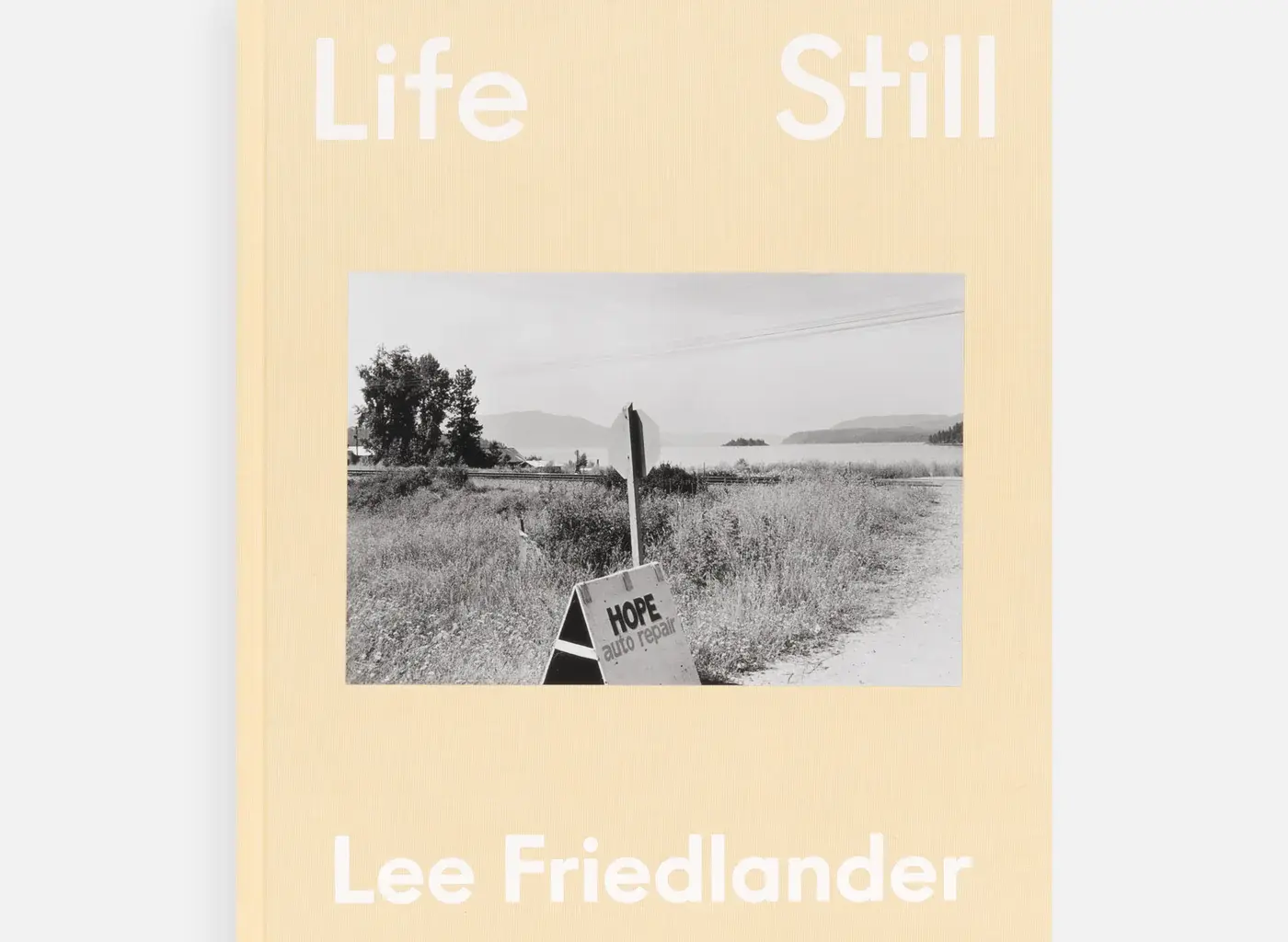
Lee Friedlander: Life Still
Hua Hsu
Aperture, 2026
“There aren’t many people in these images, but there is presence,” writes Hua Hsu in the introductory essay to Life Still, a new monograph spotlighting the work of Lee Friedlander. Born in 1934 and an active photographer since 1948, Friedlander’s early work focused on the goings-on of street life and signage across the United States. But he’s also taken self-portraits, produced an infamous eerie series of lit televisions in motel rooms, documented jazz and blues performers, and depicted statues and monuments. His work was included in the legendary New Documents exhibition at the Museum of Modern Art in New York in 1967; more recently, he’s been the subject of a major exhibition at the Whitney Museum of American Art and, two summers ago, director Joel Coen curated a cinematic selection of his work at LUMA Arles in France.
The photographs showcase human behavior mostly in absentia of frontal bodies—but not without evidence of what Hsu calls “the American way of seeing.” This is predicated on cultural mythmaking compounded by overpromising advertisements, aspirational magazines, Hollywood films—and “disposable culture, signs of America’s crass habit of regarding anything as art.” Friedlander’s never a scold about whatever delusions are at play in “the American way of seeing”; he’s bemused by the folly and chronicles it in sly ways that are jocular.
Friedlander’s images, clever unto themselves, feel heightened in their humor thanks to the sequencings in Life Still. As Hsu put it: “You study Friedlander’s pairs, noticing the rhymes across time and space.” Two juxtaposed photographs taken in New York City have incredible formal parallels: one is a 1969 self-portrait in a dental chair, jaw agape and sheathed in latex, while the next image from 1992 shows a poster of a man with his mouth agog pasted on graffitied wooden paneling with the words “DAMAGE CONTROL.” Such ingenious mirroring happens again between a living room wall hung with animal skulls and African statuettes (shot in New York City, 2019) adjacent to a photo of orderly rows of TIME magazine covers hung in an antechamber for an Army and Navy Club space (shot in Washington DC, 2019)—respectively presiding above floral couches, each showcase a different sense of trophy. These contiguities reflect visual typologies Friedlander is attracted to, but also reflect how effective his sift of his vast archive is to create such impish pairings.