
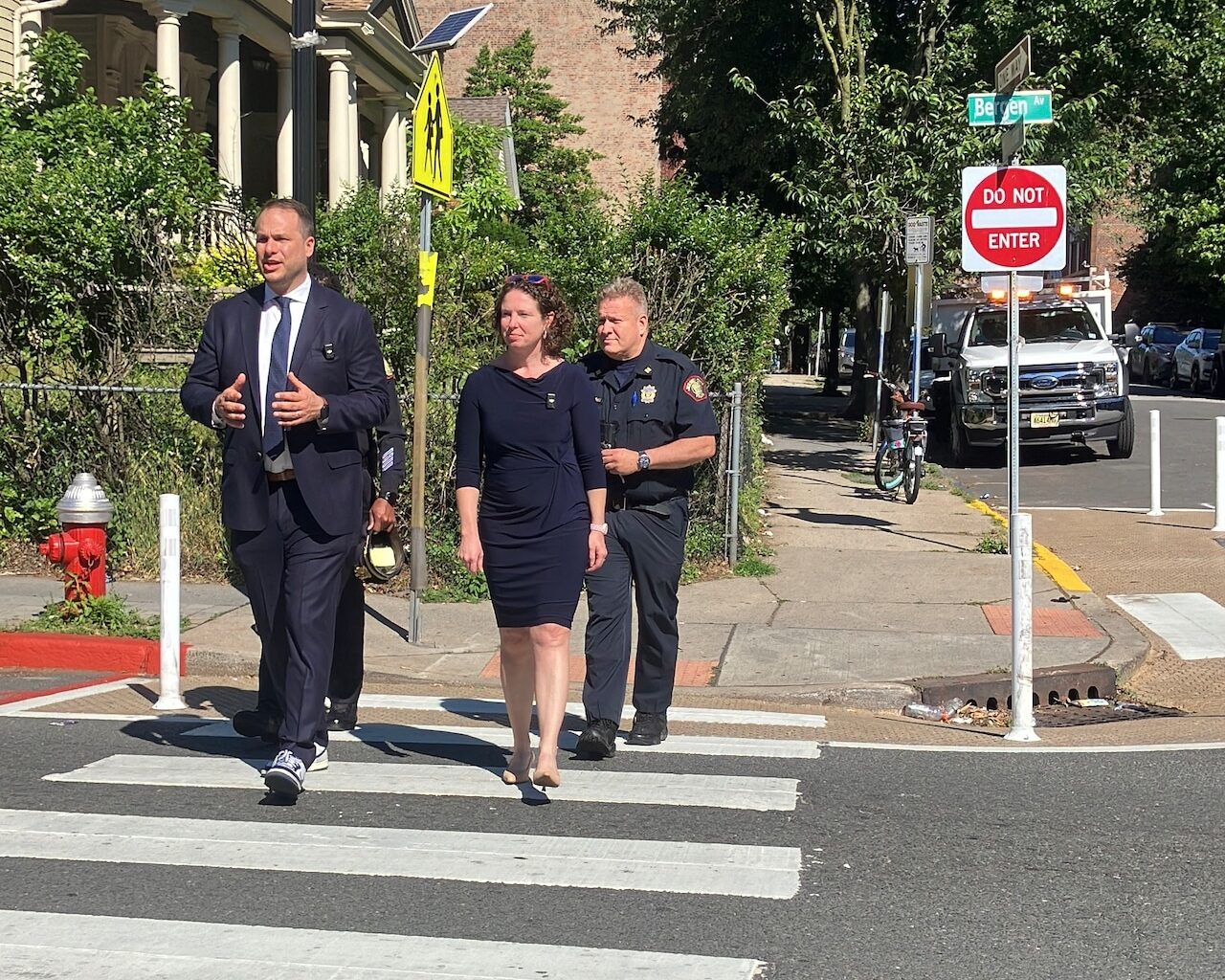
Six cars drove through a new all-way stop intersection by Public School 17 in Jersey City during a traffic safety press conference, illustrating the need for stepped up safety work in both the city and neighboring Hoboken.
Quick moving police stopped and ticketed the driver of each vehicle as officials from both cities talked about updating their Vision Zero Plans and implementing more than 100 quick-build safety infrastructure projects.
“Traffic enforcement is working,” said Andrew Kaplan, Jersey City’s infrastructure director, as the Tuesday morning ceremony started at PS 17 in Jersey City.
The signs at the intersection of Bergen Avenue and Kensington Street next to P.S. 17 included a yellow sign warning drivers the all-way stop was new. Painted bump outs and plastic bollards narrow the road and allow pedestrians, including school children, to be seen by drivers.
Soon more than 100 similar improvements will join them in both cities, in addition to an update of its Vision Zero safety plans.
City officials also had a message to other towns. They can make these simple safety improvements at trouble prone intersections in their towns without a high cost or build time.
Other projects announced include all-way stop signs and installing flashing warning beacons that alert traffic to crossing pedestrians at crosswalks where there aren’t traffic lights.
Traffic lights in critical intersections will be retimed to give pedestrians a head start crossing a busy street before vehicles get a green light.
Hoboken Mayor Emily Jabbour said the newly elected mayor of Parsippany-Troy Hills called her after a recent traffic death to ask how to get started.
A Vision Zero program sets a goal and strategies to eliminate traffic deaths and injuries by a specific date.
Hoboken hasn’t had a fatality on city streets in the nine years since it was implemented, she said.
“Hoboken used multiple funding streams, some state, some federal some local,“ she said about making safety improvements. ”You can do really easy investments by rethinking the way your infrastructure department works. It doesn’t have to be high cost.”
One easy way is to include the safety improvements in a routine road repaving project, Jabbour said.
“These are the things cities are doing,” she said.
Jersey City has $750,000 in its capital budget to cover on-call traffic signal maintenance, road striping contracts and use of in-house public works for quick-build projects, Solomon said.
Both cities also are working jointly, from applying for grants to sharing information.
“Changing driver behavior and building safer streets doesn’t stop at the border,” Solomon said. “Hoboken has lead the way with zero traffic deaths since 2017.”
The joint Vision Zero update and some of the projects are funded by a $940,000 USDOT Safe Streets and Roads for All planning grant that Hoboken and Jersey City applied for and a $235,000 local funding from the cities.
That is helping to fund an update of the Vision Zero plans, which will also help officials decide on future safety infrastructure improvements.
“We have not met our (Vision Zero) goal, seven lives were lost in 2025,” Mayor Solomon said. ”We’re renewing Vision Zero with Hoboken and committing to action now.”
Jersey City is in the process of doing engineering studies to follow Hoboken’s lead in implementing a city wide 20 mph speed limit, Kaplan said.
Jersey City’s 100 improvements in 80 locations were selected based on evaluating data and not on picking them for political convenience, he said.
But traffic enforcement is as important as infrastructure, Solomon said. He reinstated the city police department traffic enforcement bureau, which started operating on May 1.
“In a month, we issued 300% more summons, we’ve seen crashes decline,” he said. “We need traffic enforcement paired with infrastructure.”
Enforcement is concentrated at critical intersections and the locations publicized on social media, he said.
“The goal is we don’t want to issue tickets, we want safe driving,” Solomon said.
Jabbour said infrastructure helps get safe driving behaviors since her smaller city doesn’t have the budget to put police at every problem intersection.
Hudson County Compete Streets member Jimmie Lee mentioned the death of a 6-year-old boy who was riding his bike in a crosswalk and was hit by a delivery truck making a right turn.
“For too many years, traffic deaths are thought of as a way of life,” he said. “We hear fixing the problem will cost too much, and we wait, wait, wait.”
He called Tuesday’s announcement “a starting line, not a finishing line.”
“Traffic deaths are not inevitable,” Jabbour said. “It’s why we campaign for improvements for safer roads and neighborhoods.”
Ryan Sharp, Hoboken’s director of Transportation and Parking, also paid tribute to advocacy groups, including Hudson County Complete Streets, Bike Hoboken and Bike JC, which have lobbied for traffic safety.
“Without the advocates to step up, there is no vision Zero program or projects,” he said. “The challenge is I want everyone to think of what they can do to make streets safer.”
One advocate who spoke was Ken Bandes of Jersey City, whose 23-year-old daughter Ella was hit and killed by an MTA bus in Brooklyn in 2013.
He and his wife joined Families for Safe Streets to work for safety improvements.
“Every improvement increases the chance that people make it across the street alive. There is a lot to do,” he said. “We don’t want to wait. We don’t want to do more studies. We want progress.”
Part of that advocacy also involves telling Ella’s story to public officials to get action.
“We can’t save our daughter, maybe we can save yours,” he said.