

Track your investments for FREE with Simply Wall St, the portfolio command center trusted by over 7 million individual investors worldwide.
Uber Technologies (NYSE:UBER) has filed a lawsuit against New York City to block enforcement of a new law that limits when it can deactivate drivers.
The company argues the law threatens rider safety and violates its constitutional rights.
The case centers on how much control ride hailing platforms can retain over driver access to their apps.
For investors watching NYSE:UBER, this dispute goes to the core of how the company runs its ride hailing marketplace. Uber operates a global platform that connects riders and drivers, and New York City is one of its most visible and heavily regulated markets. City level rules like this can shape how platforms handle safety policies, driver discipline, and customer protections.
The outcome of this lawsuit could influence future rules in other cities that are watching New York’s approach. It may also affect Uber’s legal exposure and the way it balances rider safety policies with driver protections. For shareholders, the case highlights how regulatory decisions can touch both day to day operations and longer term risk for the business.
Wall Street’s queuing for one rocket. While SpaceX counts down to its IPO, other companies tied to the new space race are already in orbit. → 20 Compelling Space Companies watchlist · Global Space Race Investing Ideas screener · Scan the sector by valuation on Rocket Lab’s valuation page.
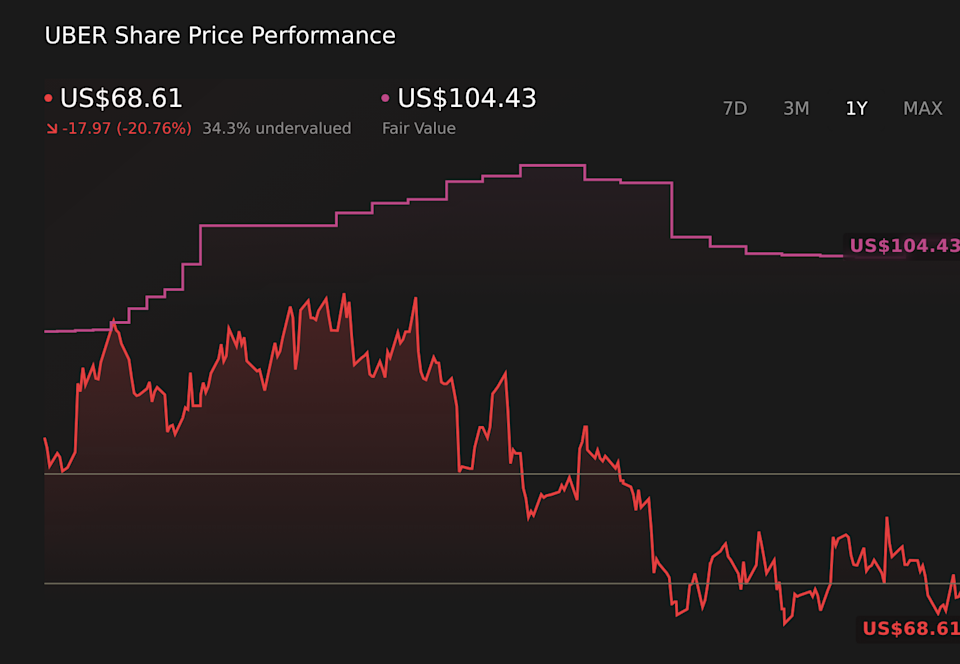 NYSE:UBER 1-Year Stock Price Chart
For Uber, the lawsuit against New York City highlights how closely its operating flexibility is tied to local regulation. The company says Local Law 52 would restrict when it can deactivate drivers and require sharing rider complaints with drivers, which it argues could compromise passenger privacy and safety. That goes to the heart of how Uber manages platform risk day to day, especially in a city that is both a large market and a reference point for other regulators. If the court sides with the city, Uber could face tighter rules on driver discipline, potential exposure to wrongful deactivation claims, and a more formal appeals process that may increase compliance costs. If Uber secures relief, it would preserve more control over who can drive on its platform but may attract further scrutiny from policymakers and advocacy groups. Either way, the dispute adds another regulatory thread on top of existing issues such as labor classification and insurance structures, which investors already watch closely for their impact on margins and long term legal risk.
How This Fits Into The Uber Technologies Narrative
The legal pushback in New York aligns with the narrative that regulation is a central factor in Uber’s long term profitability, because control over driver supply and safety standards influences trip quality and operating costs.
This dispute also challenges the idea that scale alone will smooth out legal and regulatory friction, since one city level rule can directly affect how Uber applies its global safety and deactivation policies.
The focus on driver rights and due process introduces a dimension that may not be fully reflected in the existing narrative, which concentrates more on autonomous vehicles, membership, advertising, and international expansion than on potential constraints to managing human drivers.
Knowing what a company is worth starts with understanding its story. Check out one of the top narratives in the Simply Wall St Community for Uber Technologies to help decide what it’s worth to you.
The Risks and Rewards Investors Should Consider
⚠️ A ruling that upholds Local Law 52 could limit Uber’s ability to remove drivers it considers unsafe, potentially increasing incident risk and reputation damage, especially compared with competitors like Lyft, DoorDash (for delivery drivers), and traditional taxi fleets.
⚠️ The case highlights broader regulatory exposure, adding to previously flagged risks around profit margins and one off items in results, and may encourage other cities to consider similar rules that increase compliance and legal costs.
🎁 A clear legal outcome, even if not fully in Uber’s favor, could reduce uncertainty by defining the framework for deactivations in New York, helping investors better assess ongoing regulatory risk.
🎁 Uber’s decision to contest the law may signal to riders and regulators that it is willing to defend its safety standards and data handling policies, which could support trust in the platform relative to competitors if the company’s arguments are seen as prioritizing passenger protection.
What To Watch Going Forward
From here, focus on the court timetable, any temporary injunctions, and whether New York signals openness to revising Local Law 52. Watch for commentary on how driver deactivation policies evolve in other large cities, because a tighter New York framework could become an informal template elsewhere. Investors may also want to track any disclosures on legal expenses, insurance arrangements, and incident reporting, as these can show whether regulatory friction is starting to influence Uber’s cost base or operating practices in a way that matters for long term returns.
To ensure you’re always in the loop on how the latest news impacts the investment narrative for Uber Technologies, head to the community page for Uber Technologies to never miss an update on the top community narratives.
This article by Simply Wall St is general in nature. We provide commentary based on historical data and analyst forecasts only using an unbiased methodology and our articles are not intended to be financial advice. It does not constitute a recommendation to buy or sell any stock, and does not take account of your objectives, or your financial situation. We aim to bring you long-term focused analysis driven by fundamental data. Note that our analysis may not factor in the latest price-sensitive company announcements or qualitative material. Simply Wall St has no position in any stocks mentioned.
Companies discussed in this article include UBER.
Have feedback on this article? Concerned about the content? Get in touch with us directly. Alternatively, email editorial-team@simplywallst.com