
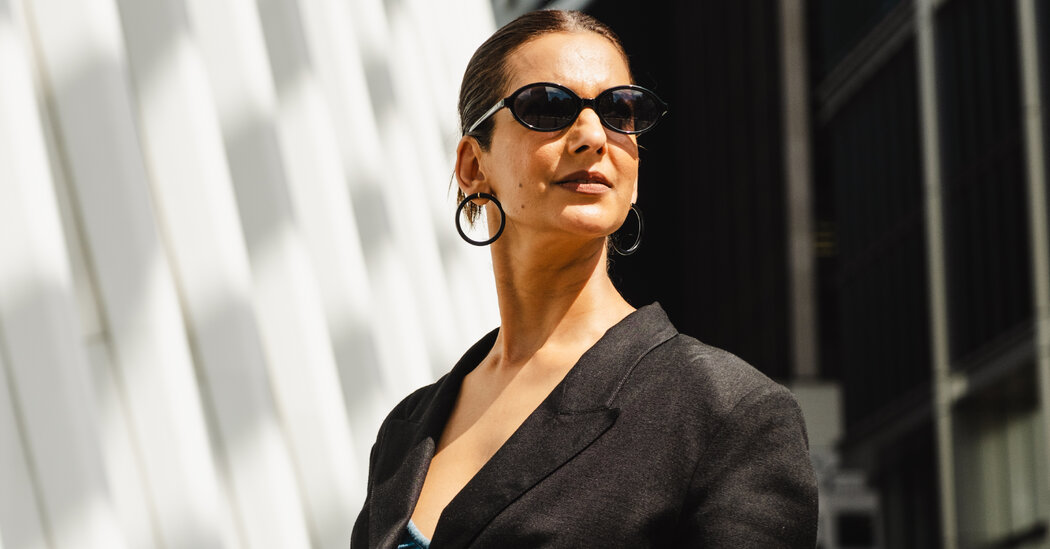
Poorna Jagannathan, dressed in a prim, black Stella McCartney jumpsuit, her wildly curly hair slicked back into a bun, was seated outside her favorite restaurant, in Manhattan’s NoLIta neighborhood, chatting about menopause.
“When I told my mum I was going through menopause, she said, ‘It’s OK, it’ll be over in one day,’” she recalled.
Jagannathan, 53, then raised her eyebrows and her hands in the air and, with perfect comic timing, added: “I have no idea what she’s talking about, because I’m in year three of absolute hell.”
It was the kind of wry and refreshingly honest remark that the actress is known for among close friends — like the actress Sarita Choudhury, with whom she was having lunch — but a side of her personality that viewers rarely saw onscreen. That is, until her most recent role as the cunning mob boss Lucky Auntie in the Hulu series “Deli Boys,” which released its second season in May. The show follows a drug trafficking enterprise run out of a Philadelphia convenience store.
It’s a pivotal role for Jagannathan, known in part for her characters in “Never Have I Ever” and “Wolfs,” because it’s a departure from the clichéd doctor or meek mother molds she played earlier in her career. But it’s also one that, she said, she probably couldn’t have inhabited before perimenopause.
One benefit of her 50s is that they come with “a really weird mind set shift,” Jagannathan continued. She finally understands what it means not to care about certain things, especially others’ opinions, she said, using far more colorful words than The New York Times would print.
The self-assurance, Jagannathan added, “just washes over you.”
During a break in Jagannathan’s hectic press schedule, she sat in on a class at the Barrow Group acting school, where she learned her craft; got her hair cut by her longtime stylist; and caught up with Choudhury at the restaurant Epistrophy, where they have been meeting since it opened over two decades ago — when both of them were pregnant.
As they shared plates of tagliatelle, burrata and endive salad, they reminisced over memories of rehearsing lines together in one corner of the restaurant, and doing their laundry at the laundromat next door.
At the exact moment of an interview with this Times reporter, another friend happened to be driving by and called out to say hello: The comedian and producer Ramy Youssef. He honked and rolled down his window to get her attention.
“Get out!” she ordered Youssef. “Pull over!”
“I can’t!” he shouted back, before driving away.
Jagannathan got back to chatting about the impostor syndrome she would have felt had she played Lucky Auntie, who guns down opponents with the ease of a hair flick and plays the incompetent men around her like pawns, earlier in her career. “I would have really been faking it,” she said.
Choudhury nodded knowingly. “Power roles are so tough,” she said.
Acting was not Jagannathan’s first career. She moved to New York in the 1990s to work at the advertising agencies Chiat/Day and then Ogilvy. Her work involved frequent presentations in front of audiences — something that was extremely difficult because of her stage fright — so she signed up for weekend acting classes to overcome the fear of public speaking.
The classes did much more, offering glimpses of a new life path. In 2001, she quit her job and signed up for more classes, renting out rooms in her apartment and doing freelance advertising to make ends meet. “I put a tiny curtain up and sectioned off a tiny part of the living room where I lived,” she said.
One of her first Hollywood roles came in 2006 when she played a minor character in “Law & Order” named Dr. Sikh, which is an absurd name, she pointed out, because Sikh refers to followers of Sikhism; it’s the equivalent of naming a character Dr. Catholic. But she didn’t feel she had the authority to bring it up and, for years, was cast in similar roles “with no real flesh underneath,” she said.
As a South Indian woman starting an acting career in her mid-30s, Jagannathan found that casting directors “didn’t know what to do with me,” she said.
In 2016, Jagannathan was at an advertising conference when she got a call from her agent: She had booked what would become a breakout role on the critically acclaimed HBO series “The Night Of.”
A longtime colleague, Mick McCabe, recalled her leaving the conference and her advertising career behind that day: “We were like, ‘You gotta go now?’” McCabe said, “and she was like, ‘I gotta go now.’”
In the two decades since Jagannathan got her start, Hollywood has awakened to the fact that stories with people of color in lead roles — as three-dimensional characters — resonate with audiences. By the time Jagannathan appeared in 2019 as Dr. Nalini Vishwakumar in Mindy Kaling’s hit coming-of-age series “Never Have I Ever,” viewers had seen movies like “Crazy Rich Asians” and shows like “Master of None” garner critical success. Jagannathan felt more empowered to weigh in on character lines, costumes and even onscreen meals.
The variety of characters she has played in the last five years is a testament to the fact that “she breaks out of boxes no matter the role, no matter the form,” New York’s mayor, Zohran Mamdani, who is a friend of Jagannathan’s, said in an email. In 2019, Jagannathan had helped Mamdani connect with the Indian celebrity chef Madhur Jaffrey for one of his rap music videos. She defies boundaries offscreen, as well: “I feel like Poorna would slap me if I called her an auntie,” he wrote. “She’s more like my cool older cousin.”
Case in point: Lucky Auntie was initially written as a male character, but after the show’s creator, Abdullah Saeed, watched “Never Have I Ever,” he turned the uncle into an auntie and didn’t need anyone else to audition.
In the second season of “Deli Boys,” Jagannathan gets to be part of something that has also been rare in her career: a full romance plot, with Max Sugar, a casino owner played by Fred Armisen.
As she put it: Auntie “gets to boink!”