
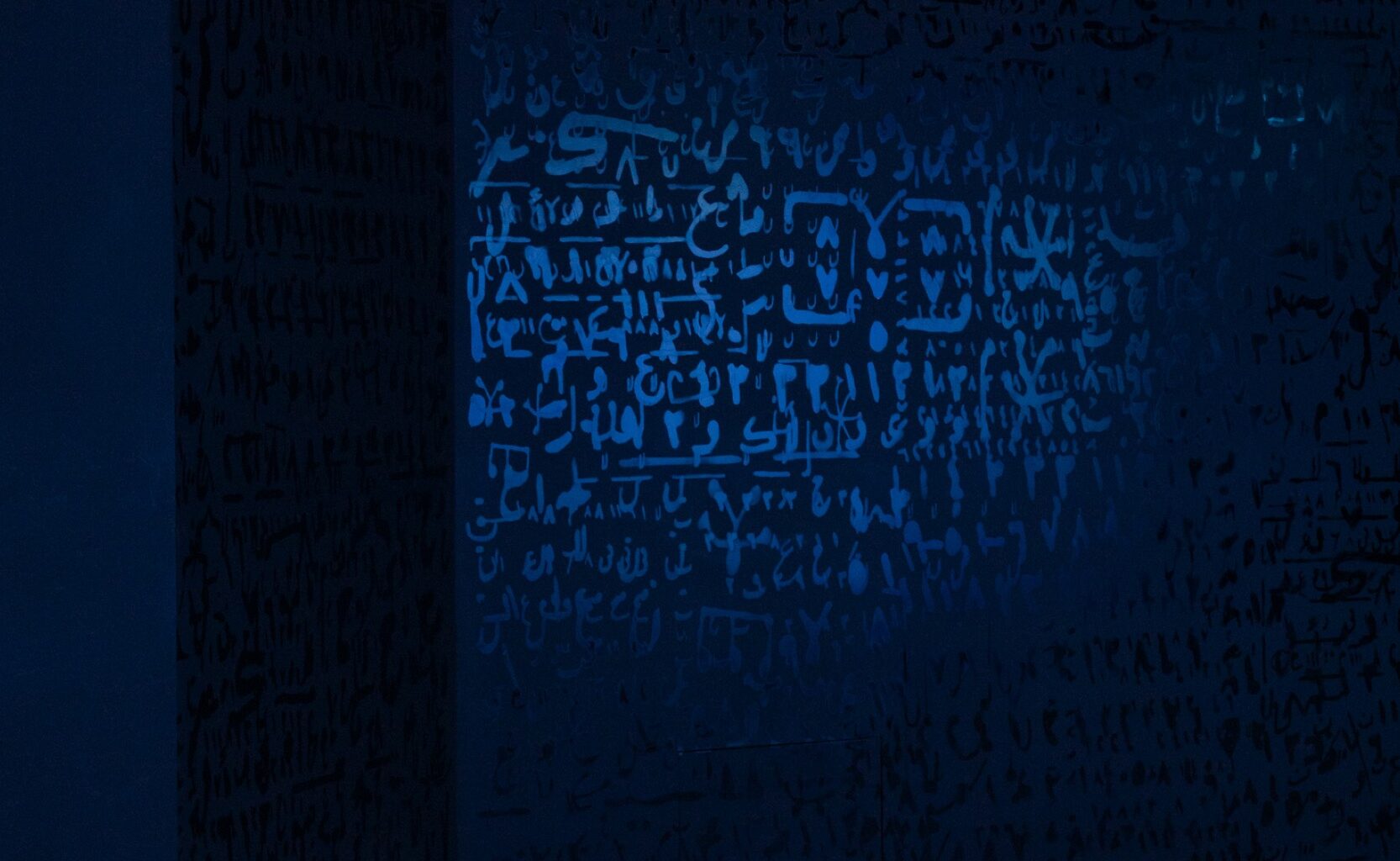
I moved further into the Arsenale and was struck by the Timor-Leste Pavilion, which featured the woven work of Veronica Pereira Maia, and the audiovisual works of Etson Caminha and Juventino Madeira. The project centers on language as a generative force within Timor-Leste’s layered systems of communication and on the artists’ ability to define the identity of this young nation with its tragic history. Timor-Leste is a Southeast Asian nation, located on the eastern half of the island of Timor. Timor-Leste is one of the world’s youngest countries, having bloodily struggled against Portuguese and then Indonesian control, before finally gaining formal independence in 2002. In this pavilion of a nation with very limited resources, I found the artists’ work to be profound and powerfully produced. This important work stood out: great art matters more than geopolitics.
Nalini Malani, the Magazzini del Sale
I turned next to Nalini Malani’s Of Woman Born, a newly commissioned moving animation chamber that fills the Magazzini del Sale on the fondamenta delle Zattere. With an early background in experimental film and a lifelong career that revolves around drawing, the artist developed this very large, immersive video installation. The work is based on “sixty-seven of Malani’s animations derived from more than thirty thousand iPad drawings, organized across nine channels of larger-than-life projection, each lasting three to five minutes,” and run in a constantly changing order. The work takes viewers into a deep, dark cave-like chamber with moving images projected onto the heavily salt encrusted walls of the cavernous space. The work draws upon the ancient Greek myth of Orestes, who kills his mother to avenge his father and is absolved by Athena, a goddess not born of a woman. The viewer is invited into this unsettling space to live through the afterlives, unable to resolve the story of Orestes, and to listen to the dispossessed women whose muted histories return here with a demand to be heard. Malani’s powerful project was curated by Roobina Karode, the Artistic Director and Chief Curator of the Kiran Nadar Museum of Art (KNMA) in New Delhi, a leading art museum in India.
Palazzo Grassi
One of my last stops in Venice was Pinault Collection’s Palazzo Grassi. I was eager again to see Amar Kanwar’s installation presented in an exquisite building, and with utmost attention to the installation’s detail. Kanwar’s The Torn First Pages (2004–08) documents the complexity of the struggle for democracy in Myanmar (former Burma). It is the result of Kanwar’s characteristic practice of collecting, synthesizing, and redeploying archival documents. As the literature explains,
The title of the installation is in honor of a gesture of protest by the bookseller Ko Than Htay, who tore the first page out of each book he sold—the page that, as mandated by law, contained declarations of the military dictatorship’s political objectives. Kanwar’s installation presents printed material and videos, drawing attention to the Burmese regime’s atrocities, and form an ode to the resilience of political protest in Myanmar and worldwide.
What struck me was the fastidious attention to presenting Kanwar’s installation perfectly. Every detail was carefully considered and carried out, adding to the installation’s brilliant lucidity.
For whom is history written?
After a week in Venice, I returned to Manhattan and mulled over what I had seen and experienced.
Venice still has its charm, and the Biennale always features strong work. But a lot has changed, especially given the surfeit of digital information readily at hand. What makes someone search for meaning and pause for a moment to ask, what is reliable knowledge and what is meaningful experience? These questions necessitate new forms of thinking in a communication society, where direct interaction is prized as a new form of narrative. And so, my visit forms a story drawn from my humanitarian interests that over the years more or less remain the same. I know that tastes will always change, and younger curators and critics will always see things differently. That’s simply how it is.