
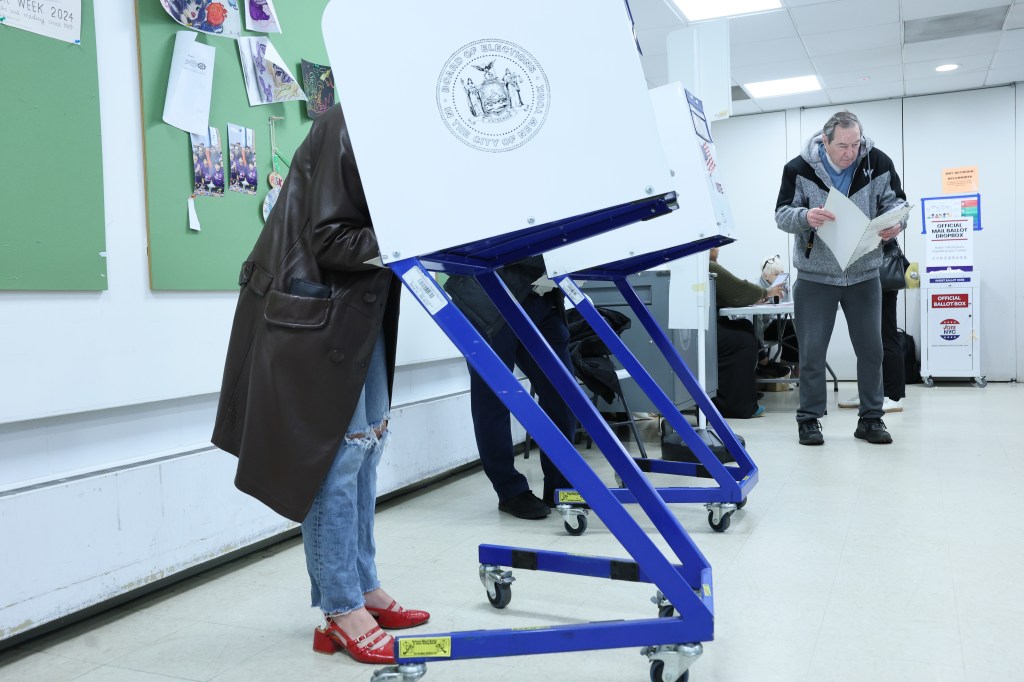
I testified before both former Mayor Eric Adams’ Charter Revision Commission hearing in the Bronx on May 27 and Mayor Mamdani’s Charter Revision Commission — the “Commission on Government Efficiency” (COGE) — in Manhattan on June 9. Two different mayors and two different panels, but my testimony was the same: In support of an open, nonpartisan primary for New York City’s municipal elections.
The Adams’ commission unanimously voted to place having a nonpartisan primary on the ballot for November and COGE should do the same.
Nonpartisan primaries will do a better job by giving New York voters a broader choice. According to the most recent voter roll from February 2026, New York City has roughly 1.3 million unaffiliated voters. These voters are disenfranchised simply because they do not identify with either the Democratic or the Republican parties.
I saw this firsthand as a Democratic candidate for City Council in 2023 how many independent voters were shut out of the closed primary. In Lower Manhattan, there were 110,694 registered voters, 26% of them are unaffiliated voters. However, only 8,761 Democrats voted in that year’s primary. How can we call this a democratic process when only 8% of the entire voting population decided who the next council person will be?
And the number is even more astonishing when the winner of that race only received 5,485 votes. This is not a representative government when less than 5% of the voting population selected the winner in a closed primary. Nonpartisan primaries will do a better job by giving New York voters a broader choice.
By opening closed primaries to all voters, we can create a more accurate representation. A study by the Bipartisan Policy Center titled “The Effect of Open Primaries on Turnout and Representation,” found that “open and nonpartisan primaries tend to produce more representative electorates than closed primaries. The electorate grows more demographically and politically representative.”
In another study, researchers observed a 5-percentage-point boost to voter turnout when they open their primaries to participation from unaffiliated voters. This participation boost is shared across racial groups, with Asian and white voters increasing their participation by approximately 5 percentage points and Black and Latino voters enjoying a 3-point boost to turnout.
If we are serious about increasing voter turnout and getting minority voters invested in our democratic process, a nonpartisan primary is a good solution. When we examine voter registration in New York City, the majority of unaffiliated voters in NYC are minority voters; more than a third are Black and Hispanic. Young voters of color are the most likely to be registered without a party affiliation. In a study conducted by Micatka et al, “independents are 7 percentage points more likely to be primary voters if living in a state with a nonpartisan primary.”
As a naturalized U.S. citizen from Hong Kong, I know the importance of the right to vote — a privilege seldom exercised in my native land. I have voted in every presidential election since Bill Clinton was running. I have voted in every municipal and midterm election since 2021, after Hong Kong passed its National Security Law.
I know what it is like when a government puts limits on your right to vote. I know what it is like to be disenfranchised. Nonpartisan primaries will give approximately 1.3 million unaffiliated voters the right to vote. If we are truly a democratic society, let the voters decide and put a nonpartisan primary on the ballot this November.
Lee is a life-long Democrat who was a City Council candidate in 2021 and 2023.