
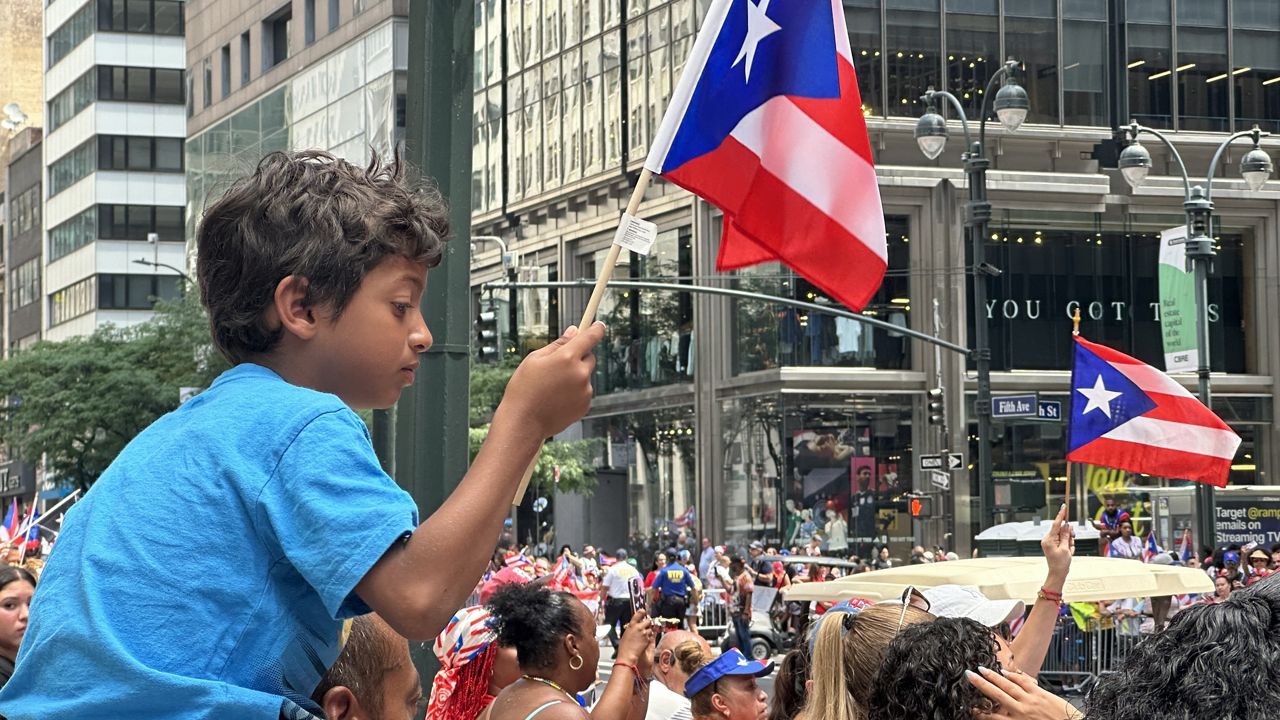
The annual Puerto Rican Day Parade stepped off in Manhattan on Sunday.
For some, it was their first parade. For others, it was a tradition decades in the making.
But year after year, people return for the same reason: to celebrate who they are.
What You Need To Know
This year marked 69 years of the Puerto Rican Day Parade
As many as 600,000 Puerto Ricans call New York home
Among those marching were Mayor Zohran Mamdani and Gov. Kathy Hochul
“I’ve been wanting to go for the longest,” Reimundo Pagan said.
“He asked me every day, can we go? Can we go? Can we go? And I gave in,” Reimundo’s dad, Rey Pagan, added. “To me, it’s showing him our culture, showing where we came from.”
Forty years after his first parade, Angel Torres still makes the trip down from Yonkers. It’s proof that for many Puerto Ricans, the parade isn’t just a celebration — it’s a tradition passed down.
“It’s a beautiful day to enjoy the atmosphere and the company and to have a good day,” Torres said.
This year marked 69 years of the parade, the largest celebration of its kind in the country, running up Fifth Avenue from 44th Street to 79th Street.
Among those marching were Mayor Zohran Mamdani and Gov. Kathy Hochul.
As many as 600,000 Puerto Ricans call New York home, and Sunday, the city was the center of a celebration that stretches far beyond it.
“I’m here to represent. This is my island. It’s my island,” Hilda Guzman said.
This year’s theme: “Somos Más Que 100×35,” or “We Are More Than 100×35,” a reference to the island’s dimensions, and a reminder that Puerto Rican identity isn’t confined to its border.
“I flew from Thailand to come here,” Joanne Valle Bailleux said.
For many in the crowd, the parade is a once-a-year chance to feel connected to home, to family and to each other.
“The pride that we have, and it’s like a family thing. We come together all the time,” Maria Gomez said.
“Yeah, we’re part of the United States, but we also have our own culture and we also have our own identity, and we want to represent that, and that’s what we have today, identity,” Katiria Diaz added.