
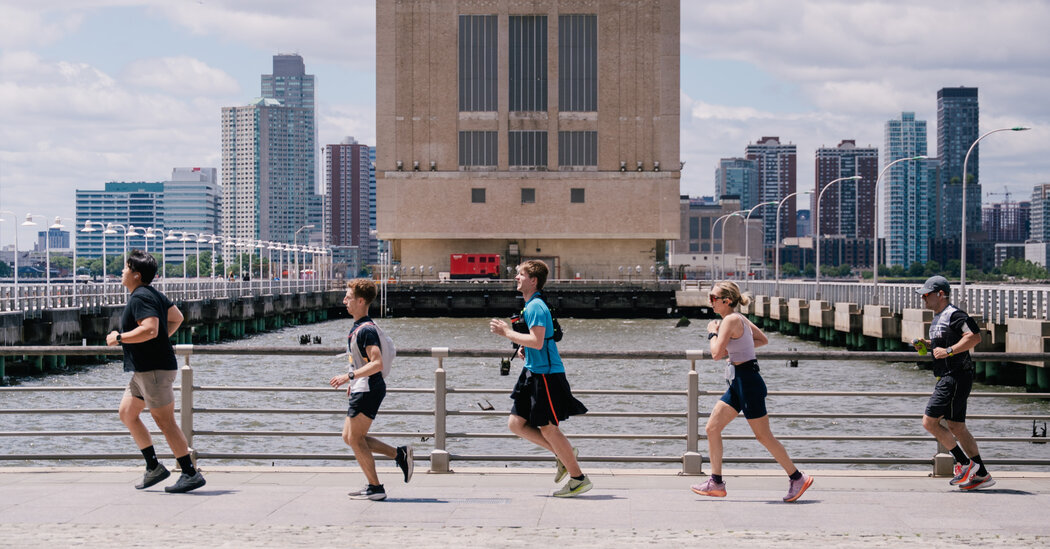
On a recent Thursday, Joe Longo got an unexpected text from a friend: “Hey, wanna run around the entire Manhattan perimeter on Saturday?” For Mr. Longo, 26, the answer was an easy yes. “How often do you get a text from a friend asking if you want to run an ultramarathon that weekend?” said Mr. Longo, who lives in Flatbush, Brooklyn. “I was like, ‘Well, I can’t really say no to that, obviously.’”
Two days later, it was not even 8 a.m., and Mr. Longo and his friend, Sarah Shields — also 26 — were already about five miles into their mission, running north along the East River Greenway. The two started running last year, and the perimeter was the longest run either of them had attempted. Mr. Longo has run one marathon, and Ms. Shields ran a half marathon last fall.
The length of the Manhattan perimeter — around 32 miles, give or take a few detours around construction — is roughly equivalent to the 50-kilometer distance many runners seek out for their first ultramarathon. For many New Yorkers who run, there’s a certain beauty in this coincidence. (An ultramarathon is typically defined as any run longer than 26.2 miles.)
In late May, I joined Mr. Longo, Ms. Shields and a group of nearly 200 other runners in a perimeter run attempt organized by Central Park Run Club. It was the club’s fourth year facilitating the event, and by far the best attended: The first year, in 2023, only 10 runners showed up. Last year, there were about 70, according to Izzie Fulcher, one of the club’s coaches.
Mile 0
Brookfield Place
|
Just before 7 a.m., the group met inside Brookfield Place, on the Hudson River waterfront in Lower Manhattan. The runners stretched, adjusted their packs and made conversation (“Are you running the whole thing?”) until the coaches called their attention. Tony Yung, another coach, gave the runners a quick primer on etiquette: Don’t run more than two across; fall into single file in crowded spaces. “You’re going to see places in Manhattan you’ve never seen before,” he said. Shortly after 7 a.m., the group took off. I ran with them for about seven miles.
Running the perimeter is an old tradition: It was a regular route for Ted Corbitt, the Olympic marathoner and founding president of New York Road Runners. Sometimes, when he was training for an ultramarathon, he’d run the perimeter twice in a row, said his son, Gary Corbitt, who is 75 and lives in Jacksonville, Fla.
But in recent years, the perimeter run has become more popular, particularly among runners in the city seeking a fresh — and free — challenge. According to data collected by Strava, the fitness tracking app, the number of runs uploaded to the app with a map matching the perimeter of Manhattan increased in 2025 by 30 percent compared with 2024.
Joe DiNoto, the founder of Orchard Street Runners, which organizes unsanctioned races around the city, said that in 2014 the club held its first iteration of an unsanctioned race around the perimeter, with just 11 runners. This year, they had 200 runners show up.
There might be an element of one-upmanship in the perimeter’s appeal, said Maria Gilbert, who ran the route in 2024 with some friends. “The trend was running the New York Marathon,” said Ms. Gilbert, 29. “And then so many people started running the New York Marathon that it’s almost like, ‘OK, what’s the next crazy thing to do?’”
But in some ways, running the perimeter is easier than running the marathon: This year, according to New York Road Runners, more than 240,000 people entered the marathon lottery, a nearly 20 percent increase over last year. Roughly 1 percent of those applicants will be running the race this fall.
Mile 7
United Nations Headquarters
|
Beyond the lottery, some runners enter the race by raising money for charity or running a qualifying time, or by running multiple other N.Y.R.R. races, but many of those races are now difficult to get into, too. Several runners said the perimeter had become an alternative local running goal that’s similarly challenging but much more accessible — plus, there’s no entry fee. The cost for nonmembers to register for the New York City Marathon is over $300.
“Is it a lifelong dream? Probably,” Ms. Shields said of the marathon. “Is it realistic? For me, probably not,” she said.
Ms. Fulcher and the other coaches had urged participants to bring their own water and food, but plenty of the runners decided to rely on the city’s water fountains and bodegas for support. As Ms. Shields and Mr. Longo made their way up the East Side, passing the Queensboro Bridge and Carl Schurz Park, I took the train up to Inwood, where I waited for the runners at a deli, a suggested refueling spot about 18 miles in.
By then, many of the runners were feeling the distance. “Things are starting to hurt,” said Juan Acosta, who’s 31 and lives in Downtown Brooklyn. Before this, his longest run ever had been 20 miles. As the runners took off again, one of them yelled, “Final push — let’s go!” At this, another runner said, “Aren’t there, like, 12 miles left?”
Mile 19
Inwood Hill Park
|
I tagged along for another seven miles with the group. As they ran up and down Inwood Hill Park’s leafy, shaded trails, some of the newer runners marveled at how far they’d come. “It’s my first half marathon, my first marathon, and my first ultra,” said Brittany Yau, who lives on Long Island. Her previous longest run was 10 miles.
She and her cousin Nicholas Chan had only planned to run the equivalent of a half marathon. But Mile 13 had come and gone about an hour ago, and they still felt like running.
The problem: They’d only brought enough food to sustain them through their original plan. “I brought maple syrup, but not enough, because I didn’t think I’d be running the whole thing,” Mr. Chan said. A few miles earlier, they’d popped into a bodega and bought a few Rice Krispies Treats.
“I should’ve bought more,” Ms. Yau said. “I only bought one and already demolished it.” Without breaking stride, Mr. Chan pulled a bar out of his pack and offered it to his cousin as they ran up a hill. “You can have the other,” he said. “I have two more.”
Around 1 p.m., a large group of runners — who had run a pace of about 10 minutes per mile, not including stops — made it back to the starting point. No finish line or medals awaited them. Instead, they sat or sprawled on the concrete plaza behind Brookfield Place. They cheered as each new runner arrived and made overtures at new friendships: “Are you on Strava?”
Sebastian Chiu, an ultrarunner who said he’d run the perimeter about 10 times, surveyed the growing crowd of finishers approvingly. “This is probably the best vibes I’ve ever had from one of these,” he said.
In the end, Ms. Fulcher estimated that around 75 people finished the entire route. “It was pain, just pain,” said Mr. Acosta. Mr. Chan finished too, but Ms. Yau stopped around Mile 22. She plans to attend next year, better prepared to finish, she said.
Around 4 p.m., long after the other runners had left, Mr. Longo and Ms. Shields reached the plaza and flopped to the ground. The last few miles had been tough, and they’d been taking walking breaks ever since Mile 18.
Mr. Longo said he knew almost immediately that he wanted to try the perimeter again, this time without walking. “I’m hoping to go back next year and run the whole thing,” he said.
At first, Ms. Shields wasn’t so sure. “I did say at Mile 27 that I’m never going to do any distance run ever again,” she said. A few days later, though, she backtracked: She hadn’t meant it. She’s planning to run the Williamsburg Bridge Marathon in August.