
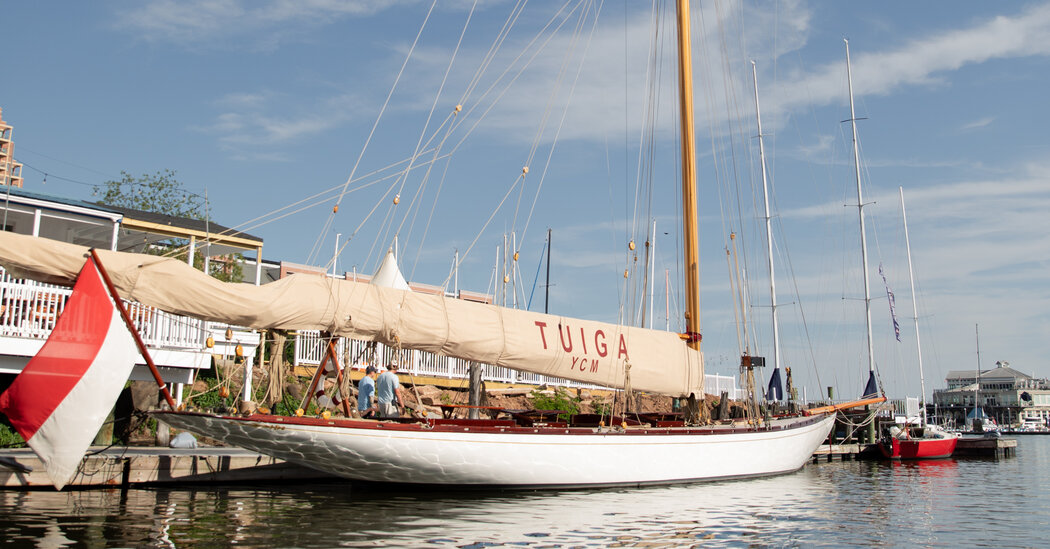
As part of the nation’s 250th anniversary celebration, a startling nautical spectacle will soon take shape off the coast of New York City.
About 80 vessels — tall ships with white sails, some gray-hulled warships bristling with weapons, maybe even a 100,000-ton aircraft carrier — will tie up in and around New York Harbor. Nearly 200 military aircraft will be poised to fly overhead.
The stated purpose of this two-day extravaganza, set to begin July 3, is to celebrate the American colonies’ declaration of independence from King George III in 1776, by convening what organizers say will be the “largest maritime and aerial gathering in American history.”
The event, called Sail4th 250, is so intricately complicated that the commander of Coast Guard Sector New York, Capt. Jonathan Andrechik, a 26-year veteran who helped lead the rescue of 7,500 people in Texas during Hurricane Harvey, described it as “by far the most complex planned event I have ever been part of.”
“We’ve sort of run out of adjectives to describe the scale and scope of what we’re going to do here,” he said.
Numerous tabletop exercises have been played out to prepare for the countless eventualities that could derail the proceedings. The federal government is helping de-conflict radio signals, so the different law enforcement agencies involved will be able to talk to one another.
“We have put together this crisis management plan, and anything that could go wrong — from 100-degree temperatures, to coastal storm to active shooter — has all been identified,” Beth Rooney, the port director of the Port Authority of New York and New Jersey, said on a recent Wednesday afternoon. “And it’s all been identified to say OK, if it happens in this location, who’s in charge, what do you do, how do you do it, what have you, so that we’re not looking at each other to say, who’s doing what, what do you do?”
The logistical challenges extend to dry land.
The tall ships and war vessels will carry roughly 20,000 sailors, as much as 10 times the number of the average Fleet Week, and they are expected to come ashore in waves. Hundreds of thousands of New Yorkers are expected to crowd the shoreline on July 4 to see the ships, just hours before a similar number will crowd the waterfront to witness Macy’s 50th anniversary fireworks show.
And all of this will coincide with New York City’s hosting of thousands of tourists for the World Cup soccer matches in New Jersey, just across the Hudson River.
The torrent of early July gatherings is expected to push New York City to its operational brink.
“In my 18 years in government, I have not seen a threat environment quite like this one, where multiple vectors are all active at the same time and where developments abroad can have immediate consequences here at home,” Police Commissioner Jessica Tisch said at a recent City Council hearing.
Another walrus-size wrinkle hangs over the weekend: It remains unclear if President Trump will attend. But if all goes according to plan, a federal dignitary will board a Navy destroyer the morning of July 4 and pass south alongside the military ships moored on the Hudson for an international naval review, the seventh in U.S. history.
That dignitary’s voyage will conclude at the Verrazzano-Narrows Bridge, a span named for the Florentine explorer who traveled the Atlantic seaboard by sail, kidnapped an 8-year-old Native American boy and was, perhaps, ultimately eaten by cannibals. Then the dignitary will transfer to a flat-topped amphibious assault vessel and watch as a parade of tall ships sails from the Verrazzano up the Hudson, all under the watchful eye of a Goodyear blimp.
For now, Ms. Rooney has a sparser view, from the 23rd-floor conference window of her office building. But come July 4, nine different vessels will be moored off the Brookfield Place ferry terminal on the Hudson below, and the Port Authority will run a de facto water taxi, ferrying sailors back and forth.
Naval and tall ships will dock, among other places, at Brooklyn Bridge Park and near the Intrepid Museum in Midtown, where the city has constructed a temporary floating barge structure, and in Stapleton on Staten Island.
The question of what ship goes where remains unsettled. One of the many complexities attending the Navy’s so-called scheme of maneuver is the shifting roster of participants in a world that, 250 years after the country’s creation, remains mired in conflict.
“It almost eclipses the preparation that’s happening behind the scenes for the World Cup,” said Justin Brannan, senior director of major event operations for Gov. Kathy Hochul.
As of now, the event will feature more than 40 tall ships, including four so-called sister ships built in a Hamburg, Germany, navy yard in the 1930s: the Sagres, the Mircea, the Gorch Fock and the Horst Wessel, whose launch ceremony was attended by Adolf Hitler. The Horst Wessel was taken by the United States in reparations after World War II and rechristened the Eagle; it is now used to train Coast Guard cadets.
There will also be more than 30 warships, possibly including the U.S.S. Nimitz, one of the Navy’s limited supply of aircraft carriers, as well as ships from Belgium, Canada, Peru, Spain, Korea, Germany and Senegal.
Israel will not be participating as was originally planned. The Israeli Navy pulled out “in light of the operational reality in our region, and after carefully considering all implications” a spokesman for the Israeli Defense Forces said in May. It will be sending a Navy delegation instead.
All ships will drop anchor in predesignated spots, in a harbor teeming with subway and highway tunnels, pipelines and electrical cables. The ships will have designated swing circles (the area in which the ship can ride its anchor without infringing on the harbor’s navigation channel) and buffer zones.
Twenty-six years after suicide bombers in Yemen used a speedboat to attack the U.S.S. Cole, each of the warships will be surrounded by a security zone of at least 100 yards, beyond which other craft will not be permitted to travel.
To enforce these buffers, the U.S. Coast Guard and the U.S. Navy plan to bring in hundreds of additional officers from around the world, according to Captain Andrechik.
The event is being produced by the U.S. Navy and the Sail4th 250 nonprofit. The event’s largest benefactor is the hedge fund manager Ken Griffin — a circumstance that may add its own special frisson to the proceedings. (Mr. Griffin, a billionaire, and Zohran Mamdani, the democratic socialist mayor, have been feuding over the latter’s decision to use Mr. Griffin’s $238 million pied-à-terre as Exhibit A in explaining why the city should tax nonresident property owners.)
One of the few times New York Harbor has seen a congregation of this size, one complete with both tall ships and an international naval review, was for the country’s bicentennial in 1976.
It was, like now, a period of national political and economic malaise. Sixteen tall ships and roughly 50 warships participated, President Gerald Ford presided and so many onlookers lined the Hudson that The Daily News claimed the coastline had shrunk a foot. (“Opsail Crowd Had Manhattan Tilting to West,” read the headline.)
No matter what you call them — barques, barkentines or schooners — tall ships are an obsolete relic of an age before steamboats, railroads and airplanes. That tall ships parades have endured as a ritual is largely thanks to a die-hard band of enthusiasts who were eager to save the vessels from reassignment to Davy Jones’ proverbial locker.
The idea for a tall ship gathering in New York Harbor was hatched in the early 1960s by Nils Hansell, the art director at IBM’s Journal of Research and Development, who approached Frank Braynard, a prominent maritime historian.
The concept came to fruition in 1964, with a tall ship parade running in conjunction with the World’s Fair in Flushing Meadows Corona Park in Queens.
Shortly thereafter, the Brooklyn Navy Yard ended its 165-year run as a major ship manufacturer. Among other ships the Navy Yard had produced the U.S.S. Arizona, a quarter-century before Japanese bombers sent it (and 1,177 sailors and Marines) to the bottom of Pearl Harbor. The Navy Yard also built the U.S.S. Missouri, where Japan surrendered to the Allied forces in Tokyo Bay in 1945.
“We don’t think there’s another city anywhere where we could truly culminate a celebration of our maritime history, except for New York City,” said Doug G. Perry, a Navy vice admiral, in a recent interview. “This is the city where we need to celebrate this.”
David M. Halbfinger and Tyler Pager contributed reporting; Susan C. Beachy contributed research.