
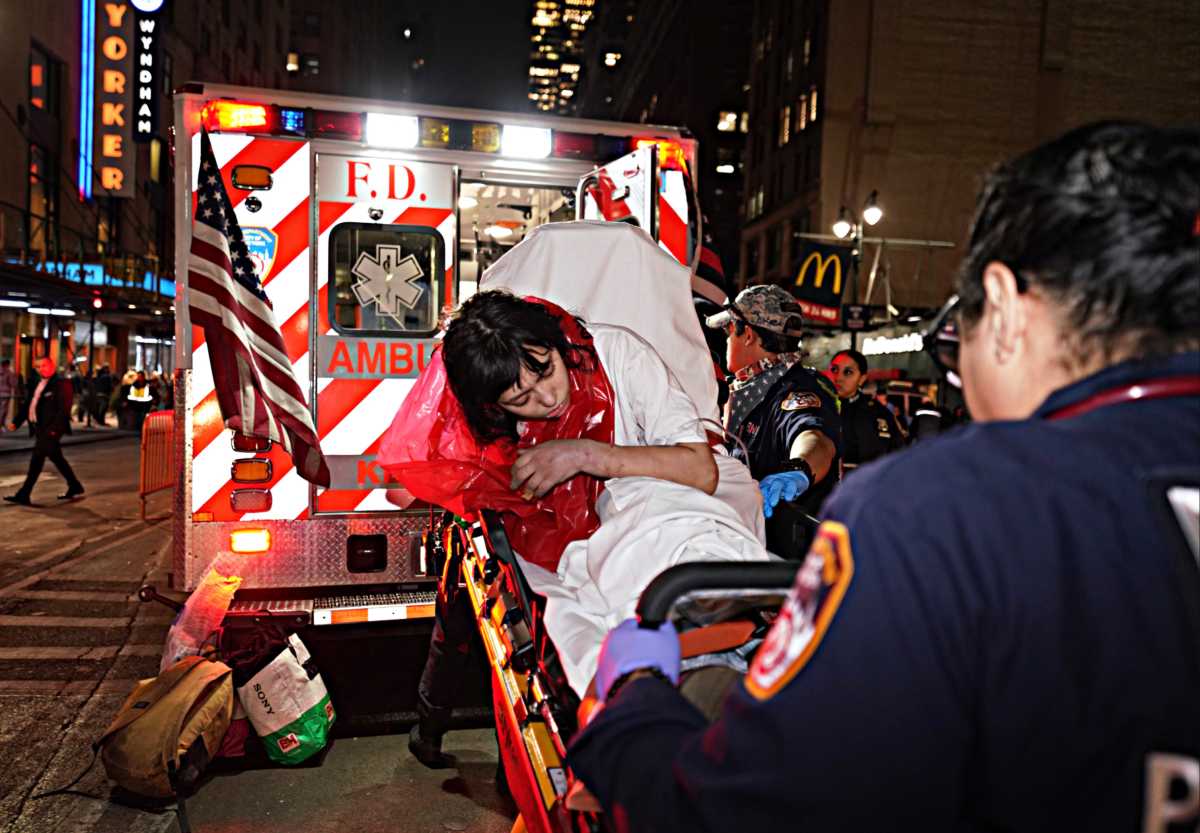
Imagine the trouble New York would be in without the lifesaving work of its brave first responders, most especially our city’s unsung heroes of FDNY EMS.
New York has the busiest Emergency Medical Service in the world. Yet despite saving over 1.7 million lives last year alone, our EMTs and paramedics are paid more like they serve a single stoplight town. To put it bluntly, New York City EMS members are completely fed up with being treated like the agency’s doormat.
FDNY EMTs start at a disgraceful $18.94/hour with an actual take-home wage hovering closer to $12 to $13/hour after factoring in taxes and deductions.
This has led a staggering 50% of new EMTs to quit in the first five years on the force, with projections that 1/3 might turn in their badges in 2026 alone. The effect is a dramatic brain drain, and much longer response times for your loved ones as they fight for their lives.
Our outstanding firefighters are paid $109,352 after 5 1/2 years. By comparison, an EMT’s pay maxes out after five years at $59,534. That is the ceiling. Although the work is substantially similar since Fire and EMS are responding to both medical calls and fires, it does not go unnoticed that there is a statistically significant difference in race and gender between them.
In May, New York City’s hotel workers reached a new eight-year contract to guarantee a 50% wage increase, partially due to city and state legislative pressure. By the end of their contract, those much deserving hospitality sector workers will be earning six figures.
The EMS mosaic is representative of our distinct city population, yet this mostly female and minority workforce of one of the highly diverse agencies in the nation is being treated differently.
Our union, which advocates for 4,300 FDNY EMTs, paramedics and fire inspectors, has spent four years at the negotiating table waiting for the city to offer a fair and respectable contract, commensurate with our peer first responders in the FDNY and yes, the hospital-based medical professionals we collaborate with each time a patient’s life hangs in the balance.
Our members have put up with broken promises and endless bureaucratic foot-dragging through several city administrations. Now, with fewer ambulance crews on the street, longer response times and unlivable wages, this situation is unsustainable. For the safety of fellow first responders, residents of New York City and visitors, this requires immediate intervention,
According to the 2026 Mayor’s Preliminary Management Report, in the first four months of fiscal year 2026, response times for life-threatening medical emergencies are up to 12:05. That is an extra 2 minutes and 31 seconds since fiscal year 2021. If it is your loved suffering from a stroke or heart attack, or bleeding out from a stabbing or gunshot wound, that time can be the difference between life and death.
EMS members respond to strokes, cardiac incidents, fatal fires, stabbings, active shooter events, drug dens and overdoses, mental health episodes, building collapses, train derailments, and possible CBRN (chemical, biological, radiological, nuclear) events.
Some of our EMTs live in homeless shelters. Many require multiple jobs, just to make it through the month financially.
EMS members have saved over 30 million lives in the last 20 years, so how can our city leaders justify a complete lack of investment in our highly skilled medical first responders? Like most years, FDNY EMS represents only 14% of the total FDNY budget. Yet, the city’s own data reports that of the department’s total 1.9 million emergencies, nearly 86% (1.63 million) were medical emergencies handled by EMS.
The City of New York spends tens of thousands of dollars to train each FDNY EMS professional, only to compensate them like teenagers on a weekly allowance. While decades ago, the job might have been more focused on transporting victims, today it’s about administering intensive emergency room-level care from the moment our highly skilled medical staff arrive on the scene.
New York’s emergency medical responders are desperate for something proactive to slow this brain drain. It’s time for New York City to make the FDNY EMS more central to strategic planning and budgeting at the greatest rescue agency in the world.
The fight for pay parity has been ongoing and we remain confident and hopeful that with this mayoral administration and City Council leaders, we can reach the solution that the dedicated women and men of EMS – and the citizens we are sworn to protect – deserve.
Michael Greco is the president of FDNY EMS Local 2507, representing New York’s over 4,000 Uniformed EMTs, Paramedics & Fire Inspectors.