
For years, rankings of the “best bike cities” have often felt like a popularity contest. Cities with strong cycling reputations tended to remain near the top, while communities making meaningful improvements sometimes flew under the radar. But a major update to one of North America’s most influential cycling scorecards is offering a much clearer picture of what actually makes a city bikeable.
PeopleForBikes has released its 2026 City Ratings, unveiling what the organization calls its most accurate assessment of bikeability to date. The updated methodology evaluates how effectively a city’s cycling network connects people to the places they need to go every day — work, school, shopping, healthcare, recreation, and other essential destinations.
The results offer an encouraging snapshot of progress. Across the United States, 555 communities now score 50 or higher on the PeopleForBikes scale, a threshold the organization considers indicative of a bike network capable of supporting practical, everyday riding.
“Communities of all sizes can make meaningful progress when they prioritize connected networks that work for everyone,” said Jenn Dice, president and CEO of PeopleForBikes. “These results show that biking is becoming a practical transportation option, a valuable recreational activity, and an integral part of daily life in more places across the country.”
A More Accurate Picture of Bikeability
The biggest story may not be which cities ranked highest, but how the rankings themselves have evolved.
The 2026 ratings are built on a substantially revised methodology that incorporates updated census data, new infrastructure classifications, and revised safety guidance from the National Association of City Transportation Officials (NACTO). The changes are designed to better reflect the real-world experience of riding a bike in American communities.
Rather than simply measuring the presence of bike lanes, the ratings focus on connectivity. A protected bike lane that ends abruptly or fails to connect people to destinations offers limited value. A connected network, by contrast, allows riders of varying ages and abilities to travel safely and comfortably across a city.
This approach aligns with what cycling advocates and transportation planners have increasingly emphasized over the past decade: individual bike lanes matter, but networks matter more.
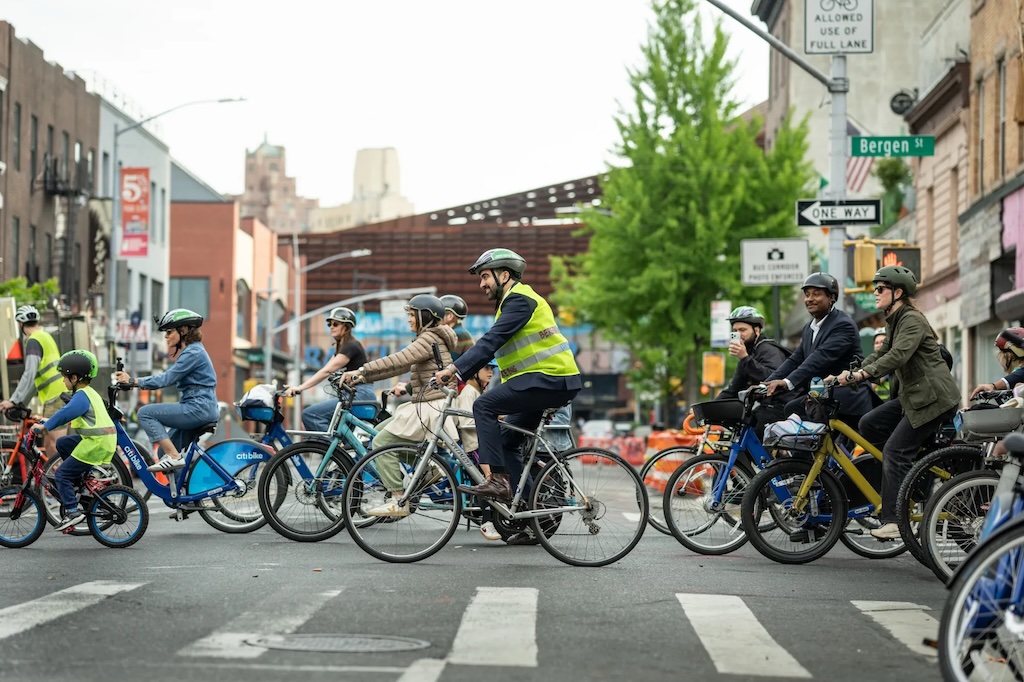
New York City Mayor Zohran Mamdani and the Bergen Bike Bus
The Cities Leading the Way
Among large cities, New York City’s outer boroughs performed exceptionally well. Brooklyn earned the highest score among large U.S. cities with a rating of 70, followed by Minneapolis at 68, Seattle at 66, Queens at 63, and San Francisco at 61.
The results reflect years of investment in protected cycling infrastructure, traffic calming, and network expansion. Minneapolis continues to benefit from its extensive system of off-street trails and bikeways, while Seattle’s growing protected lane network has steadily improved connectivity throughout the city.
Among medium-sized communities, Hoboken, New Jersey, emerged as the national leader with a remarkable score of 83. Rochester Hills, Michigan, followed closely at 80, while Anchorage, Alaska, achieved an impressive 72.
Perhaps most interesting are the communities that achieved perfect scores. Mackinac Island, Michigan, Crested Butte, Colorado, and Old Orchard, Pennsylvania each received a rating of 100.
The appearance of places like Crested Butte and Mackinac Island highlights an important reality: world-class bikeability isn’t limited to major metropolitan areas. Smaller communities can often create highly connected networks more quickly and at lower cost than larger cities struggling to retrofit decades of car-oriented infrastructure.
Why Connectivity Matters
The findings reinforce a lesson that cities across North America continue to grapple with.
Building a handful of protected bike lanes may improve conditions on individual corridors, but it doesn’t necessarily create a transportation system that people feel comfortable using daily. Riders need continuous routes that connect homes with schools, workplaces, parks, transit stations, and commercial districts.
When those connections exist, cycling becomes far more than a recreational activity. It becomes a realistic transportation option.
This shift is particularly important as cities look for ways to reduce congestion, improve public health, lower transportation costs, and meet climate goals. A connected cycling network offers benefits that extend well beyond the riders themselves.
The fact that more than 550 U.S. communities have now crossed the threshold for everyday bikeability suggests that many local governments are beginning to understand this relationship.

Two people cycling on a bike lane in Seattle, states
A Tool for Cities — and Advocates
PeopleForBikes stresses that City Ratings should be viewed less as a competition and more as a planning tool.
“City Ratings is more than a ranking. It’s a roadmap,” said Dice. “By helping communities understand where they are today and where opportunities exist to improve, we’re giving local leaders a powerful tool to build safer, more connected places to ride.”
For cycling advocates, the data provides something equally valuable: evidence. Cities often debate whether investments in bike infrastructure are worthwhile, but the ratings offer a measurable framework for evaluating progress and identifying gaps.
For residents, the rankings can help explain why some communities feel easy to navigate by bike while others remain challenging despite visible infrastructure investments.
The message from the 2026 results is straightforward. Bikeability isn’t determined by a city’s reputation, geography, or size. It is largely determined by whether leaders commit to building connected networks that make cycling a practical choice for everyday trips.
And according to the latest data, more American communities are starting to do exactly that.