
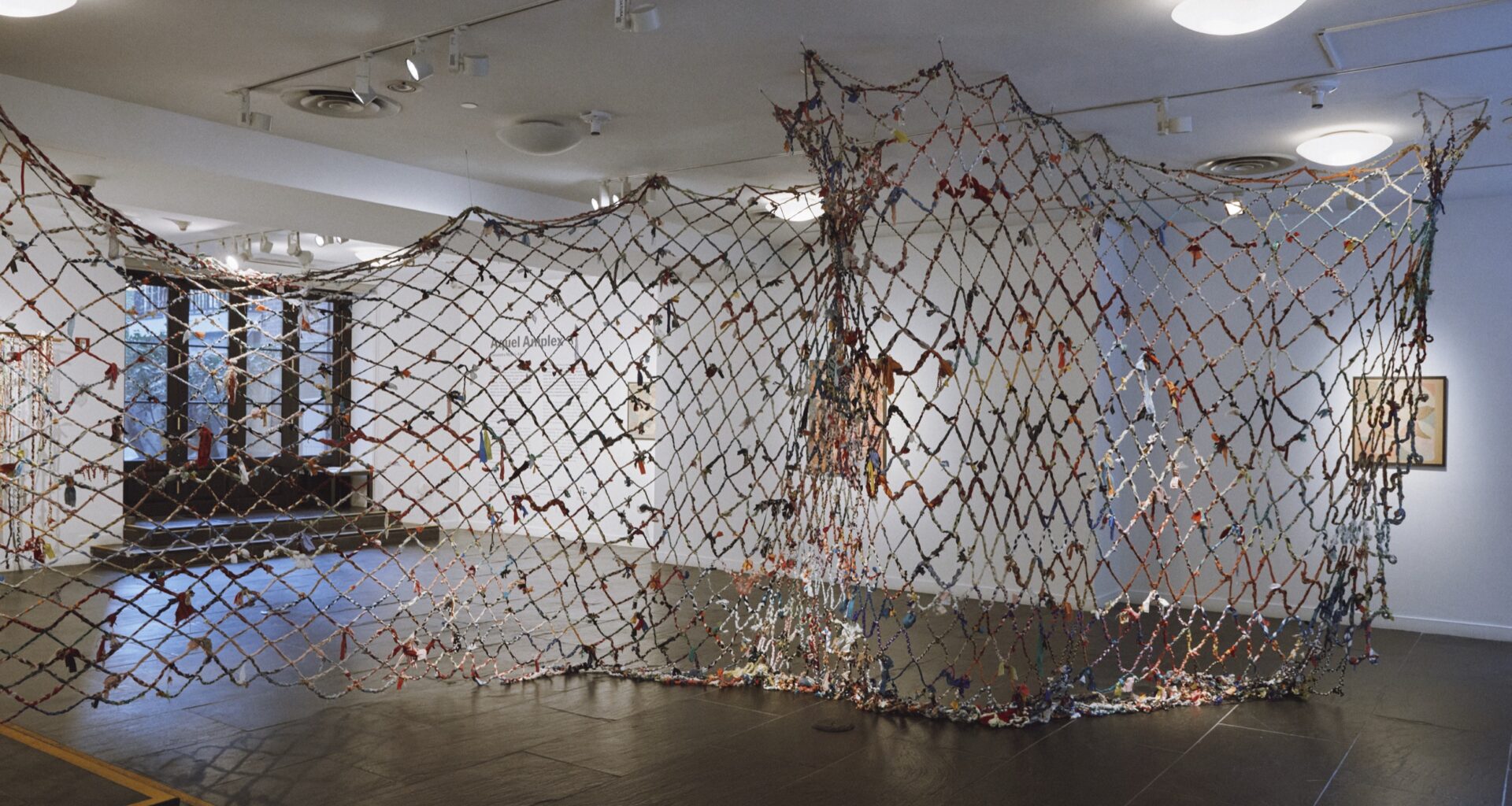
Aquel Amplex
Instituto Cervantes
April 16–June 27, 2026
New York
An art which is “modern” does not exist. There is only one art, that which is eternal.
—Egon Schiele, my translation from the French
There are memories of my grandmother making quilts for me—and then with me, seated at the sewing machine between generations—evoked every time I see fabric made into art. Pieces come together forming another: a whole is its parts. Cassandra Mayela Allen’s current exhibition, Aquel Amplex, at Instituto Cervantes in Manhattan, is exactly about that embrace.
Curated by Fabiola R. Delgado and Carlos Núñez, Aquel Amplex is a collection of the Venezuelan-born artist’s recent textile and painting works. Featured (under the same title as the show) is a chain-like net constructed with braids made of a kaleidoscope of color knotted together (2024–26). It cuts across the open space of the gallery in the familiar form of a wall or a fence, but one that we can see through and walk around.
This title is inspired by a 1969 letter from Brazilian artist Hélio Oiticica to Lygia Clark when both lived in exile, where they mention “aquel amplex,” “that embrace.” In their letters, they investigate relationships between object and viewer, giving the “spectator-author” a sort of power in participation. In one from 1968, Clark writes, “I speak of a well, from inside which a sound would be taken, not by the you-well, but by the other, in the sense that he throws his own stone … It is as if I had created an egg of space that belongs to me and that embraces me.”1
Aquel Amplex was made over two years’ time with the help of many hands. In this piece, the artist attached braids woven by people invited to take part themselves and with their own material. Mayela Allen is particularly known for her cooperative practice: a former piece, Maps of Displacement (2021– ), involved Venezuelan immigrants and the pieces of clothing they brought with them to this country. Aware of its foundations in Venezuelan and Latin American modernism, the act and its result is an homage to history—human and art. Aquel Amplex confronts notions of temporality by enlisting the memory and experience of people other than just the artist, the community, emphasizing a true sense of what it means to collaborate.
Hung around the perimeter are more pieces created individually, which further explain the mentality behind the work. There is Hija de la Independencia (2026), drawn in colored pencil strokes across paper as if ticked by a clock moved by currents. Hazme de todo menos daño (2026) is a ribboned grid overlaying more rainbow scratches cascading into each other. Tassels untied open to interpretation past the border of the canvas. A breeze could blow them into the garden.2
In keeping with her practice, Mayela Allen hosted two communal braiding workshops at the Instituto in conjunction with the exhibition. In the first, flags of South American countries which previously hung in the foyer of the building were repurposed as craft material. Participants sat at a shared table and cut the squares into shreds, braiding in quiet conversation. “Is this yours?” A woman asks. “No,” I answered. “None of it is.”